
Join Our JEE Preparation Group
Prep with like-minded aspirants; Get access to free daily tests and study material.
Sign in
Please select an account to continue using cracku.in
↓ →
Join Our JEE Preparation Group
Prep with like-minded aspirants; Get access to free daily tests and study material.
The sum of all values of $$\theta \in [0,2\pi]$$ satisfying $$2\sin^{2}\theta =\cos2\theta \text{ and }2\cos^{2}\theta =3\sin\theta$$ is
We are given the system of equations:
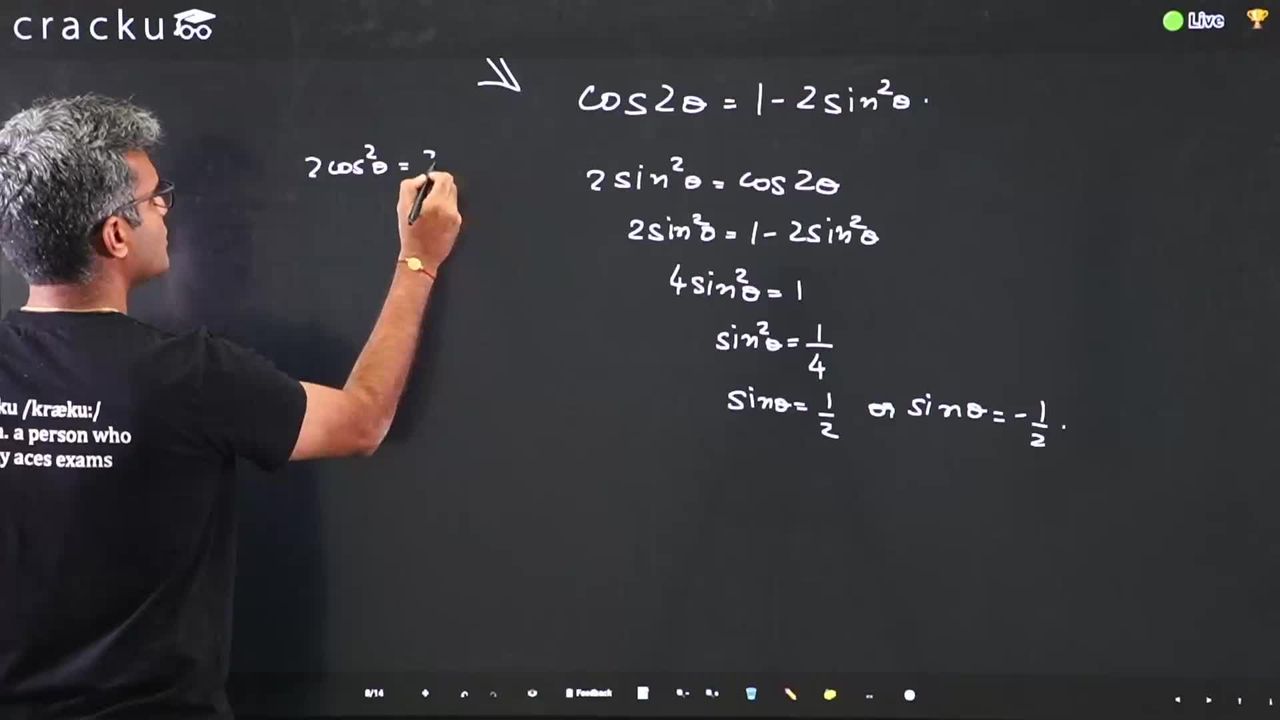
$$2\sin^{2}\theta = \cos 2\theta \quad \text{(1)}$$
$$2\cos^{2}\theta = 3\sin\theta \quad \text{(2)}$$
We need to find all $$\theta \in [0, 2\pi]$$ satisfying both equations and sum them.
First, recall the double-angle identity for cosine: $$\cos 2\theta = 1 - 2\sin^{2}\theta$$.
Substitute this into equation (1):
$$2\sin^{2}\theta = 1 - 2\sin^{2}\theta$$
Bring all terms to one side:
$$2\sin^{2}\theta - 1 + 2\sin^{2}\theta = 0$$
$$4\sin^{2}\theta - 1 = 0$$
$$4\sin^{2}\theta = 1$$
$$\sin^{2}\theta = \frac{1}{4}$$
Thus, $$\sin\theta = \pm \frac{1}{2}$$.
Now, from equation (2): $$2\cos^{2}\theta = 3\sin\theta$$.
Since, the LHS of equation 2 will always be positive, the only value for the which the RHS is positive is $$\sin\theta=\frac{1}{2}$$.
Now, find all $$\theta \in [0, 2\pi]$$ such that $$\sin\theta = \frac{1}{2}$$.
Sine is positive in the first and second quadrants. The reference angle is $$\frac{\pi}{6}$$.
In first quadrant: $$\theta = \frac{\pi}{6}$$.
In second quadrant: $$\theta = \pi - \frac{\pi}{6} = \frac{5\pi}{6}$$.
Verify both solutions satisfy the original equations.
For $$\theta = \frac{\pi}{6}$$:
Equation (1): $$2\sin^{2}\left(\frac{\pi}{6}\right) = 2 \left(\frac{1}{2}\right)^2 = 2 \times \frac{1}{4} = \frac{1}{2}$$, $$\cos 2\left(\frac{\pi}{6}\right) = \cos \frac{\pi}{3} = \frac{1}{2}$$, so equal.
Equation (2): $$2\cos^{2}\left(\frac{\pi}{6}\right) = 2 \left(\frac{\sqrt{3}}{2}\right)^2 = 2 \times \frac{3}{4} = \frac{3}{2}$$, $$3\sin\left(\frac{\pi}{6}\right) = 3 \times \frac{1}{2} = \frac{3}{2}$$, so equal.
For $$\theta = \frac{5\pi}{6}$$:
Equation (1): $$2\sin^{2}\left(\frac{5\pi}{6}\right) = 2 \left(\frac{1}{2}\right)^2 = \frac{1}{2}$$, $$\cos 2\left(\frac{5\pi}{6}\right) = \cos \frac{5\pi}{3} = \cos \left(2\pi - \frac{\pi}{3}\right) = \cos \left(-\frac{\pi}{3}\right) = \cos \frac{\pi}{3} = \frac{1}{2}$$, so equal.
Equation (2): $$2\cos^{2}\left(\frac{5\pi}{6}\right) = 2 \left(-\frac{\sqrt{3}}{2}\right)^2 = 2 \times \frac{3}{4} = \frac{3}{2}$$, $$3\sin\left(\frac{5\pi}{6}\right) = 3 \times \frac{1}{2} = \frac{3}{2}$$, so equal.
No other solutions exist in $$[0, 2\pi]$$ as the value of sine is negative in $$[\pi,2\pi]$$.
Sum of solutions: $$\frac{\pi}{6} + \frac{5\pi}{6} = \frac{6\pi}{6} = \pi$$.
The sum is $$\pi$$, which corresponds to option C.
Was this solution helpful?
Click on the Email ☝️ to Watch the Video Solution
Create a FREE account and get:
_1.webp)

Educational materials for JEE preparation

Ask our AI anything

AI can make mistakes. Please verify important information.
AI can make mistakes. Please verify important information.
