
Join Our JEE Preparation Group
Prep with like-minded aspirants; Get access to free daily tests and study material.
Sign in
Please select an account to continue using cracku.in
↓ →
Join Our JEE Preparation Group
Prep with like-minded aspirants; Get access to free daily tests and study material.
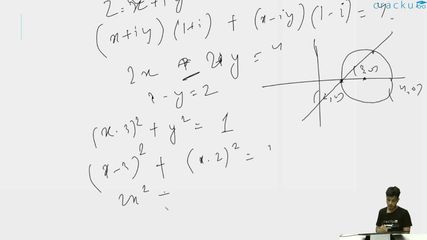
Let the curve $$z(1+i)+\overline{z}(1-i)=4,z \in C$$,divide the region $$|z-3|\leq 1$$ into two parts of areas $$\alpha$$ and $$\beta$$. Then $$|\alpha - \beta |$$ equals:
The given curve is $$z(1+i) + \overline{z}(1-i) = 4$$, where $$z \in \mathbb{C}$$. Let $$z = x + iy$$, so $$\overline{z} = x - iy$$. Substituting into the equation:
$$
(x + iy)(1 + i) + (x - iy)(1 - i) = 4
$$
$$ (x + iy)(1 + i) = x \cdot 1 + x \cdot i + iy \cdot 1 + iy \cdot i = x + ix + iy + i^2 y = x + ix + iy - y = (x - y) + i(x + y) $$
$$
(x - iy)(1 - i) = x \cdot 1 + x \cdot (-i) + (-iy) \cdot 1 + (-iy) \cdot (-i) = x - ix - iy + i^2 y = x - ix - iy - y = (x - y) - i(x + y)
$$
$$
[(x - y) + i(x + y)] + [(x - y) - i(x + y)] = (x - y + x - y) + i(x + y - x - y) = 2x - 2y
$$
$$ 2x - 2y = 4 \implies x - y = 2 $$
Thus, the curve is the straight line $$x - y = 2$$.
The region $$|z - 3| \leq 1$$ is a disk centered at $$(3, 0)$$ with radius 1, since $$|(x - 3) + iy| \leq 1$$ gives $$(x - 3)^2 + y^2 \leq 1$$.
To find how the line $$x - y = 2$$ divides this disk, first find the points of intersection by substituting $$y = x - 2$$ into the circle equation:
$$
(x - 3)^2 + (x - 2)^2 = 1
$$
$$
(x^2 - 6x + 9) + (x^2 - 4x + 4) = 1 \implies 2x^2 - 10x + 13 = 1 \implies 2x^2 - 10x + 12 = 0
$$
$$ x^2 - 5x + 6 = 0 \implies (x - 2)(x - 3) = 0 $$
So $$x = 2$$ or $$x = 3$$. When $$x = 2$$, $$y = 2 - 2 = 0$$; when $$x = 3$$, $$y = 3 - 2 = 1$$. The intersection points are $$(2, 0)$$ and $$(3, 1)$$.
The chord joining $$(2, 0)$$ and $$(3, 1)$$ subtends an angle at the center $$(3, 0)$$. The vectors from the center to these points are $$\overrightarrow{CA} = (-1, 0)$$ and $$\overrightarrow{CB} = (0, 1)$$. The dot product is $$(-1)(0) + (0)(1) = 0$$, and the magnitudes are both 1, so $$\cos \theta = 0$$, giving $$\theta = \pi/2$$ radians.
The disk has area $$\pi r^2 = \pi \cdot 1^2 = \pi$$. The chord divides the disk into two segments: a minor segment and a major segment. The area of a segment is given by $$\frac{r^2}{2} (\theta - \sin \theta)$$, where $$\theta$$ is the central angle in radians.
For the minor segment, $$\theta = \pi/2$$:
$$ \text{Area} = \frac{1}{2} \left( \frac{\pi}{2} - \sin \frac{\pi}{2} \right) = \frac{1}{2} \left( \frac{\pi}{2} - 1 \right) = \frac{\pi}{4} - \frac{1}{2} $$
For the major segment, $$\theta = 2\pi - \pi/2 = 3\pi/2$$:
$$ \text{Area} = \frac{1}{2} \left( \frac{3\pi}{2} - \sin \frac{3\pi}{2} \right) = \frac{1}{2} \left( \frac{3\pi}{2} - (-1) \right) = \frac{1}{2} \left( \frac{3\pi}{2} + 1 \right) = \frac{3\pi}{4} + \frac{1}{2} $$
Let $$\alpha$$ be the minor segment area and $$\beta$$ the major segment area:
$$ \alpha = \frac{\pi}{4} - \frac{1}{2}, \quad \beta = \frac{3\pi}{4} + \frac{1}{2} $$
The absolute difference is:
$$ |\alpha - \beta| = \left| \left( \frac{\pi}{4} - \frac{1}{2} \right) - \left( \frac{3\pi}{4} + \frac{1}{2} \right) \right| = \left| \frac{\pi}{4} - \frac{1}{2} - \frac{3\pi}{4} - \frac{1}{2} \right| = \left| -\frac{2\pi}{4} - 1 \right| = \left| -\frac{\pi}{2} - 1 \right| = \frac{\pi}{2} + 1 $$
Since $$\beta > \alpha$$, $$\beta - \alpha = \left( \frac{3\pi}{4} + \frac{1}{2} \right) - \left( \frac{\pi}{4} - \frac{1}{2} \right) = \frac{2\pi}{4} + 1 = \frac{\pi}{2} + 1$$, confirming the result.
The value $$\frac{\pi}{2} + 1$$ matches option A: $$1 + \frac{\pi}{2}$$.
Thus, $$|\alpha - \beta| = 1 + \frac{\pi}{2}$$.
Was this solution helpful?
Click on the Email ☝️ to Watch the Video Solution
Create a FREE account and get:
_1.webp)

Educational materials for JEE preparation

Ask our AI anything

AI can make mistakes. Please verify important information.
AI can make mistakes. Please verify important information.
