
Join Our JEE Preparation Group
Prep with like-minded aspirants; Get access to free daily tests and study material.
Sign in
Please select an account to continue using cracku.in
↓ →
Join Our JEE Preparation Group
Prep with like-minded aspirants; Get access to free daily tests and study material.
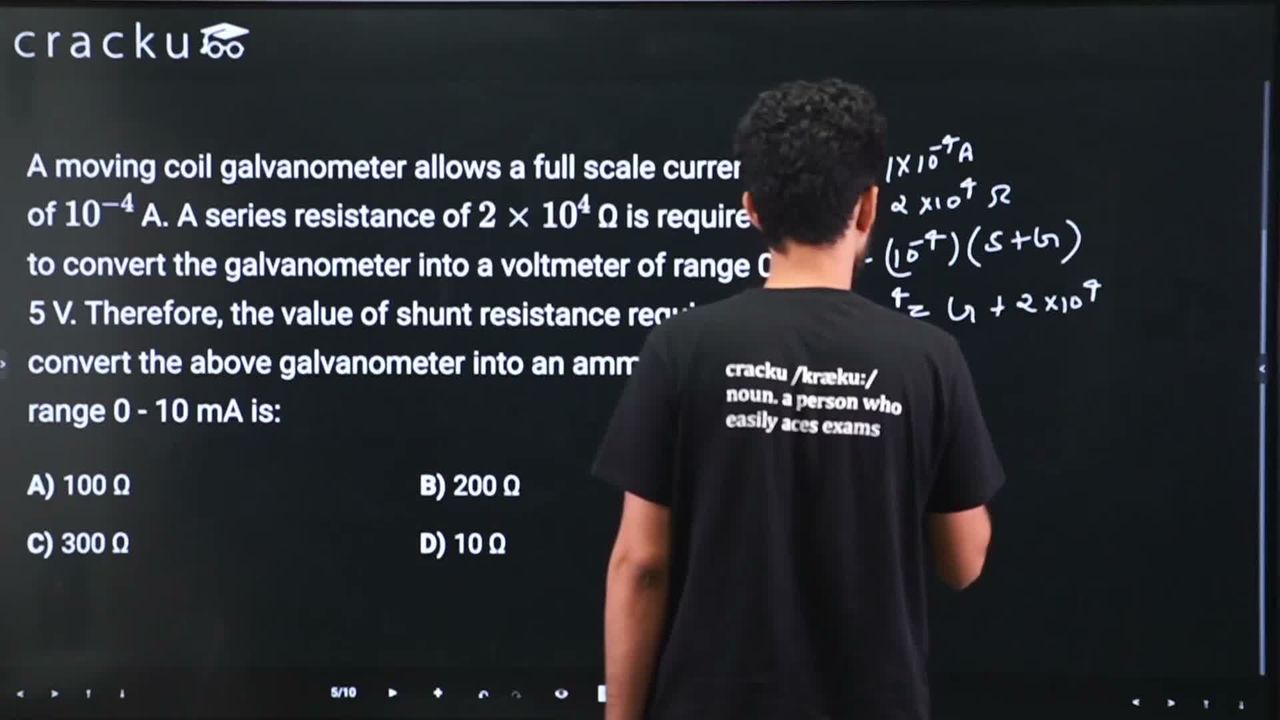
A moving coil galvanometer allows a full scale current of $$10^{-4}$$ A. A series resistance of $$2 \times 10^4$$ Ω is required to convert the galvanometer into a voltmeter of range 0 - 5 V. Therefore, the value of shunt resistance required to convert the above galvanometer into an ammeter of range 0 - 10 mA is:
We are told that the galvanometer gives full-scale deflection when a current of $$I_g = 10^{-4}\ {\rm A}$$ flows through it. Its own resistance is not given directly; we must first find it.
When the galvanometer is converted into a voltmeter of range $$0 - 5\ {\rm V}$$, a series resistance $$R_s = 2 \times 10^4\ \Omega$$ is connected.
For a voltmeter, the full-scale voltage is related to the full-scale current by the well-known relation
$$V = I_g\,(G + R_s),$$
where $$G$$ is the resistance of the galvanometer itself.
Substituting the known values, we have
$$5 = 10^{-4}\,(G + 2 \times 10^4).$$
Dividing both sides by $$10^{-4}$$ gives
$$5 \div 10^{-4} = G + 2 \times 10^4.$$
Since $$5 \div 10^{-4} = 5 \times 10^{4} = 5.0 \times 10^{4} = 50000,$$ we write
$$50000 = G + 20000.$$
So,
$$G = 50000 - 20000 = 30000\ \Omega = 3 \times 10^{4}\ \Omega.$$
Now we have the galvanometer resistance $$G = 3 \times 10^{4}\ \Omega$$ and its full-scale current $$I_g = 10^{-4}\ {\rm A}.$$
Next, we must convert this galvanometer into an ammeter of range $$0 - 10\ {\rm mA} = 0.01\ {\rm A}.$$ To do this, we place a shunt resistance $$S$$ in parallel with the galvanometer.
The standard formula for the required shunt is
$$S = \frac{I_g\,G}{I - I_g},$$
where $$I$$ is the desired full-scale ammeter current.
Substituting $$I_g = 10^{-4}\ {\rm A},\; G = 3 \times 10^{4}\ \Omega,\; I = 0.01\ {\rm A},$$ we get
$$S = \frac{(10^{-4})(3 \times 10^{4})}{0.01 - 10^{-4}}.$$
Evaluating the numerator,
$$(10^{-4})(3 \times 10^{4}) = 3.$$
The denominator is
$$0.01 - 0.0001 = 0.0099.$$
Hence,
$$S = \frac{3}{0.0099}\ \Omega.$$
Computing this quotient gives
$$S \approx 303\ \Omega.$$ Since the nearest tabulated option is $$300\ \Omega,$$ we take that as the required shunt.
Hence, the correct answer is Option C.
Was this solution helpful?
Click on the Email ☝️ to Watch the Video Solution
Create a FREE account and get:
_1.webp)

Educational materials for JEE preparation

Ask our AI anything

AI can make mistakes. Please verify important information.
AI can make mistakes. Please verify important information.
