
Join Our JEE Preparation Group
Prep with like-minded aspirants; Get access to free daily tests and study material.
Sign in
Please select an account to continue using cracku.in
↓ →
Join Our JEE Preparation Group
Prep with like-minded aspirants; Get access to free daily tests and study material.
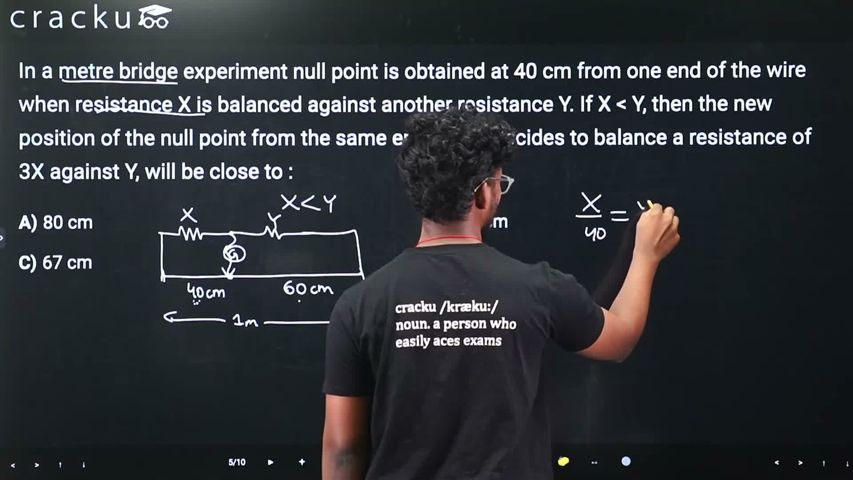
In a metre bridge experiment null point is obtained at 40 cm from one end of the wire when resistance X is balanced against another resistance Y. If X < Y, then the new position of the null point from the same end, if one decides to balance a resistance of 3X against Y, will be close to :
In a meter bridge experiment, we have a wire of length 100 cm. The null point occurs when the ratio of the resistances equals the ratio of the lengths of the wire segments. Initially, resistance X is balanced against resistance Y, and the null point is at 40 cm from the end where X is connected. Since X is less than Y, we use the formula:
$$\frac{X}{Y} = \frac{l_1}{100 - l_1}$$
Here, $$ l_1 = 40 $$ cm. Substituting the values:
$$\frac{X}{Y} = \frac{40}{100 - 40} = \frac{40}{60} = \frac{2}{3}$$
So, we have $$ \frac{X}{Y} = \frac{2}{3} $$, which means $$ X = \frac{2}{3} Y $$.
Now, we need to balance a resistance of 3X against Y. Let the new null point be at $$ l $$ cm from the same end where X was connected. The balance condition becomes:
$$\frac{3X}{Y} = \frac{l}{100 - l}$$
Substitute $$ \frac{X}{Y} = \frac{2}{3} $$ into the equation:
$$\frac{3X}{Y} = 3 \times \frac{X}{Y} = 3 \times \frac{2}{3} = 2$$
So, the equation simplifies to:
$$2 = \frac{l}{100 - l}$$
To solve for $$ l $$, multiply both sides by $$ 100 - l $$:
$$2 \times (100 - l) = l$$
Which gives:
$$200 - 2l = l$$
Now, bring all terms involving $$ l $$ to one side:
$$200 = l + 2l$$
$$200 = 3l$$
Dividing both sides by 3:
$$l = \frac{200}{3} \approx 66.67 \text{ cm}$$
This value is approximately 67 cm. Comparing with the options, 67 cm corresponds to option C.
Hence, the correct answer is Option C.
Was this solution helpful?
Click on the Email ☝️ to Watch the Video Solution
Create a FREE account and get:
_1.webp)

Educational materials for JEE preparation

Ask our AI anything

AI can make mistakes. Please verify important information.
AI can make mistakes. Please verify important information.


