
Join Our JEE Preparation Group
Prep with like-minded aspirants; Get access to free daily tests and study material.
Sign in
Please select an account to continue using cracku.in
↓ →
Join Our JEE Preparation Group
Prep with like-minded aspirants; Get access to free daily tests and study material.
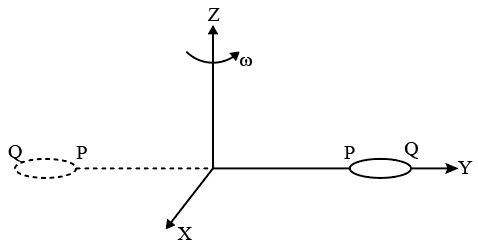
The general motion of a rigid body can be considered to be a combination of (i) a motion --- centre of mass about an axis, and (ii) its motion about an instantanneous axis passing through center of mass. These axes need not be stationary. Consider, for example, a thin uniform welded (rigidly fixed) horizontally at its rim to a massless stick, as shown in the figure. Where disc-stick system is rotated about the origin ona horizontal frictionless plane with angular sp--- $$\omega$$, the motion at any instant can be taken as a combination of (i) a rotation of the centre of mass the disc about the z-axis, and (ii) a rotation of the disc through an instantaneous vertical axis pass through its centre of mass (as is seen from the changed orientation of points P and Q). Both the motions have the same angular speed $$\omega$$ in the case.
Now consider two similar systems as shown in the figure: case (a) the disc with its face ver--- and parallel to x-z plane; Case (b) the disc with its face making an angle of $$45^\circ$$ with x-y plane its horizontal diameter parallel to x-axis. In both the cases, the disc is weleded at point P, and systems are rotated with constant angular speed $$\omega$$ about the z-axis.
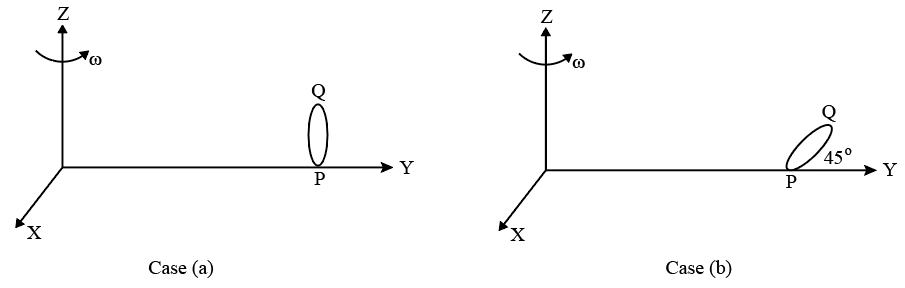
Which of the following statements about the instantaneous axis (passing through the centre of mass) is correct?
Create a FREE account and get:
_1.webp)

Educational materials for JEE preparation

Ask our AI anything

AI can make mistakes. Please verify important information.
AI can make mistakes. Please verify important information.
