
Join Our JEE Preparation Group
Prep with like-minded aspirants; Get access to free daily tests and study material.
Sign in
Please select an account to continue using cracku.in
↓ →
Join Our JEE Preparation Group
Prep with like-minded aspirants; Get access to free daily tests and study material.
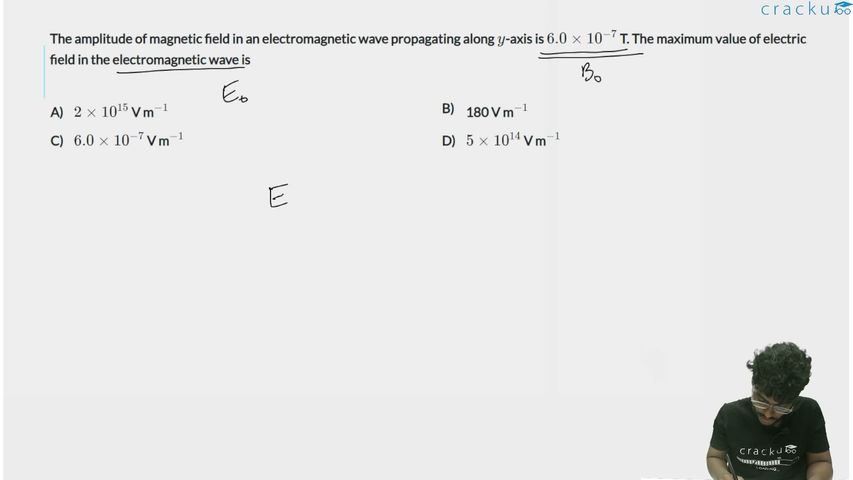
The amplitude of magnetic field in an electromagnetic wave propagating along $$y$$-axis is $$6.0 \times 10^{-7}$$ T. The maximum value of electric field in the electromagnetic wave is
We need to find the maximum value of the electric field in an electromagnetic wave, given that the amplitude of the magnetic field is $$B_0 = 6.0 \times 10^{-7}$$ T.
In an electromagnetic wave, the electric field ($$E$$) and magnetic field ($$B$$) are related by the speed of light, and their amplitudes satisfy $$E_0 = c \cdot B_0$$ where $$c = 3 \times 10^8$$ m/s is the speed of light in vacuum.
This relationship comes from Maxwell's equations, which show that the ratio of the electric field amplitude to the magnetic field amplitude in an EM wave always equals the speed of light.
We begin by substituting the given values into $$E_0 = c \times B_0$$, so that $$E_0 = (3 \times 10^8 \text{ m/s}) \times (6.0 \times 10^{-7} \text{ T})$$.
Next, multiplying the numerical parts gives $$3 \times 6.0 = 18.0$$, and combining the powers of 10 yields $$10^8 \times 10^{-7} = 10^{8+(-7)} = 10^1 = 10$$, which together give $$E_0 = 18.0 \times 10 = 180 \text{ V/m}$$.
Then we verify the units: the unit of $$c \cdot B$$ is (m/s)(T) = (m/s)(kg/(A·s$$^2$$)) = kg·m/(A·s$$^3$$) = V/m, which is indeed the correct unit for electric field. Therefore $$E_0 = 180$$ V/m.
The correct answer is Option 2: 180 V m$$^{-1}$$.
Was this solution helpful?
Click on the Email ☝️ to Watch the Video Solution
Create a FREE account and get:
_1.webp)

Educational materials for JEE preparation

Ask our AI anything

AI can make mistakes. Please verify important information.
AI can make mistakes. Please verify important information.


