
Join Our JEE Preparation Group
Prep with like-minded aspirants; Get access to free daily tests and study material.
Sign in
Please select an account to continue using cracku.in
↓ →
Join Our JEE Preparation Group
Prep with like-minded aspirants; Get access to free daily tests and study material.
Match List-I with List-II.
| List - I | List - II | |
|---|---|---|
| (a) $$\omega L > \frac{1}{\omega C}$$ | (i) | Current is in phase with emf |
| (b) $$\omega L = \frac{1}{\omega C}$$ | (ii) | Current lags behind the applied emf |
| (c) $$\omega L < \frac{1}{\omega C}$$ | (iii) | Maximum current occurs |
| (d) Resonant frequency | (iv) | Current leads the emf |
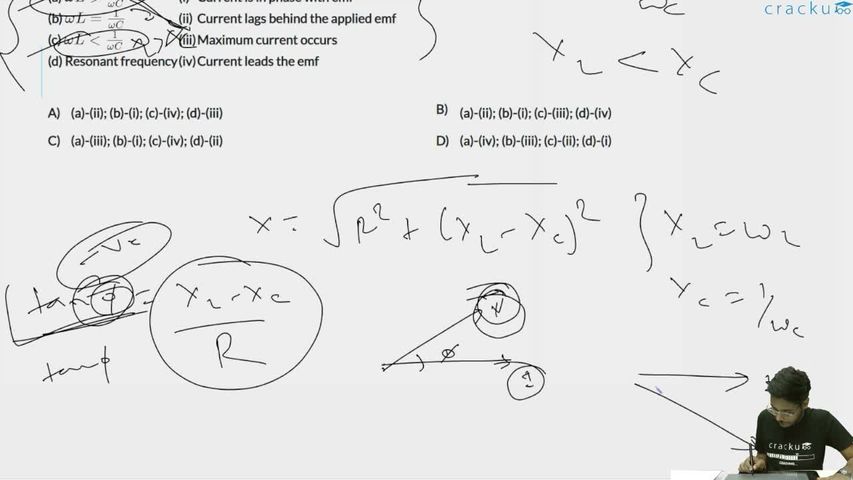
For a series $$RLC$$ circuit the impedance is $$Z = \sqrt{R^{2}+\left(\,\omega L-\frac{1}{\omega C}\right)^{2}}$$ and the phase angle $$\phi$$ between the current $$I$$ and the applied emf $$E$$ is given by
$$\tan \phi = \frac{\omega L-\dfrac{1}{\omega C}}{R}$$
Sign of $$\left(\omega L-\dfrac{1}{\omega C}\right)$$ decides whether the circuit behaves inductively or capacitively.
Case a: $$\omega L \gt \dfrac{1}{\omega C}$$ ⇒ $$\tan\phi \gt 0$$, so $$\phi$$ is positive. A positive phase angle means the current lags behind the emf.
Hence (a) matches with (ii) “Current lags behind the applied emf”.
Case b: $$\omega L = \dfrac{1}{\omega C}$$ ⇒ $$\tan\phi = 0$$, so $$\phi = 0$$. The current is exactly in phase with the emf and the circuit is at resonance.
Hence (b) matches with (i) “Current is in phase with emf”.
Case c: $$\omega L \lt \dfrac{1}{\omega C}$$ ⇒ $$\tan\phi \lt 0$$, so $$\phi$$ is negative. A negative phase angle means the current leads the emf.
Hence (c) matches with (iv) “Current leads the emf”.
Case d: “Resonant frequency” refers to the condition $$\omega L = \dfrac{1}{\omega C}$$, where the impedance is minimum ($$Z = R$$) and the circuit admits the largest current.
Hence (d) matches with (iii) “Maximum current occurs”.
Collecting all matches:
(a) - (ii); (b) - (i); (c) - (iv); (d) - (iii)
Therefore the correct option is Option A.
Click on the Email ☝️ to Watch the Video Solution
Create a FREE account and get:
_1.webp)

Educational materials for JEE preparation

Ask our AI anything

AI can make mistakes. Please verify important information.
AI can make mistakes. Please verify important information.


