
Join Our JEE Preparation Group
Prep with like-minded aspirants; Get access to free daily tests and study material.
Sign in
Please select an account to continue using cracku.in
↓ →
Join Our JEE Preparation Group
Prep with like-minded aspirants; Get access to free daily tests and study material.
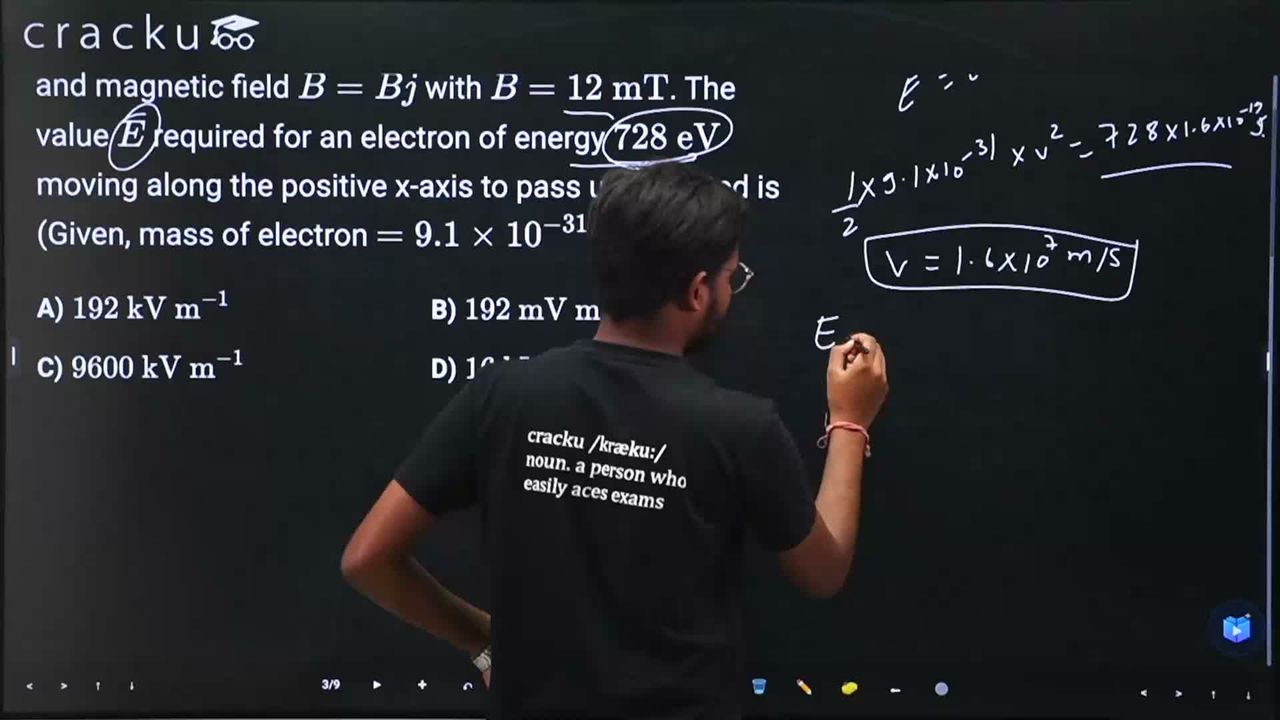
A velocity selector consists of electric field $$\vec{E} = E\hat{k}$$ and magnetic field $$\vec{B} = B\hat{j}$$ with $$B = 12 \text{ mT}$$. The value $$E$$ required for an electron of energy $$728 \text{ eV}$$ moving along the positive x-axis to pass undeflected is (Given, mass of electron $$= 9.1 \times 10^{-31} \text{ kg}$$)
A velocity selector has $$\vec{E} = E\hat{k}$$ and $$\vec{B} = B\hat{j}$$ with $$B = 12 \text{ mT}$$. An electron has energy $$728 \text{ eV}$$ and moves along the positive x-axis. We need to find $$E$$.
The kinetic energy of the electron is $$KE = \dfrac{1}{2}mv^2 = 728 \text{ eV} = 728 \times 1.6 \times 10^{-19} \text{ J}$$, which simplifies to $$1164.8 \times 10^{-19} \text{ J} = 1.1648 \times 10^{-16} \text{ J}$$.
Substituting this value into the expression for velocity gives $$v^2 = \dfrac{2 \times KE}{m} = \dfrac{2 \times 1.1648 \times 10^{-16}}{9.1 \times 10^{-31}} = 2.56 \times 10^{14}$$, so that $$v = 1.6 \times 10^7 \text{ m s}^{-1}$$.
For the electron to pass undeflected through the selector, the electric force must balance the magnetic force, thus $$qE = qvB$$ and hence $$E = vB$$.
Substituting $$v = 1.6 \times 10^7 \text{ m s}^{-1}$$ and $$B = 12 \times 10^{-3}$$ yields $$E = 1.6 \times 10^7 \times 12 \times 10^{-3} = 19.2 \times 10^4 = 1.92 \times 10^5 \text{ V m}^{-1}$$, which is equal to $$192 \text{ kV m}^{-1}$$.
Therefore, the correct answer is Option A: $$192 \text{ kV m}^{-1}$$.
Was this solution helpful?
Click on the Email ☝️ to Watch the Video Solution
Create a FREE account and get:
_1.webp)

Educational materials for JEE preparation

Ask our AI anything

AI can make mistakes. Please verify important information.
AI can make mistakes. Please verify important information.
