
Join Our JEE Preparation Group
Prep with like-minded aspirants; Get access to free daily tests and study material.
Sign in
Please select an account to continue using cracku.in
↓ →
Join Our JEE Preparation Group
Prep with like-minded aspirants; Get access to free daily tests and study material.
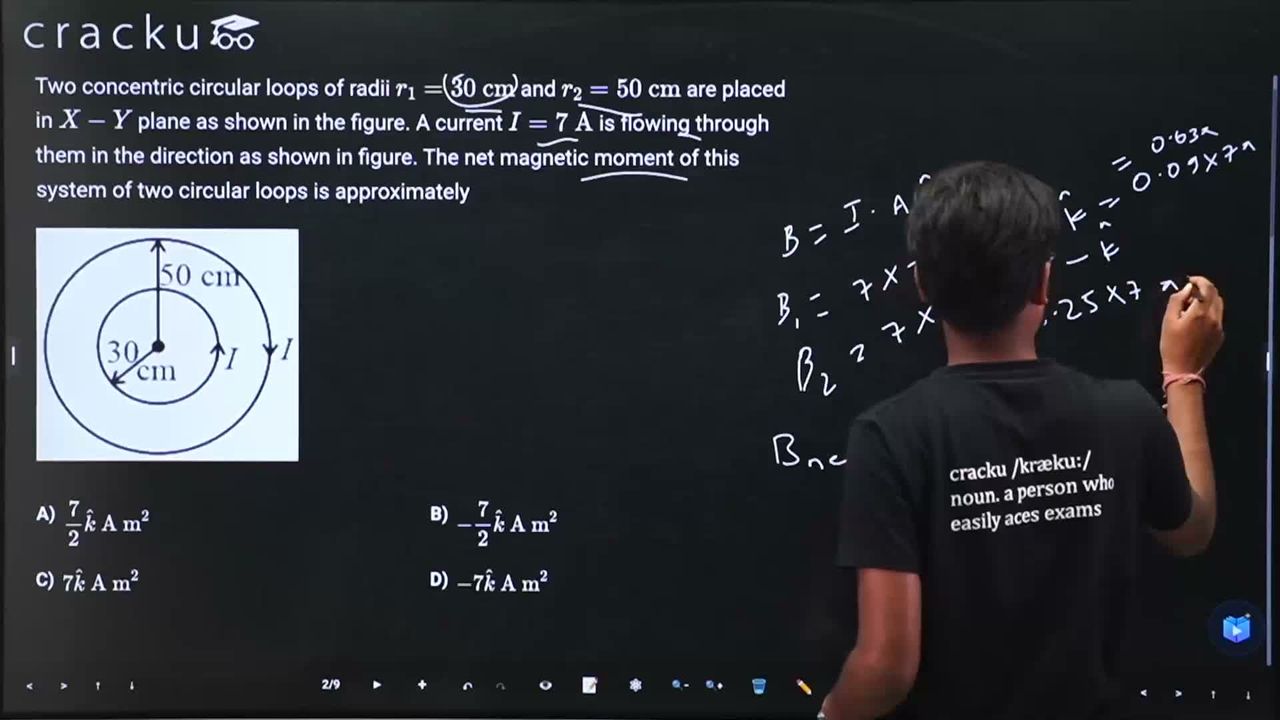
Two concentric circular loops of radii $$r_1 = 30 \text{ cm}$$ and $$r_2 = 50 \text{ cm}$$ are placed in $$X-Y$$ plane as shown in the figure. A current $$I = 7 \text{ A}$$ is flowing through them in the direction as shown in figure. The net magnetic moment of this system of two circular loops is approximately
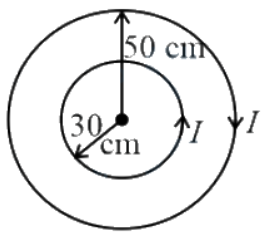
Two concentric circular loops of radii $$r_1 = 30 \text{ cm}$$ and $$r_2 = 50 \text{ cm}$$ in the X-Y plane carry current $$I = 7 \text{ A}$$. We need to find the net magnetic moment.
The magnetic moment of a circular loop is:
$$\vec{M} = I \cdot A \cdot \hat{n}$$
where $$A = \pi r^2$$ is the area and $$\hat{n}$$ is the unit normal determined by the direction of current (right-hand rule).
From the figure, the inner loop ($$r_1 = 0.3 \text{ m}$$) carries current in one direction and the outer loop ($$r_2 = 0.5 \text{ m}$$) carries current in the opposite direction.
For the inner loop (current gives $$+\hat{k}$$):
$$M_1 = 7 \times \pi \times (0.3)^2 = 7 \times 0.09\pi = 0.63\pi \text{ A m}^2$$
For the outer loop (current gives $$-\hat{k}$$):
$$M_2 = 7 \times \pi \times (0.5)^2 = 7 \times 0.25\pi = 1.75\pi \text{ A m}^2$$
$$\vec{M}_{net} = 0.63\pi \hat{k} - 1.75\pi \hat{k} = -1.12\pi \hat{k}$$
$$\vec{M}_{net} = -1.12 \times 3.14 \hat{k} \approx -3.52 \hat{k} \approx -\dfrac{7}{2} \hat{k} \text{ A m}^2$$
The correct answer is Option B: $$-\dfrac{7}{2} \hat{k} \text{ A m}^2$$.
Was this solution helpful?
Click on the Email ☝️ to Watch the Video Solution
Create a FREE account and get:
_1.webp)

Educational materials for JEE preparation

Ask our AI anything

AI can make mistakes. Please verify important information.
AI can make mistakes. Please verify important information.
