
Join Our JEE Preparation Group
Prep with like-minded aspirants; Get access to free daily tests and study material.
Sign in
Please select an account to continue using cracku.in
↓ →
Join Our JEE Preparation Group
Prep with like-minded aspirants; Get access to free daily tests and study material.
In the network shown below, the charge accumulated in the capacitor in steady state will be:
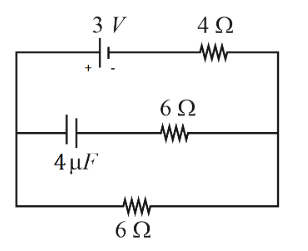
At steady state, capacitor branch carries no current.
So middle branch is open, and only top and bottom branches determine potential across capacitor.
Top branch: battery with resistor $$4Ω$$
Bottom branch: resistor $$6Ω$$
They form one closed loop.
Current:
$$I=\frac{3}{4+6}=0.3A$$
Potential drop across bottom $$6Ω$$ resistor:
V=IR
$$=0.3(6)=1.8V$$
This is the potential difference between left and right nodes.
Since in steady state no current flows through middle $$6Ω$$, no voltage drop occurs across that resistor, so capacitor gets full node voltage:
$$V_C=1.8V$$
Charge stored:
$$Q=CV$$
$$=(4\mu F)(1.8)$$
$$=7.2μC$$
Was this solution helpful?
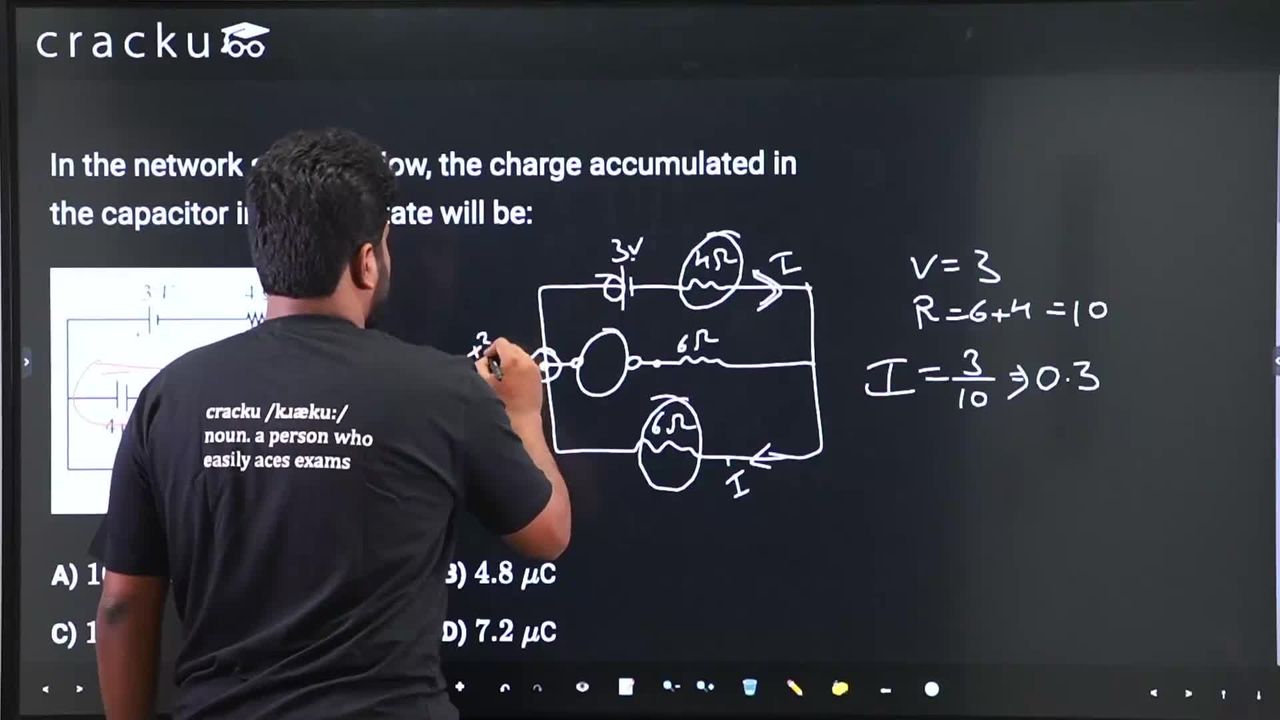
Click on the Email ☝️ to Watch the Video Solution
Create a FREE account and get:
_1.webp)

Educational materials for JEE preparation

Ask our AI anything

AI can make mistakes. Please verify important information.
AI can make mistakes. Please verify important information.
