
Join Our JEE Preparation Group
Prep with like-minded aspirants; Get access to free daily tests and study material.
Sign in
Please select an account to continue using cracku.in
↓ →
Join Our JEE Preparation Group
Prep with like-minded aspirants; Get access to free daily tests and study material.
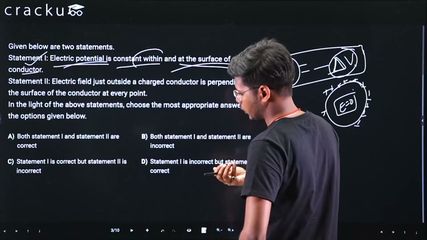
Given below are two statements.
Statement I: Electric potential is constant within and at the surface of each conductor.
Statement II: Electric field just outside a charged conductor is perpendicular to the surface of the conductor at every point.
In the light of the above statements, choose the most appropriate answer from the options given below.
We consider each statement about conductors in electrostatic equilibrium.
Statement I: In electrostatic equilibrium, the electric field inside a conductor is zero. Since $$\vec{E} = -\nabla V$$, a zero electric field throughout the conductor means the potential does not change — it is constant within and on the surface of the conductor. This statement is correct.
Statement II: For a charged conductor in equilibrium, any net charge resides on the surface. The electric field just outside the surface must be perpendicular to the surface at every point. If there were a tangential component, it would cause surface charges to move, contradicting the assumption of electrostatic equilibrium. Therefore, the field is purely normal (perpendicular) to the surface. This statement is correct.
Since both statements are correct, hence the correct answer is Option A.
Was this solution helpful?
Click on the Email ☝️ to Watch the Video Solution
Create a FREE account and get:
_1.webp)

Educational materials for JEE preparation

Ask our AI anything

AI can make mistakes. Please verify important information.
AI can make mistakes. Please verify important information.
