
Join Our JEE Preparation Group
Prep with like-minded aspirants; Get access to free daily tests and study material.
Sign in
Please select an account to continue using cracku.in
↓ →
Join Our JEE Preparation Group
Prep with like-minded aspirants; Get access to free daily tests and study material.
A spherically symmetric charge distribution is considered with charge density varying as $$\rho(r) = \begin{cases} \rho_0\left(\frac{3}{4} - \frac{r}{R}\right) & \text{for } r \leq R \\ 0 & \text{for } r > R \end{cases}$$
Where, $$r(r < R)$$ is the distance from the centre O (as shown in figure). The electric field at point P will be:
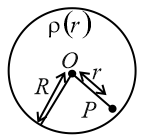
We need to find the electric field at a point $$P$$ located at a distance $$r$$ ($$r < R$$) from the center of a spherically symmetric charge distribution.
The charge density is given as:
$$\rho(r) = \rho_0 \left( \frac{3}{4} - \frac{r}{R} \right) \quad \text{for } r \le R$$
According to Gauss's Law, the electric flux through a spherical Gaussian surface of radius $$r$$ is equal to the enclosed charge ($$Q_{\text{encl}}$$) divided by the permittivity of free space ($$\varepsilon_0$$):
$$\oint \vec{E} \cdot d\vec{A} = \frac{Q_{\text{encl}}}{\varepsilon_0}$$
Due to spherical symmetry, the electric field $$E$$ is radial and constant in magnitude at a distance $$r$$. The surface area of the sphere is $$4\pi r^2$$, so the left side of the equation simplifies to:
$$E \cdot (4\pi r^2) = \frac{Q_{\text{encl}}}{\varepsilon_0} \implies E = \frac{Q_{\text{encl}}}{4\pi \varepsilon_0 r^2}$$
The total charge enclosed within a sphere of radius $$r$$ is found by integrating the charge density over the volume of thin spherical shells of thickness $$dx$$ from $$0$$ to $$r$$:
$$Q_{\text{encl}} = \int_0^r \rho(x) \cdot (4\pi x^2 \, dx)$$
Substituting the given charge density formula into the integral expression:
$$Q_{\text{encl}} = 4\pi \int_0^r \rho_0 \left( \frac{3}{4} - \frac{x}{R} \right) x^2 \, dx$$
$$Q_{\text{encl}} = 4\pi \rho_0 \int_0^r \left( \frac{3}{4}x^2 - \frac{x^3}{R} \right) dx$$
Performing the integration term by term:
$$Q_{\text{encl}} = 4\pi \rho_0 \left[ \frac{3}{4} \cdot \frac{x^3}{3} - \frac{x^4}{4R} \right]_0^r$$
$$Q_{\text{encl}} = 4\pi \rho_0 \left( \frac{r^3}{4} - \frac{r^4}{4R} \right)$$
Factoring out $$\frac{r^3}{4}$$ from the expression:
$$Q_{\text{encl}} = 4\pi \rho_0 \cdot \frac{r^3}{4} \left( 1 - \frac{r}{R} \right) = \pi \rho_0 r^3 \left( 1 - \frac{r}{R} \right)$$
Now, substitute the enclosed charge value back into the Gauss's Law expression:
$$E = \frac{\pi \rho_0 r^3 \left( 1 - \frac{r}{R} \right)}{4\pi \varepsilon_0 r^2}$$
Canceling out $$\pi$$ and $$r^2$$ from the numerator and denominator simplifies the equation to:
$$E = \frac{\rho_0 r}{4\varepsilon_0} \left( 1 - \frac{r}{R} \right)$$
Therefore, the correct choice is matching the marked green option:
$$\frac{\rho_0 r}{4\varepsilon_0} \left( 1 - \frac{r}{R} \right)$$
Was this solution helpful?
Create a FREE account and get:
_1.webp)

Educational materials for JEE preparation

Ask our AI anything

AI can make mistakes. Please verify important information.
AI can make mistakes. Please verify important information.
