
Join Our JEE Preparation Group
Prep with like-minded aspirants; Get access to free daily tests and study material.
Sign in
Please select an account to continue using cracku.in
↓ →
Join Our JEE Preparation Group
Prep with like-minded aspirants; Get access to free daily tests and study material.
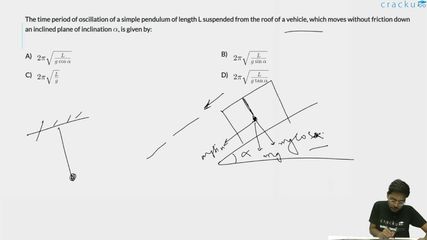
The time period of oscillation of a simple pendulum of length L suspended from the roof of a vehicle, which moves without friction down an inclined plane of inclination $$\alpha$$, is given by:
We have a simple pendulum of length $$L$$ suspended from the roof of a vehicle that moves without friction down an inclined plane of inclination $$\alpha$$. The key idea is to find the effective gravitational acceleration in the non-inertial frame of the vehicle.
Since the vehicle slides without friction, it accelerates down the incline with acceleration $$a = g\sin\alpha$$. In the reference frame of the vehicle, a pseudo force $$mg\sin\alpha$$ acts on the pendulum bob directed up the incline (opposite to the vehicle's acceleration).
The true gravity acts vertically downward with magnitude $$g$$. We resolve gravity along and perpendicular to the incline: the component along the incline is $$g\sin\alpha$$ (down the slope) and the component perpendicular to the incline is $$g\cos\alpha$$ (into the surface).
The pseudo force exactly cancels the component of gravity along the incline ($$mg\sin\alpha$$), leaving only the component perpendicular to the inclined surface, which is $$g\cos\alpha$$. This is the effective gravitational acceleration $$g_{eff} = g\cos\alpha$$ experienced by the pendulum in the vehicle's frame.
The time period of a simple pendulum is $$T = 2\pi\sqrt{\frac{L}{g_{eff}}} = 2\pi\sqrt{\frac{L}{g\cos\alpha}}$$.
Hence, the correct answer is Option A.
Was this solution helpful?
Click on the Email ☝️ to Watch the Video Solution
Create a FREE account and get:
_1.webp)

Educational materials for JEE preparation

Ask our AI anything

AI can make mistakes. Please verify important information.
AI can make mistakes. Please verify important information.
