
Join Our JEE Preparation Group
Prep with like-minded aspirants; Get access to free daily tests and study material.
Sign in
Please select an account to continue using cracku.in
↓ →
Join Our JEE Preparation Group
Prep with like-minded aspirants; Get access to free daily tests and study material.
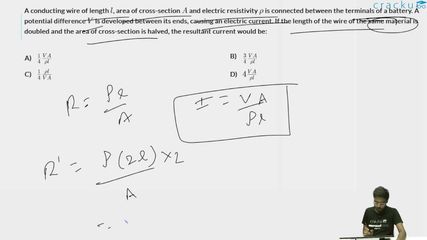
A conducting wire of length $$l$$, area of cross-section $$A$$ and electric resistivity $$\rho$$ is connected between the terminals of a battery. A potential difference $$V$$ is developed between its ends, causing an electric current. If the length of the wire of the same material is doubled and the area of cross-section is halved, the resultant current would be:
The resistance of a wire is given by $$R = \frac{\rho l}{A}$$, where $$\rho$$ is the resistivity, $$l$$ is the length, and $$A$$ is the cross-sectional area. The original current is $$I = \frac{V}{R} = \frac{VA}{\rho l}$$.
When the length is doubled ($$l' = 2l$$) and the area of cross-section is halved ($$A' = \frac{A}{2}$$), the new resistance becomes $$R' = \frac{\rho \cdot 2l}{A/2} = \frac{4\rho l}{A}$$.
Assuming the same potential difference $$V$$ is applied, the new current is $$I' = \frac{V}{R'} = \frac{V}{\frac{4\rho l}{A}} = \frac{VA}{4\rho l} = \frac{1}{4} \cdot \frac{VA}{\rho l}$$.
Click on the Email ☝️ to Watch the Video Solution
Create a FREE account and get:
_1.webp)

Educational materials for JEE preparation

Ask our AI anything

AI can make mistakes. Please verify important information.
AI can make mistakes. Please verify important information.


