
Join Our JEE Preparation Group
Prep with like-minded aspirants; Get access to free daily tests and study material.
Sign in
Please select an account to continue using cracku.in
↓ →
Join Our JEE Preparation Group
Prep with like-minded aspirants; Get access to free daily tests and study material.
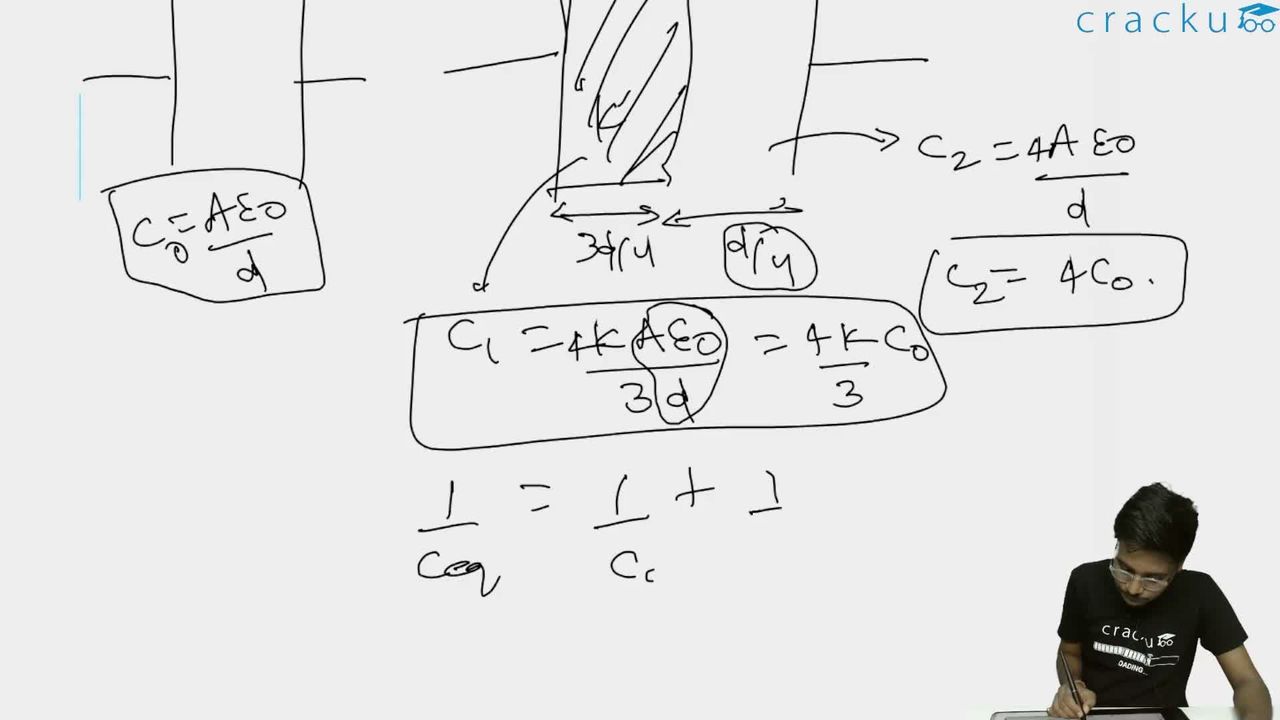
For changing the capacitance of a given parallel plate capacitor, a dielectric material of dielectric constant $$K$$ is used, which has the same area as the plates of the capacitor. The thickness of the dielectric slab is $$\frac{3}{4}d$$, where $$d$$ is the separation between the plates of parallel plate capacitor. The new capacitance $$C'$$ in terms of original capacitance $$C_0$$ is given by the following relation:
The original capacitance of the parallel plate capacitor is $$C_0 = \frac{\varepsilon_0 A}{d}$$, where $$A$$ is the plate area and $$d$$ is the separation between the plates.
When a dielectric slab of thickness $$t = \frac{3}{4}d$$ and dielectric constant $$K$$ is inserted, the capacitor can be thought of as two capacitors in series: one with the dielectric (thickness $$t$$) and one with air (thickness $$d - t$$).
The effective capacitance formula for a partially filled capacitor is $$C' = \frac{\varepsilon_0 A}{(d - t) + \frac{t}{K}}$$.
Substituting $$t = \frac{3d}{4}$$: $$C' = \frac{\varepsilon_0 A}{\left(d - \frac{3d}{4}\right) + \frac{3d}{4K}} = \frac{\varepsilon_0 A}{\frac{d}{4} + \frac{3d}{4K}}$$.
Taking the common denominator in the denominator: $$\frac{d}{4} + \frac{3d}{4K} = \frac{dK + 3d}{4K} = \frac{d(K + 3)}{4K}$$.
Therefore, $$C' = \frac{\varepsilon_0 A}{\frac{d(K+3)}{4K}} = \frac{4K \varepsilon_0 A}{d(K+3)} = \frac{4K}{K+3} \cdot \frac{\varepsilon_0 A}{d} = \frac{4K}{K+3} \, C_0$$.
Was this solution helpful?
Click on the Email ☝️ to Watch the Video Solution
Create a FREE account and get:
_1.webp)

Educational materials for JEE preparation

Ask our AI anything

AI can make mistakes. Please verify important information.
AI can make mistakes. Please verify important information.
