
Join Our JEE Preparation Group
Prep with like-minded aspirants; Get access to free daily tests and study material.
Sign in
Please select an account to continue using cracku.in
↓ →
Join Our JEE Preparation Group
Prep with like-minded aspirants; Get access to free daily tests and study material.
In the given figure, a mass $$M$$ is attached to a horizontal spring which is fixed on one side to a rigid support. The spring constant of the spring is $$k$$. The mass oscillates on a frictionless surface with time period $$T$$ and amplitude $$A$$. When the mass is in equilibrium position, as shown in the figure, another mass $$m$$ is gently fixed upon it. The new amplitude of oscillation will be:
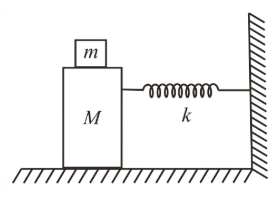
$$Mv=(M+m)v'$$Initially block M executes SHM with amplitude A.
When it passes through equilibrium position, its speed is maximum:
$$v=\omega A$$
where
$$\omega=\sqrt{\frac{k}{M}}$$
So
$$v=A\sqrt{\frac{k}{M}}$$
Now mass m is gently placed on it and sticks, so use conservation of momentum at that instant:
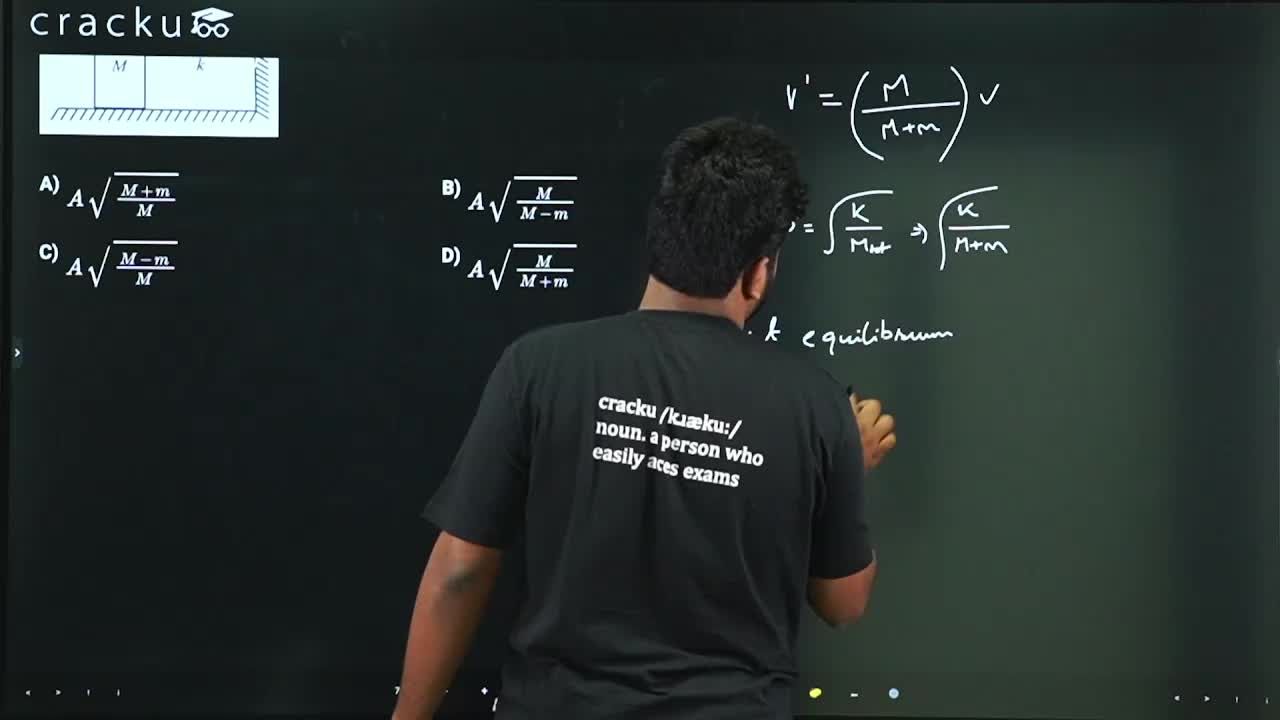
$$Mv=(M+m)v'$$
Thus
$$v'=\frac{M}{M+m}v$$
$$\frac{M}{M+m}A\sqrt{\frac{k}{M}}$$
Now new mass is
M+m
so new angular frequency is
$$\omega'=\sqrt{\frac{k}{M+m}}$$
At the instant of sticking, system is at equilibrium position, so displacement is zero and all energy is kinetic.
For new SHM, at equilibrium,
$$v′=ω′A′$$
where A′ is new amplitude.
So
$$A'=\frac{v'}{\omega'}$$
Substitute:
$$A'=\frac{\frac{M}{M+m}A\sqrt{k/M}}{\sqrt{k/(M+m)}}$$
Simplifying,
$$A'=A\sqrt{\frac{M}{M+m}}$$
Was this solution helpful?
Click on the Email ☝️ to Watch the Video Solution
Create a FREE account and get:
_1.webp)

Educational materials for JEE preparation

Ask our AI anything

AI can make mistakes. Please verify important information.
AI can make mistakes. Please verify important information.


