
Join Our JEE Preparation Group
Prep with like-minded aspirants; Get access to free daily tests and study material.
Sign in
Please select an account to continue using cracku.in
↓ →
Join Our JEE Preparation Group
Prep with like-minded aspirants; Get access to free daily tests and study material.
A cube of side $$a$$ has point charges +Q located at each of its vertices except at the origin where the charge is -Q. The electric field at the centre of cube is:
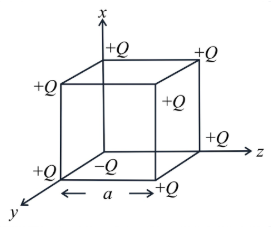
Using x, y, z components only:
Take the corner with charge −Q as origin
(0,0,0)
Center of cube is at
$$\left(\frac{a}{2},\frac{a}{2},\frac{a}{2}\right)$$
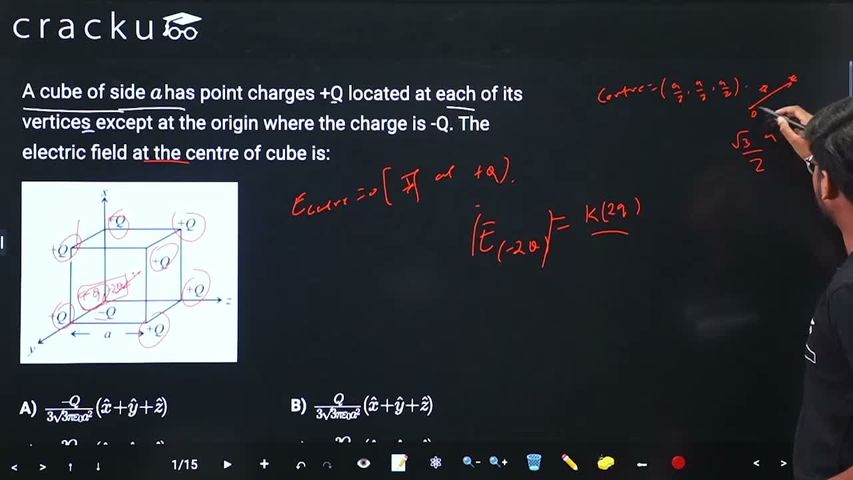
First imagine all 8 corners have charge +Q.
By symmetry, electric field at cube center is zero.
Now replacing the +Q at origin by −Q is equivalent to adding an extra charge
−2Q
at origin.
So net field at center is simply field due to charge −2Q at origin.
Distance of center from origin:
$$r=\frac{\sqrt{3}a}{2}$$
Magnitude of field:
$$E=\frac{k(2Q)}{r^2}=\frac{8kQ}{3a^2}$$
Direction is from center toward origin, i.e. along
(−1,−1,−1)
Unit vector in this direction:
$$\left(-\frac{1}{\sqrt{3}},-\frac{1}{\sqrt{3}},-\frac{1}{\sqrt{3}}\right)$$
So components are
$$E_x=-\frac{8kQ}{3\sqrt{3}a^2}$$
$$E_y=-\frac{8kQ}{3\sqrt{3}a^2}$$
$$E_z=-\frac{8kQ}{3\sqrt{3}a^2}$$
Hence field is
$$(E_x,E_y,E_z)=\left(-\frac{8kQ}{3\sqrt{3}a^2},-\frac{8kQ}{3\sqrt{3}a^2},-\frac{8kQ}{3\sqrt{3}a^2}\right)$$
Was this solution helpful?
Click on the Email ☝️ to Watch the Video Solution
Create a FREE account and get:
_1.webp)

Educational materials for JEE preparation

Ask our AI anything

AI can make mistakes. Please verify important information.
AI can make mistakes. Please verify important information.


