NTA JEE Mains 2nd April Shift 2 2026
For the following questions answer them individually
NTA JEE Mains 2nd April Shift 2 2026 - Question 21
Let $$A = \{2, 3, 4, 5, 6\}$$. Let $$R$$ be a relation on the set $$A \times A$$ given by $$(x, y)R(z, w)$$ if and only if $$x$$ divides $$z$$ and $$y \le w$$. Then the number of elements in $$R$$ is _________.
789
456
123
0.-
Clear All
NTA JEE Mains 2nd April Shift 2 2026 - Question 22
Consider the matrices $$A = \begin{bmatrix} 2 & -2 \\ 4 & -2 \end{bmatrix}$$ and $$B = \begin{bmatrix} 3 & 9 \\ 1 & 3 \end{bmatrix}$$. If matrices $$P$$ and $$Q$$ are such that $$PA = B$$ and $$AQ = B$$, then the absolute value of the sum of the diagonal elements of $$2(P + Q)$$ is _________.
789
456
123
0.-
Clear All
NTA JEE Mains 2nd April Shift 2 2026 - Question 23
Let $$A$$ be the point $$(3, 0)$$ and circles with variable diameter $$AB$$ touch the circle $$x^2 + y^2 = 36$$ internally. Let the curve $$C$$ be the locus of the point $$B$$. If the eccentricity of $$C$$ is $$e$$, then $$72e^2$$ is equal to _________.
789
456
123
0.-
Clear All

NTA JEE Mains 2nd April Shift 2 2026 - Question 24
If the area of the region bounded by $$16x^2 - 9y^2 = 144$$ and $$8x - 3y = 24$$ is $$A$$, then $$3(A + 6\log_e(3))$$ is equal to _________.
789
456
123
0.-
Clear All
NTA JEE Mains 2nd April Shift 2 2026 - Question 25
The number of points in the interval $$[2, 4]$$, at which the function $$f(x) = \left\lfloor x^2 - x - \frac{1}{2} \right\rfloor$$, where $$[\cdot]$$ denotes the greatest integer function, is discontinuous, is _________.
789
456
123
0.-
Clear All
NTA JEE Mains 2nd April Shift 2 2026 - Question 26
Dimensions of universal gravitational constant $$(G)$$ in terms of Planck's constant $$(h)$$, distance $$(L)$$, mass $$(M)$$ and time $$(T)$$ are :
NTA JEE Mains 2nd April Shift 2 2026 - Question 27
A 0.5 kg mass is in contact against the inner wall of a cylindrical drum of radius 4 m rotating about its vertical axis. The minimum rotational speed of the drum to enable the mass to remain stuck to the wall (without falling) is 5 rad/s. The coefficient of friction between the drum's inner wall surface and mass is : (Take $$g = 10$$ m/s$$^2$$)
NTA JEE Mains 2nd April Shift 2 2026 - Question 28
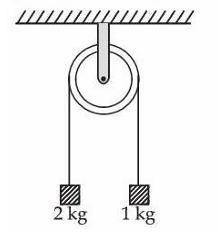
Two blocks of masses 2 kg and 1 kg respectively, are tied to the ends of a string which passes over a light frictionless pulley as shown in the figure. The masses are held at rest at the same horizontal level and then released. The distance traversed by the centre of mass in 2 s is _________ m. (Take $$g = 10$$ m/s$$^2$$)
NTA JEE Mains 2nd April Shift 2 2026 - Question 29
A particle having charge $$10^{-9}$$ C moving in the x-y plane in fields of $$0.4\hat{j}$$ N/C and $$4 \times 10^{-3}\hat{k}$$ T experiences a force of $$(4\hat{i} + 2\hat{j}) \times 10^{-10}$$ N. The velocity of the particle at that instant is :
NTA JEE Mains 2nd April Shift 2 2026 - Question 30
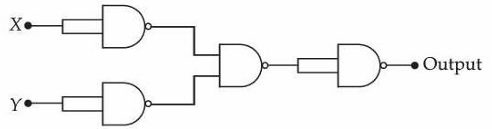
If X and Y are the inputs, the given circuit works as :