For the following questions answer them individually
Consider the efficiency of Carnot's engine is given by $$\eta = \frac{\alpha\beta}{\sin\theta} \log_e\frac{\beta x}{kT}$$, where $$\alpha$$ and $$\beta$$ are constants. If $$T$$ is temperature, $$k$$ is Boltzmann constant, $$\theta$$ is angular displacement and $$x$$ has the dimensions of length. Then, choose the incorrect option.
At time $$t = 0$$ a particle starts travelling from a height $$7\hat{z}$$ cm in a plane keeping z coordinate constant. At any instant of time, it's position along the x and y directions are defined as $$3t$$ and $$5t^3$$ respectively. At $$t = 1$$ s acceleration of the particle will be
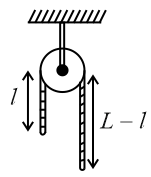
A uniform metal chain of mass $$m$$ and length $$L$$ passes over a massless and frictionless pulley. It is released from rest with a part of its length $$l$$ is hanging on one side and rest of its length $$(L-l)$$ is hanging on the other side of the pulley. At a certain point of time, when $$l = \frac{L}{x}$$, the acceleration of the chain is $$\frac{g}{2}$$. The value of $$x$$ is
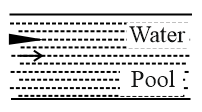
A bullet of mass 200 g having initial kinetic energy 90 J is shot inside a long swimming pool as shown in the figure. If it's kinetic energy reduces to 40 J within 1 s, the minimum length of the pool, the bullet has to travel so that it completely comes to rest is
Assume there are two identical simple pendulum Clocks-1 is placed on the earth and Clock-2 is placed on a space station located at a height h above the earth surface. Clock-1 and Clock-2 operate at time periods 4 s and 6 s respectively. Then the value of h is (consider radius of earth $$R_E = 6400$$ km and $$g$$ on earth $$10 \ m s^{-2}$$)
A pressure-pump has a horizontal tube of cross-sectional area 10 cm$$^2$$ for the outflow of water at a speed of 20 m s$$^{-1}$$. The force exerted on the vertical wall just in front of the tube which stops water horizontally flowing out of the tube, is: [given: density of water $$= 1000$$ kg m$$^{-3}$$]
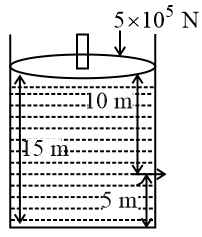
Consider a cylindrical tank of radius 1 m is filled with water. The top surface of water is at 15 m from the bottom of the cylinder. There is a hole on the wall of cylinder at a height of 5 m from the bottom. A force of $$5 \times 10^5$$ N is applied on the top surface of water using a piston. The speed of efflux from the hole will be: (given atmospheric pressure $$P_A = 1.01 \times 10^5$$ Pa, density of water $$\rho_w = 1000$$ kg m$$^{-3}$$ and gravitational acceleration $$g = 10 \ m s^{-2}$$)
A vessel contains 14 g of nitrogen gas at a temperature of $$27^\circ C$$. The amount of heat to be transferred to the gas to double the r.m.s. speed of its molecules will be: (Take $$R = 8.32$$ J mol$$^{-1}$$ K$$^{-1}$$)
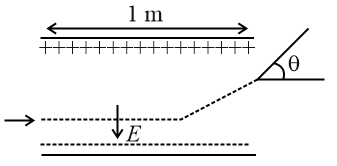
A uniform electric field $$E = \frac{8m}{e}$$ V m$$^{-1}$$ is created between two parallel plates of length 1 m as shown in figure, (where $$m$$ = mass of electron and $$e$$ = charge of electron). An electron enters the field symmetrically between the plates with a speed of 2 m s$$^{-1}$$. The angle of the deviation $$\theta$$ of the path of the electron as it comes out of the field will be
A slab of dielectric constant K has the same cross-sectional area as the plates of a parallel plate capacitor and thickness $$\frac{3}{4}d$$, where $$d$$ is the separation of the plates. The capacitance of the capacitor when the slab is inserted between the plates will be: (Given $$C_0$$ = capacitance of capacitor with air as medium between plates.)
Given below are two statements:
Statement I: A uniform wire of resistance 80 $$\Omega$$ is cut into four equal parts. These parts are now connected in parallel. The equivalent resistance of the combination will be 5 $$\Omega$$.
Statement II: Two resistances 2R and 3R are connected in parallel in an electric circuit. The value of thermal energy developed in 3R and 2R will be in the ratio 3:2.
In the light of the above statements, choose the most appropriate answer from the options given below
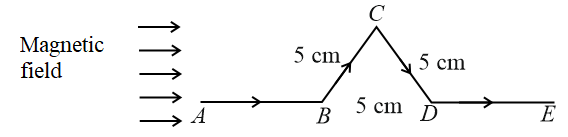
A triangular shaped wire carrying 10 A current is placed in a uniform magnetic field of 0.5 T, as shown in figure. The magnetic force on segment CD is (Given BC = CD = BD = 5 cm).
The magnetic field at the center of current carrying circular loop is $$B_1$$. The magnetic field at a distance of $$\sqrt{3}$$ times radius of the given circular loop from the center on its axis is $$B_2$$. The value of $$\frac{B_1}{B_2}$$ will be
A transformer operating at primary voltage 8 kV and secondary voltage 160 V serves a load of 80 kW. Assuming the transformer to be ideal with purely resistive load and working on unity power factor, the loads in the primary and secondary circuit would be
Sun light falls normally on a surface of area 36 cm$$^2$$ and exerts an average force of $$7.2 \times 10^{-9}$$ N within a time period of 20 minutes. Considering a case of complete absorption, the energy flux of incident light is
The power of a lens (biconvex) is 1.25 m$$^{-1}$$ in particular medium. Refractive index of the lens is 1.5 and radii of curvature are 20 cm and 40 cm respectively. The refractive index of surrounding medium:
Two streams of photons, possessing energies equal to five and ten times the work function of metal are incident on the metal surface successively. The ratio of the maximum velocities of the photoelectron emitted, in the two cases respectively, will be
A radioactive sample decays $$\frac{7}{8}$$ times its original quantity in 15 minutes. The half-life of the sample is
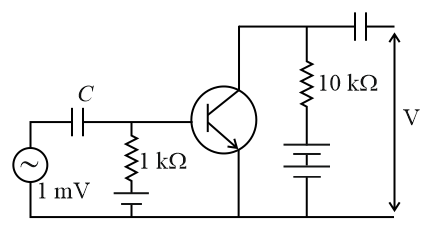
An n.p.n transistor with current gain $$\beta = 100$$ in common emitter configuration is shown in figure. The output voltage of the amplifier will be
A FM Broadcast transmitter, using modulating signal of frequency 20 kHz has a deviation ratio of 10. The Bandwidth required for transmission is:
In an experiment to find acceleration due to gravity $$g$$ using simple pendulum, time period of 0.5 s is measured from time of 100 oscillation with a watch of 1 s resolution. If measured value of length is 10 cm known to 1 mm accuracy. The accuracy in the determination of $$g$$ is found to be $$x\%$$. The value of $$x$$ is
A ball is thrown vertically upwards with a velocity of 19.6 m s$$^{-1}$$ from the top of a tower. The ball strikes the ground after 6 s. The height from the ground up to which the ball can rise will be $$\frac{k}{5}$$ m. The value of $$k$$ is _____ (use $$g = 9.8 \ m s^{-2}$$)
The distance of centre of mass from end A of a one dimensional rod (AB) having mass density $$\rho = \rho_0\left(1 - \frac{x^2}{L^2}\right)$$ kg m$$^{-1}$$ and length $$L$$ (in meter) is $$\frac{3L}{\alpha}$$ m. The value of $$\alpha$$ is _____ (where $$x$$ is the distance from end A)
A string of area of cross-section 4 mm$$^2$$ and length 0.5 is connected with a rigid body of mass 2 kg. The body is rotated in a vertical circular path of radius 0.5 m. The body acquires a speed of 5 m s$$^{-1}$$ at the bottom of the circular path. Strain produced in the string when the body is at the bottom of the circle is _____ $$\times 10^{-5}$$. (Use Young's modulus $$10^{11}$$ N m$$^{-2}$$ and $$g = 10 \ m s^{-2}$$)
At a certain temperature, the degrees of freedom per molecule for gas is 8. The gas performs 150 J of work when it expands under constant pressure. The amount of heat absorbed by the gas will be _____ J.
The potential energy of a particle of mass 4 kg in motion along the x-axis is given by $$U = 4(1 - \cos 4x)$$ J. The time period of the particle for small oscillation $$(\sin\theta \approx \theta)$$ is $$\frac{\pi}{K}$$ s. The value of $$K$$ is _____
An electrical bulb rated 220 V, 100 W, is connected in series with another bulb rated 220 V, 60 W. If the voltage across combination is 220 V, the power consumed by the 100 W bulb will be about _____ W.
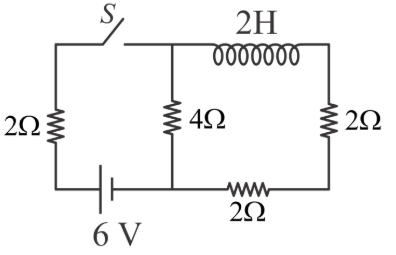
For the given circuit the current through battery of 6 V just after closing the switch 'S' will be _____ A.
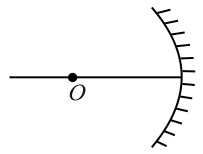
An object 'O' is placed at a distance of 100 cm in front of a concave mirror of radius of curvature 200 cm as shown in the figure. The object starts moving towards the mirror at a speed 2 cm s$$^{-1}$$. The position of the image from the mirror after 10 s will be at _____ cm.
In an experiment with a convex lens, the plot of the image distance ($$v'$$) against the object distance ($$\mu'$$) measured from the focus gives a curve $$v'\mu' = 225$$. If all the distances are measured in cm. The magnitude of the focal length of the lens is _____ cm.