
Join Our JEE Preparation Group
Prep with like-minded aspirants; Get access to free daily tests and study material.
Sign in
Please select an account to continue using cracku.in
↓ →
Join Our JEE Preparation Group
Prep with like-minded aspirants; Get access to free daily tests and study material.
A pressure-pump has a horizontal tube of cross-sectional area 10 cm$$^2$$ for the outflow of water at a speed of 20 m s$$^{-1}$$. The force exerted on the vertical wall just in front of the tube which stops water horizontally flowing out of the tube, is: [given: density of water $$= 1000$$ kg m$$^{-3}$$]
We are given a pressure-pump with a horizontal tube of cross-sectional area $$A = 10 \text{ cm}^2 = 10 \times 10^{-4} \text{ m}^2$$ and outflow speed $$v = 20 \text{ m/s}$$. A vertical wall in front of the tube stops the water completely.
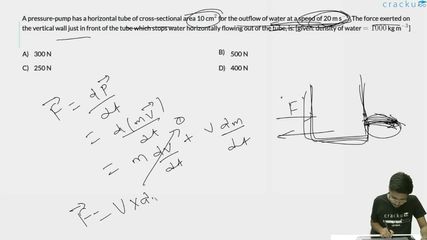
The force exerted on the wall can be found using the rate of change of momentum. The mass flow rate of water is $$\frac{dm}{dt} = \rho A v$$, where $$\rho = 1000 \text{ kg/m}^3$$.
Since the water is brought to rest (from speed $$v$$ to 0), the force on the wall is $$F = \frac{dm}{dt} \times v = \rho A v^2$$.
Substituting the values: $$F = 1000 \times 10 \times 10^{-4} \times (20)^2 = 1000 \times 10^{-3} \times 400 = 400 \text{ N}$$.
Hence, the correct answer is Option D.
Was this solution helpful?
Click on the Email ☝️ to Watch the Video Solution
Create a FREE account and get:
_1.webp)

Educational materials for JEE preparation

Ask our AI anything

AI can make mistakes. Please verify important information.
AI can make mistakes. Please verify important information.
