
Join Our JEE Preparation Group
Prep with like-minded aspirants; Get access to free daily tests and study material.
Sign in
Please select an account to continue using cracku.in
↓ →
Join Our JEE Preparation Group
Prep with like-minded aspirants; Get access to free daily tests and study material.
Given below are two statements:
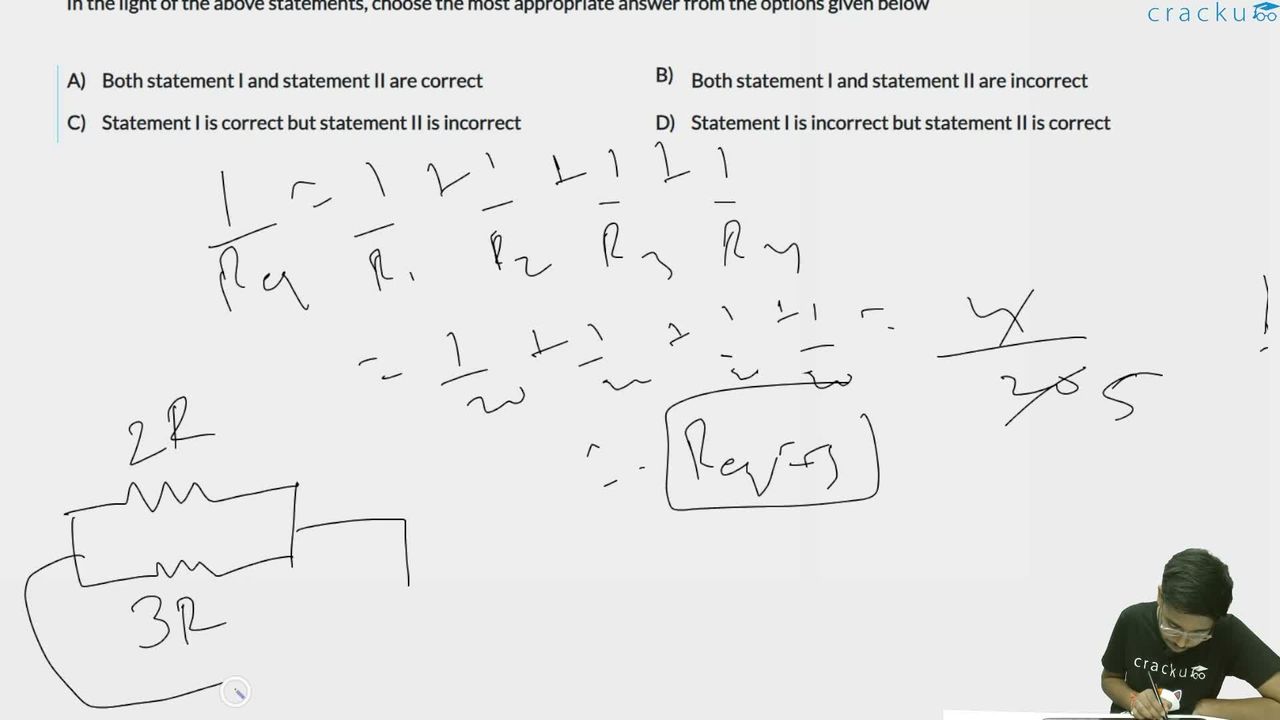
Statement I: A uniform wire of resistance 80 $$\Omega$$ is cut into four equal parts. These parts are now connected in parallel. The equivalent resistance of the combination will be 5 $$\Omega$$.
Statement II: Two resistances 2R and 3R are connected in parallel in an electric circuit. The value of thermal energy developed in 3R and 2R will be in the ratio 3:2.
In the light of the above statements, choose the most appropriate answer from the options given below
Statement I: A uniform wire of resistance 80 $$\Omega$$ is cut into four equal parts. Each part has resistance $$\frac{80}{4} = 20 \ \Omega$$. When four resistances of 20 $$\Omega$$ each are connected in parallel, the equivalent resistance is $$R_{eq} = \frac{20}{4} = 5 \ \Omega$$. So Statement I is correct.
Statement II: Two resistances $$2R$$ and $$3R$$ are connected in parallel. In a parallel combination, both resistors have the same potential difference $$V$$ across them. The thermal energy (power) developed in each resistor is $$P = \frac{V^2}{R_{\text{resistor}}}$$.
So the power in $$3R$$ is $$P_1 = \frac{V^2}{3R}$$ and the power in $$2R$$ is $$P_2 = \frac{V^2}{2R}$$.
The ratio of thermal energy developed in $$3R$$ to that in $$2R$$ is $$\frac{P_1}{P_2} = \frac{V^2/3R}{V^2/2R} = \frac{2R}{3R} = \frac{2}{3}$$, i.e., $$2:3$$.
The statement claims the ratio is $$3:2$$, which is incorrect. So Statement II is incorrect.
Hence, the correct answer is Option C.
Was this solution helpful?
Click on the Email ☝️ to Watch the Video Solution
Create a FREE account and get:
_1.webp)

Educational materials for JEE preparation

Ask our AI anything

AI can make mistakes. Please verify important information.
AI can make mistakes. Please verify important information.
