
Join Our JEE Preparation Group
Prep with like-minded aspirants; Get access to free daily tests and study material.
Sign in
Please select an account to continue using cracku.in
↓ →
Join Our JEE Preparation Group
Prep with like-minded aspirants; Get access to free daily tests and study material.
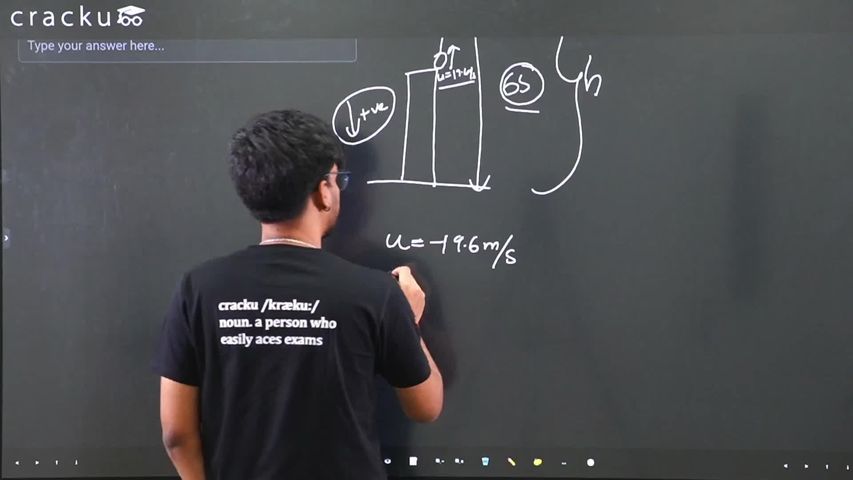
A ball is thrown vertically upwards with a velocity of 19.6 m s$$^{-1}$$ from the top of a tower. The ball strikes the ground after 6 s. The height from the ground up to which the ball can rise will be $$\frac{k}{5}$$ m. The value of $$k$$ is _____ (use $$g = 9.8 \ m s^{-2}$$)
Correct Answer: 392
We have a ball thrown vertically upwards with an initial velocity of $$u = 19.6 \text{ m/s}$$ from the top of a tower. The ball strikes the ground after $$t = 6 \text{ s}$$. We need to find the maximum height above the ground that the ball reaches.
Let the height of the tower be $$h$$. Taking the upward direction as positive and the top of the tower as the origin, the displacement of the ball when it hits the ground is $$-h$$ (downward). Using $$s = ut + \frac{1}{2}(-g)t^2$$, we get $$-h = 19.6(6) - \frac{1}{2}(9.8)(36) = 117.6 - 176.4 = -58.8$$.
So the height of the tower is $$h = 58.8 \text{ m}$$.
Now, the ball rises above the tower before coming back down. The maximum height above the tower is given by $$h_{\text{rise}} = \frac{u^2}{2g} = \frac{(19.6)^2}{2 \times 9.8} = \frac{384.16}{19.6} = 19.6 \text{ m}$$.
So the maximum height of the ball above the ground is $$H = h + h_{\text{rise}} = 58.8 + 19.6 = 78.4 \text{ m}$$.
We are told this equals $$\frac{k}{5}$$, so $$\frac{k}{5} = 78.4$$, which gives $$k = 78.4 \times 5 = 392$$.
Hence, the value of $$k$$ is $$\textbf{392}$$.
Was this solution helpful?
Click on the Email ☝️ to Watch the Video Solution
Create a FREE account and get:
_1.webp)

Educational materials for JEE preparation

Ask our AI anything

AI can make mistakes. Please verify important information.
AI can make mistakes. Please verify important information.
