For the following questions answer them individually
The correct decreasing order of energy, for the orbitals having following set of quantum numbers:
(A) $$n = 3, l = 0, m = 0$$
(B) $$n = 4, l = 0, m = 0$$
(C) $$n = 3, l = 1, m = 0$$
(D) $$n = 3, l = 2, m = 1$$
Outermost electronic configurations of four elements A, B, C, D are given below:
(A) $$3s^2$$
(B) $$3s^2 3p^1$$
(C) $$3s^2 3p^3$$
(D) $$3s^2 3p^4$$
The correct order of first ionization enthalpy for them is
Match List-I with List-II
| List-I | List-II |
|---|---|
| A. $$\Psi_{MO} = \Psi_A - \Psi_B$$ | I. Dipole moment |
| B. $$\mu = Q \times r$$ | II. Bonding molecular orbital |
| C. $$\frac{N_b - N_a}{2}$$ | III. Anti-bonding molecular orbital |
| D. $$\Psi_{MO} = \Psi_A + \Psi_B$$ | IV. Bond order |
The plot of pH-metric titration of weak base $$NH_4OH$$ vs strong acid $$HCl$$ looks like
An element A of group 1 shows similarity to an element B belonging to group 2. If A has maximum hydration enthalpy in group 1, then B is
Given below are two statements: one is labelled as Assertion A and the other is labelled as Reason R
Assertion A: Boron is unable to form $$BF_6^{3-}$$
Reason R: Size of B is very small.
In the light of the above statements, choose the correct answer from the options given below:
Match List-I with List-II
| List-I (Mixture) | List-II (Purification Process) |
|---|---|
| A. Chloroform & Aniline | I. Steam distillation |
| B. Benzoic acid & Naphthalene | II. Sublimation |
| C. Water & Aniline | III. Distillation |
| D. Naphthalene & Sodium chloride | IV. Crystallisation |
Given below are two statements:
Statement I: The non bio-degradable fly ash and slag from steel industry can be used by cement industry.
Statement II: The fuel obtained from plastic waste is lead free.
In the light of the above statements, choose the most appropriate answer from the options given below:
Given below are two statements:
Statement I: For KI, molar conductivity increases steeply with dilution.
Statement II: For carbonic acid, molar conductivity increases slowly with dilution.
In the light of the above statements, choose the correct answer from the options given below:
Given below are two statements: one is labelled as Assertion A and the other is labelled as Reason R
Assertion A: Dissolved substances can be removed from a colloidal solution by diffusion through a parchment paper.
Reason R: Particles in a true solution cannot pass through parchment paper but the colloidal particles can pass through the parchment paper.
In the light of the above statements, choose the correct answer from the options given below:
In neutral or alkaline solution, $$MnO_4^-$$ oxidises thiosulphate to
Low oxidation state of metals in their complexes are common when ligands
$$Fe^{3+}$$ cation gives a prussian blue precipitate on addition of potassium ferrocyanide solution due to the formation of
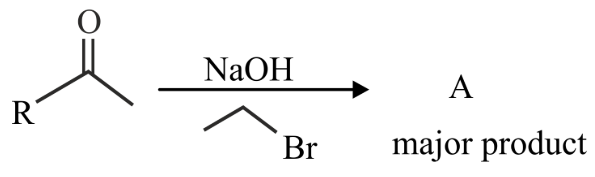
The structure of A in the given reaction is
Major product 'B' of the following reaction sequence is
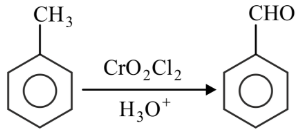
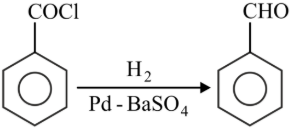
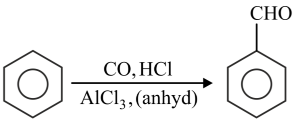
Match List-I with List-II.
| List-I | List-II |
|---|---|
A![]() | I. Gatterman Koch reaction |
B![]() | II. Etard reaction |
C![]() | III. Stephen reaction |
D![]() | IV. Rosenmund reaction |
An organic compound 'A' contains nitrogen and chlorine. It dissolves readily in water to give a solution that turns litmus red. Titration of compound 'A' with standard base indicates that the molecular weight of 'A' is $$131 \pm 2$$. When a sample of 'A' is treated with aq. NaOH, a liquid separates which contains N but not Cl. Treatment of the obtained liquid with nitrous acid followed by phenol gives orange precipitate. The compound 'A' is
Match List-I with List-II.
| List-I (Polymer) | List-II (Monomer) |
|---|---|
| A. Neoprene | I. Acrylonitrile |
| B. Teflon | II. Chloroprene |
| C. Acrilan | III. Tetrafluoroethene |
| D. Natural rubber | IV. Isoprene |
Choose the correct answer from the option given below:
Which of the following enhances the lathering property of soap?
Match List-I with List-II
| List-I | List-II |
|---|---|
| A. Glucose + HI | I. Gluconic acid |
| B. Glucose + $$Br_2$$ water | II. Glucose pentacetate |
| C. Glucose + acetic anhydride | III. Saccharic acid |
| D. Glucose + $$HNO_3$$ | IV. Hexane |

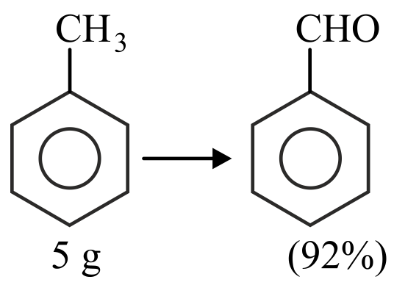
In the above reaction,5 g of toluene is converted into benzaldehyde with 92% yield. The amount of benzaldehyde produced is _____ $$\times 10^{-2}$$ g
The number of molecule(s) or ion(s) from the following having non-planar structure is ______.
$$NO_3^-$$, $$H_2O_2$$, $$BF_3$$, $$PCl_3$$, $$XeF_4$$, $$SF_4$$, $$XeO_3$$, $$PH_4^+$$, $$SO_3$$, $$[Al(OH)_4]^-$$
For a real gas at $$25^\circ C$$ temperature and high pressure (99 bar) the value of compressibility factor is 2, so the value of Van der Waal's constant 'b' should be _____ $$\times 10^{-2}$$ L mol$$^{-1}$$. (Given $$R = 0.083$$ L bar K$$^{-1}$$ mol$$^{-1}$$)
A gas (Molar mass = 280 g mol$$^{-1}$$) was burnt in excess $$O_2$$ in a constant volume calorimeter and during combustion the temperature of calorimeter increased from 298.0 K to 298.45 K. If the heat capacity of calorimeter is 2.5 kJ K$$^{-1}$$ and enthalpy of combustion of gas is 9 kJ mol$$^{-1}$$ then amount of gas burnt is _____ g.
The normality of $$H_2SO_4$$ in the solution obtained on mixing 100 mL of 0.1 M $$H_2SO_4$$ with 50 mL of 0.1 M NaOH is _____ $$\times 10^{-1}$$ N.
When a certain amount of solid A is dissolved in 100 g of water at $$25^\circ C$$ to make a dilute solution, the vapour pressure of the solution is reduced to one-half of that of pure water. The vapour pressure of pure water is 23.76 mmHg. The number of moles of solute A added is
$$[A] \xrightarrow{} [B]$$
Reactant $$\to$$ Product
If formation of compound [B] follows the first order of kinetics and after 70 minutes the concentration of [A] was found to be half of its initial concentration. Then the rate constant of the reaction is $$x \times 10^{-6} s^{-1}$$. The value of $$x$$ is ____
Among the following ores Bauxite, Siderite, Cuprite, Calamine, Haematite, Kaolinite, Malachite, Magnetite, Sphalerite, Limonite, Cryolite, the number of principal ores of iron is
The oxidation state of manganese in the product obtained in a reaction of potassium permanganate and hydrogen peroxide in basic medium is
The spin only magnetic moment of the complex present in Fehling's reagent is _____ B.M. (Round off your answer to the nearest integer)