
Join Our JEE Preparation Group
Prep with like-minded aspirants; Get access to free daily tests and study material.
Sign in
Please select an account to continue using cracku.in
↓ →
Join Our JEE Preparation Group
Prep with like-minded aspirants; Get access to free daily tests and study material.
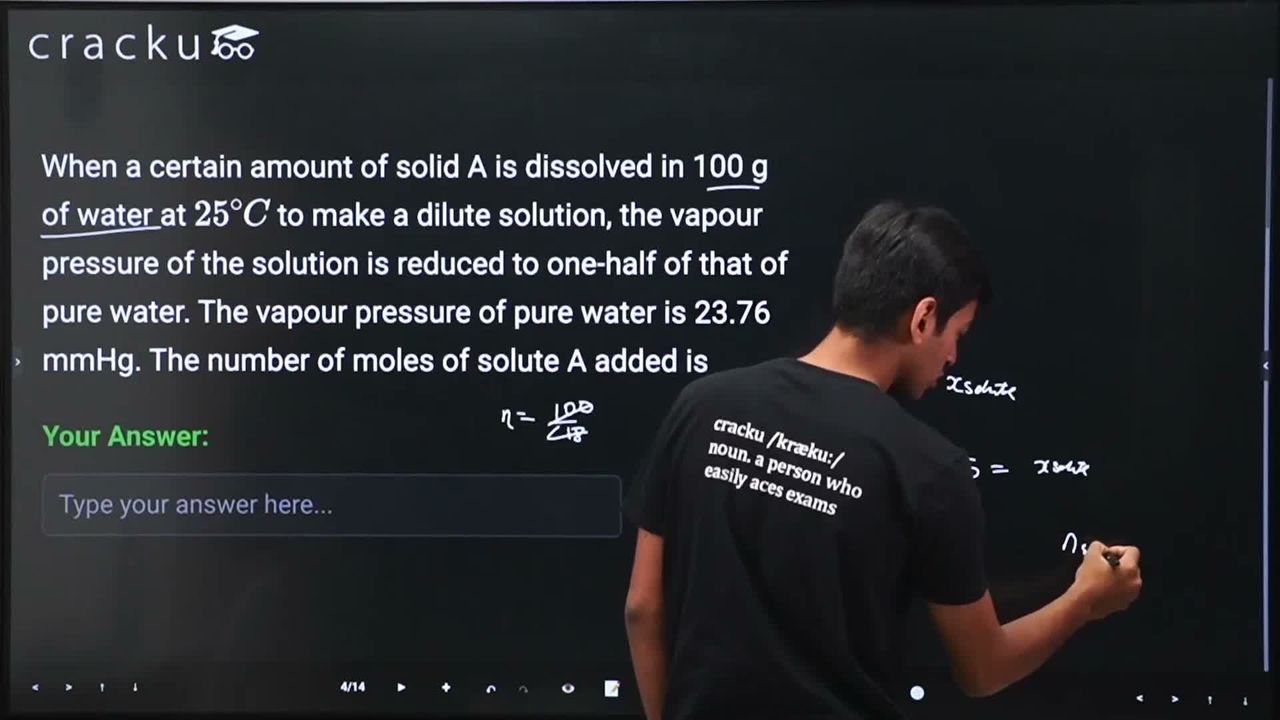
When a certain amount of solid A is dissolved in 100 g of water at $$25^\circ C$$ to make a dilute solution, the vapour pressure of the solution is reduced to one-half of that of pure water. The vapour pressure of pure water is 23.76 mmHg. The number of moles of solute A added is
Correct Answer: 5.55
We need to find the number of moles of solute A dissolved in 100 g of water such that the vapour pressure is reduced to half. Given that the mass of water (solvent) is 100 g, the vapour pressure of pure water is $$P^0 = 23.76$$ mmHg and the vapour pressure of the solution is $$P = \frac{P^0}{2} = 11.88$$ mmHg.
Using Raoult’s law, the mole fraction of the solute is given by $$\frac{P^0 - P}{P^0} = x_{\text{solute}}$$, so $$\frac{23.76 - 11.88}{23.76} = x_{\text{solute}}$$, which yields $$x_{\text{solute}} = \frac{11.88}{23.76} = 0.5$$.
The moles of water present are $$\frac{100}{18} = 5.55$$ mol. Since $$x_{\text{solute}} = \frac{n_{\text{solute}}}{n_{\text{solute}} + n_{\text{water}}}$$, we have $$0.5 = \frac{n_A}{n_A + 5.55}$$, which leads to $$0.5(n_A + 5.55) = n_A$$, then $$0.5 n_A + 2.775 = n_A$$, so $$0.5 n_A = 2.775$$ and thus $$n_A = 5.55 \text{ mol}$$.
Hence, the number of moles of solute A added is 5.55.
Was this solution helpful?
Click on the Email ☝️ to Watch the Video Solution
Create a FREE account and get:
_1.webp)

Educational materials for JEE preparation

Ask our AI anything

AI can make mistakes. Please verify important information.
AI can make mistakes. Please verify important information.
