For the following questions answer them individually
Two vectors $$\vec{X}$$ and $$\vec{Y}$$ have equal magnitude. The magnitude of $$\left(\vec{X} - \vec{Y}\right)$$ is $$n$$ times the magnitude of $$\left(\vec{X} + \vec{Y}\right)$$. The angle between $$\vec{X}$$ and $$\vec{Y}$$ is:
The force is given in terms of time $$t$$ and displacement $$x$$ by the equation $$F = A \cos Bx + C \sin Dt$$. The dimensional formula of $$\frac{AD}{B}$$ is:
The relation between time $$t$$ and distance $$x$$ for a moving body is given as $$t = mx^2 + nx$$, where $$m$$ and $$n$$ are constants. The retardation of the motion is: (When $$v$$ stands for velocity)
A balloon was moving upwards with a uniform velocity of 10 m s$$^{-1}$$. An object of finite mass is dropped from the balloon when it was at a height of 75 m from the ground level. The height of the balloon from the ground when object strikes the ground was around: (takes the value of g as 10 m s$$^{-2}$$)
The instantaneous velocity of a particle moving in a straight line is given as $$v = \alpha t + \beta t^2$$, where $$\alpha$$ and $$\beta$$ are constants. The distance travelled by the particle between 1 s and 2 s is:
A force $$\vec{F} = \left(40\hat{i} + 10\hat{j}\right)$$ N acts on a body of mass 5 kg. If the body starts from rest, its position vector $$\vec{r}$$ at time $$t = 10$$ s will be
Consider a planet in some solar system that has a mass double the mass of earth and density equal to the average density of the earth. If the weight of an object on earth is $$W$$, the weight of the same object on that planet will be:
A heat engine has an efficiency of $$\frac{1}{6}$$. When the temperature of sink is reduced by 62°C, its efficiency gets doubled. The temperature of the source is:
Two spherical soap bubbles of radii $$r_1$$ and $$r_2$$ in vacuum combine under isothermal conditions. The resulting bubble has a radius equal to:
In a simple harmonic oscillation, what fraction of total mechanical energy is in the form of kinetic energy, when the particle is midway between mean and extreme position.
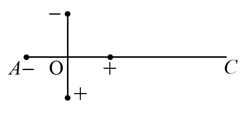
Two ideal electric dipoles $$A$$ and $$B$$, having their dipole moment $$p_1$$ and $$p_2$$ respectively are placed on a plane with their centres at $$O$$ as shown in the figure. At point $$C$$ on the axis of dipole $$A$$, the resultant electric field is making an angle of 37° with the axis. The ratio of the dipole moment of $$A$$ and $$B$$, $$\frac{p_1}{p_2}$$ is: (take sin 37° = $$\frac{3}{5}$$)
If $$q_f$$ is the free charge on the capacitor plates and $$q_b$$ is the bound charge on the dielectric slab of dielectric constant $$k$$ placed between the capacitor plates, then bound charge $$q_b$$ can be expressed as:
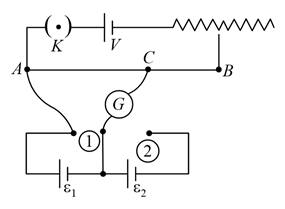
In the given potentiometer circuit arrangement, the balancing length AC is measured to be 250 cm. When the galvanometer connection is shifted from point (1) to point (2) in the given diagram, the balancing length becomes 400 cm. The ratio of the emf of two cells $$\frac{\varepsilon_1}{\varepsilon_2}$$ is:
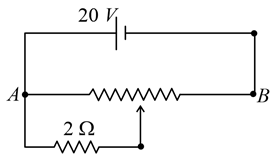
The given potentiometer has its wire of resistance 10 $$\Omega$$. When the sliding contact is in the middle of the potentiometer wire, the potential drop across 2 $$\Omega$$ resistor is:
Two ions having same mass have charges in the ratio 1 : 2. They are projected normally in a uniform magnetic field with their speeds in the ratio 2 : 3. The ratio of the radii of their circular trajectories is,
A 10 $$\Omega$$ resistance is connected across 220 V - 50 Hz AC supply. The time taken by the current to change from its maximum value to the rms value is:
A prism of refractive index $$\mu$$ and angle of prism $$A$$ is placed in the position of minimum angle of deviation. If minimum angle of deviation is also $$A$$, then in terms of refractive index,
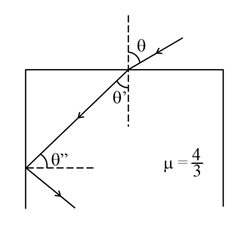
A ray of light entering from air into a denser medium of refractive index $$\frac{4}{3}$$, as shown in figure. The light ray suffers total internal reflection at the adjacent surface as shown. The maximum value of angle $$\theta$$ should be equal to:
An electron moving with speed $$v$$ and a photon moving with speed $$c$$, have the same D-Broglie wavelength. The ratio of the kinetic energy of the electron to that of a photon is:
When radiation of wavelength $$\lambda$$ is incident on a metallic surface, the stopping potential of ejected photoelectrons is 4.8 V. If the same surface is illuminated by radiation of double the previous wavelength, then the stopping potential becomes 1.6 V. The threshold wavelength of the metal is:
A force of $$F = (5y + 20)\hat{j}$$ N acts on a particle. The work done by this force when the particle is moved from $$y = 0$$ m to $$y = 10$$ m is _________ J.
A solid disc of radius 20 cm and mass 10 kg is rotating with an angular velocity of 600 rpm, about an axis normal to its circular plane and passing through its centre of mass. The retarding torque required to bring the disc at rest in 10 s is _________ $$\pi \times 10^{-1}$$ N m
A system consists of two types of gas molecules $$A$$ and $$B$$ having the same number density $$2 \times 10^{25}$$ m$$^{-3}$$. The diameter of $$A$$ and $$B$$ are 10A and 5A respectively. They suffer collisions at room temperature. The ratio of average distance covered by the molecule $$A$$ to that of $$B$$ between two successive collisions is _________ $$\times 10^{-2}$$
A 16 $$\Omega$$ wire is bent to form a square loop. A 9 V supply having an internal resistance of 1 $$\Omega$$ is connected across one of its sides. The potential drop across the diagonals of the square loop is _________ $$\times 10^{-1}$$ V.
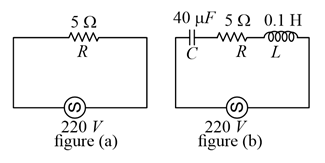
Two circuits are shown in figure (a) and (b). At a frequency of _________ rad s$$^{-1}$$ the average power dissipated in one cycle will be the same in both the circuits.
A light beam of wavelength 500 nm is incident on a metal having work function of 1.25 eV, placed in a magnetic field of intensity $$B$$. The electrons emitted perpendicular to the magnetic field $$B$$, with maximum kinetic energy are bent into a circular arc of radius 30 cm. The value of $$B$$ is _________ $$\times 10^{-7}$$ T.
Given $$hc = 20 \times 10^{-26}$$ J m, the mass of the electron = $$9 \times 10^{-31}$$ kg.
From the given data, the amount of energy required to break the nucleus of aluminium $$_{13}^{27}$$Al is _________ $$x \times 10^{-3}$$ J
Mass of neutron = 1.00866 u
Mass of proton = 1.00726 u
Mass of Aluminium nucleus = 27.18846 u
(Assume 1 u corresponds to $$x$$ J of energy)
(Round off to the nearest integer)
The nuclear activity of a radioactive element becomes $$\left(\frac{1}{8}\right)^{th}$$ of its initial value in 30 years. The half-life of radioactive element is _________ years.
In a semiconductor, the number density of intrinsic charge carriers at 27°C is $$1.5 \times 10^{16}$$ m$$^{-3}$$. If the semiconductor is doped with an impurity atom, the hole density increases to $$4.5 \times 10^{22}$$ m$$^{-3}$$. The electron density in the doped semiconductor is _________ $$\times 10^{9}$$ m$$^{-3}$$
A message signal of frequency 20 kHz and peak voltage of 20 V is used to modulate a carrier wave of frequency 1 MHz and peak voltage of 20 V. The modulation index will be: