
Join Our JEE Preparation Group
Prep with like-minded aspirants; Get access to free daily tests and study material.
Sign in
Please select an account to continue using cracku.in
↓ →
Join Our JEE Preparation Group
Prep with like-minded aspirants; Get access to free daily tests and study material.
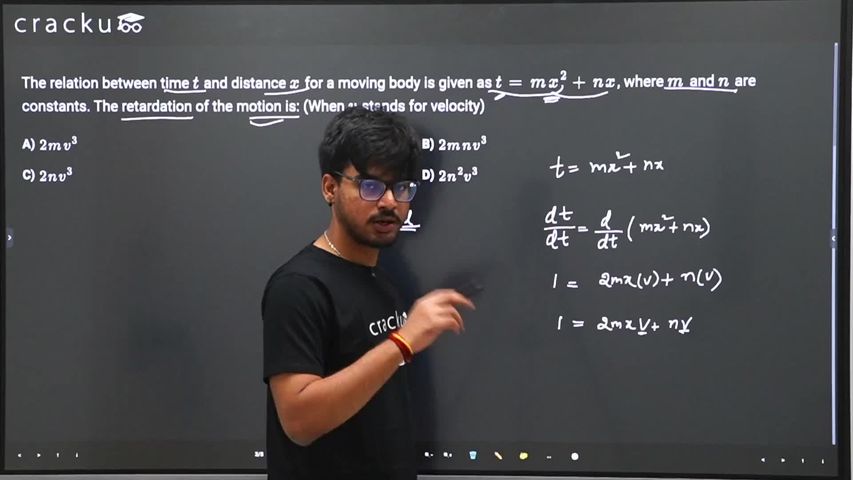
The relation between time $$t$$ and distance $$x$$ for a moving body is given as $$t = mx^2 + nx$$, where $$m$$ and $$n$$ are constants. The retardation of the motion is: (When $$v$$ stands for velocity)
The relation between time and distance is $$t = m x^2 + n x$$, with $$m$$ and $$n$$ constants.
Differentiate both sides with respect to $$x$$ to connect time and distance derivatives:
$$\frac{dt}{dx} = 2 m x + n \quad -(1)$$
Velocity is defined as $$v = \frac{dx}{dt}$$. From equation $$(1)$$,
$$v = \frac{1}{dt/dx} = \frac{1}{2 m x + n} \quad -(2)$$
Acceleration is $$a = \frac{dv}{dt}$$. Using the chain rule $$\frac{dv}{dt} = \frac{dv}{dx}\frac{dx}{dt} = v \frac{dv}{dx}$$.
First find $$\frac{dv}{dx}$$ from $$(2)$$:
$$v = (2 m x + n)^{-1}$$
$$\frac{dv}{dx} = -\,2 m \,(2 m x + n)^{-2} \quad -(3)$$
Substitute $$(2)$$ and $$(3)$$ into $$a = v \frac{dv}{dx}$$:
$$a = \frac{1}{2 m x + n}\;\bigl[-\,2 m \,(2 m x + n)^{-2}\bigr] = -\,\frac{2 m}{(2 m x + n)^3} \quad -(4)$$
The negative sign shows the body is slowing down, so the magnitude of retardation is
$$|a| = \frac{2 m}{(2 m x + n)^3} \quad -(5)$$
From $$(2)$$, $$2 m x + n = \frac{1}{v}$$. Substitute this into $$(5)$$:
$$|a| = 2 m \left(\frac{1}{v}\right)^{\!3} = 2 m v^3 \quad -(6)$$
Hence the retardation is $$2 m v^3$$.
Option A is correct.
Was this solution helpful?
Click on the Email ☝️ to Watch the Video Solution
Create a FREE account and get:
_1.webp)

Educational materials for JEE preparation

Ask our AI anything

AI can make mistakes. Please verify important information.
AI can make mistakes. Please verify important information.
