
Join Our JEE Preparation Group
Prep with like-minded aspirants; Get access to free daily tests and study material.
Sign in
Please select an account to continue using cracku.in
↓ →
Join Our JEE Preparation Group
Prep with like-minded aspirants; Get access to free daily tests and study material.
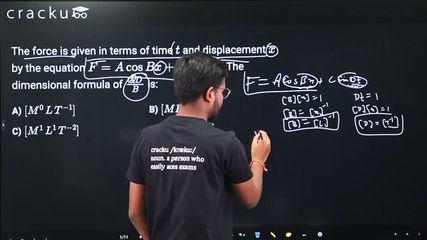
The force is given in terms of time $$t$$ and displacement $$x$$ by the equation $$F = A \cos Bx + C \sin Dt$$. The dimensional formula of $$\frac{AD}{B}$$ is:
The given force is $$F = A \cos (B x) + C \sin (D t)$$.
Dimensions of force are $$[F] = [M \, L \, T^{-2}]$$.
Inside trigonometric functions the arguments are pure numbers (dimensionless). For the first term, $$B x$$ is dimensionless, therefore
$$[B] \,[x] = 1 \;\Longrightarrow\; [B] = [x]^{-1} = L^{-1}$$.
For the second term, $$D t$$ is dimensionless, therefore
$$[D] \,[t] = 1 \;\Longrightarrow\; [D] = [t]^{-1} = T^{-1}$$.
The quantities $$A$$ and $$C$$ multiply the trigonometric functions, so their dimensions must match the dimension of force: $$[A] = [C] = [F] = M \, L \, T^{-2}$$.
We need the dimensional formula of $$\dfrac{A D}{B}$$.
Write each factor with its dimensions:
$$[A] = M \, L \, T^{-2}, \quad [D] = T^{-1}, \quad [B] = L^{-1}$$.
Multiply and divide step by step:
$$[A]\, [D] = (M \, L \, T^{-2})(T^{-1}) = M \, L \, T^{-3}$$ $$-(1)$$
Now divide by $$[B]$$:
$$\dfrac{M \, L \, T^{-3}}{L^{-1}} = M \, L \, T^{-3} \times L^{1} = M \, L^{2} \, T^{-3}$$ $$-(2)$$.
Therefore, the dimensional formula of $$\dfrac{A D}{B}$$ is $$[M \, L^{2} \, T^{-3}]$$.
Option B is correct.
Was this solution helpful?
Click on the Email ☝️ to Watch the Video Solution
Create a FREE account and get:
_1.webp)

Educational materials for JEE preparation

Ask our AI anything

AI can make mistakes. Please verify important information.
AI can make mistakes. Please verify important information.
