
Join Our JEE Preparation Group
Prep with like-minded aspirants; Get access to free daily tests and study material.
Sign in
Please select an account to continue using cracku.in
↓ →
Join Our JEE Preparation Group
Prep with like-minded aspirants; Get access to free daily tests and study material.
Two vectors $$\vec{X}$$ and $$\vec{Y}$$ have equal magnitude. The magnitude of $$\left(\vec{X} - \vec{Y}\right)$$ is $$n$$ times the magnitude of $$\left(\vec{X} + \vec{Y}\right)$$. The angle between $$\vec{X}$$ and $$\vec{Y}$$ is:
Let the common magnitude of vectors $$\vec X$$ and $$\vec Y$$ be $$a$$, so $$|\vec X| = |\vec Y| = a$$.
Let the angle between the two vectors be $$\theta$$.
Given condition: $$|\vec X - \vec Y| = n\,|\vec X + \vec Y|$$.
Squaring both sides,
$$|\vec X - \vec Y|^{2} = n^{2}\,|\vec X + \vec Y|^{2}$$ $$(1)$$
Now expand each magnitude squared with the dot-product formula $$|\vec A \pm \vec B|^{2} = |\vec A|^{2} + |\vec B|^{2} \pm 2\vec A\!\cdot\!\vec B$$.
For the difference:
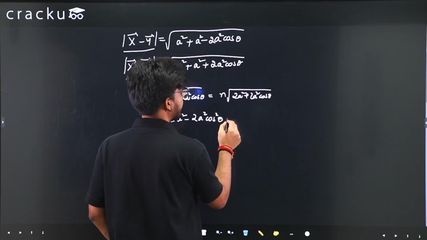
$$|\vec X - \vec Y|^{2} = a^{2} + a^{2} - 2a^{2}\cos\theta = 2a^{2}(1 - \cos\theta)$$ $$(2)$$
For the sum:
$$|\vec X + \vec Y|^{2} = a^{2} + a^{2} + 2a^{2}\cos\theta = 2a^{2}(1 + \cos\theta)$$ $$(3)$$
Substitute $$(2)$$ and $$(3)$$ into $$(1)$$:
$$2a^{2}(1 - \cos\theta) = n^{2}\,[\,2a^{2}(1 + \cos\theta)\,]$$
Cancel the common factor $$2a^{2}$$:
$$1 - \cos\theta = n^{2}(1 + \cos\theta)$$ $$(4)$$
Rearrange $$(4)$$ to isolate $$\cos\theta$$:
$$1 - \cos\theta = n^{2} + n^{2}\cos\theta$$
Bring the $$\cos\theta$$ terms to one side and the constants to the other:
$$1 - n^{2} = \cos\theta\,(n^{2} + 1)$$
Therefore,
$$\cos\theta = \frac{1 - n^{2}}{n^{2} + 1} = -\frac{n^{2} - 1}{n^{2} + 1}$$ $$(5)$$
Hence the angle is
$$\theta = \cos^{-1}\!\left(-\frac{n^{2} - 1}{\,n^{2} + 1}\right)$$
Comparing with the given options, this matches Option B.
Answer: Option B
Was this solution helpful?
Click on the Email ☝️ to Watch the Video Solution
Create a FREE account and get:
_1.webp)

Educational materials for JEE preparation

Ask our AI anything

AI can make mistakes. Please verify important information.
AI can make mistakes. Please verify important information.
