
Join Our JEE Preparation Group
Prep with like-minded aspirants; Get access to free daily tests and study material.
Sign in
Please select an account to continue using cracku.in
↓ →
Join Our JEE Preparation Group
Prep with like-minded aspirants; Get access to free daily tests and study material.
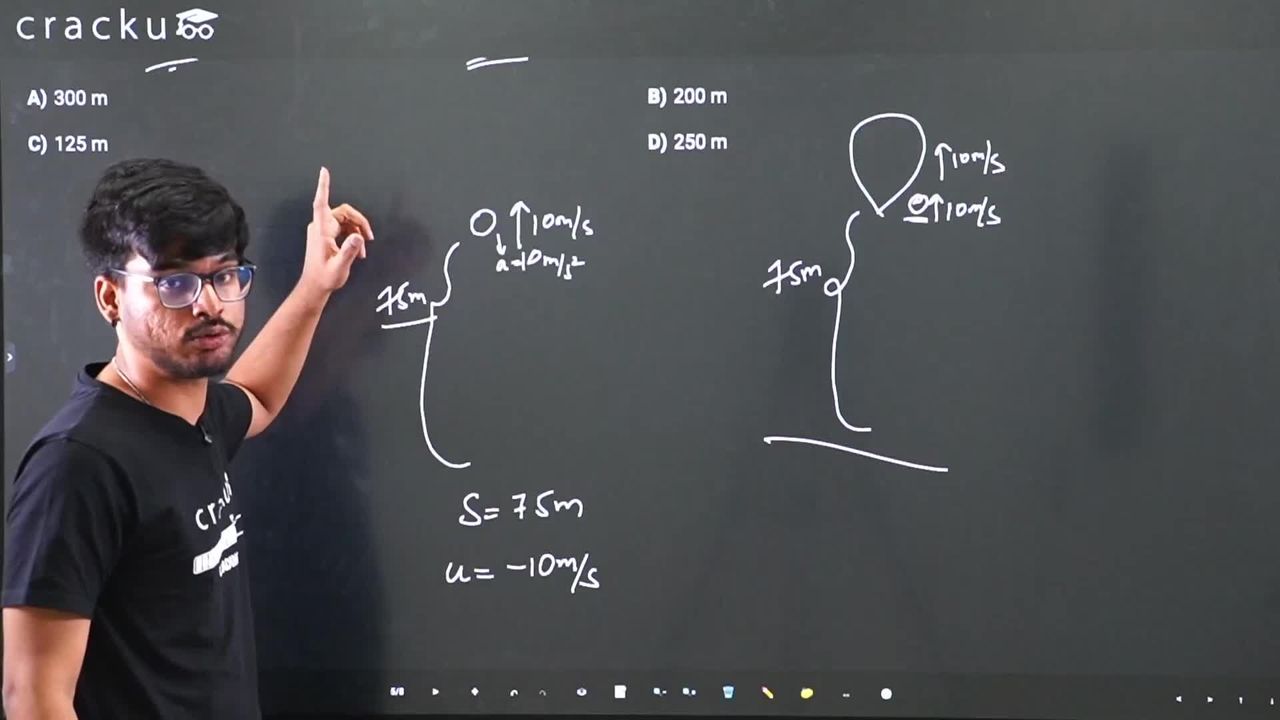
A balloon was moving upwards with a uniform velocity of 10 m s$$^{-1}$$. An object of finite mass is dropped from the balloon when it was at a height of 75 m from the ground level. The height of the balloon from the ground when object strikes the ground was around: (takes the value of g as 10 m s$$^{-2}$$)
Let upward direction be positive and let the ground be the reference level $$y = 0$$.
The balloon is rising with a constant velocity $$u_b = 10\ \text{m s}^{-1}$$. At the instant it is $$75\ \text{m}$$ above the ground, an object is released from it. Because the object was part of the balloon just before release, its initial velocity relative to the ground is the same as that of the balloon:
$$u = 10\ \text{m s}^{-1}\ (\text{upward})$$
The object then moves under gravity alone.
For vertical motion with constant acceleration we use the kinematic equation
$$y = y_0 + u t + \tfrac12 a t^2$$ $$-(1)$$
where
• $$y_0$$ = initial height, here $$75\ \text{m}$$
• $$y$$ = height after time $$t$$
• $$u$$ = initial velocity, here $$10\ \text{m s}^{-1}$$ (upward)
• $$a$$ = acceleration. Since gravity acts downward, $$a = -g = -10\ \text{m s}^{-2}$$.
The object strikes the ground when $$y = 0$$. Substituting into (1):
$$0 = 75 + 10t - \tfrac12(10)t^2$$
$$0 = 75 + 10t - 5t^2$$
Re-arranging: $$5t^2 - 10t - 75 = 0$$
Dividing by 5: $$t^2 - 2t - 15 = 0$$
Solving this quadratic:
$$t = \frac{2 \pm \sqrt{(-2)^2 - 4(1)(-15)}}{2} = \frac{2 \pm \sqrt{4 + 60}}{2} = \frac{2 \pm 8}{2}$$
The physically meaningful (positive) root is $$t = 5\ \text{s}$$.
Thus, the object reaches the ground after $$5\ \text{s}$$.
During this interval the balloon continues to rise with its constant speed of $$10\ \text{m s}^{-1}$$. Extra height gained by the balloon:
$$h_{\text{extra}} = u_b \, t = 10 \times 5 = 50\ \text{m}$$
Initial height of the balloon = $$75\ \text{m}$$. Therefore, height of the balloon when the object hits the ground:
$$H = 75 + 50 = 125\ \text{m}$$
Hence, the balloon is approximately $$125\ \text{m}$$ above the ground when the object strikes the ground.
The correct option is Option C.
Was this solution helpful?
Click on the Email ☝️ to Watch the Video Solution
Create a FREE account and get:
_1.webp)

Educational materials for JEE preparation

Ask our AI anything

AI can make mistakes. Please verify important information.
AI can make mistakes. Please verify important information.
