
Join Our JEE Preparation Group
Prep with like-minded aspirants; Get access to free daily tests and study material.
Sign in
Please select an account to continue using cracku.in
↓ →
Join Our JEE Preparation Group
Prep with like-minded aspirants; Get access to free daily tests and study material.
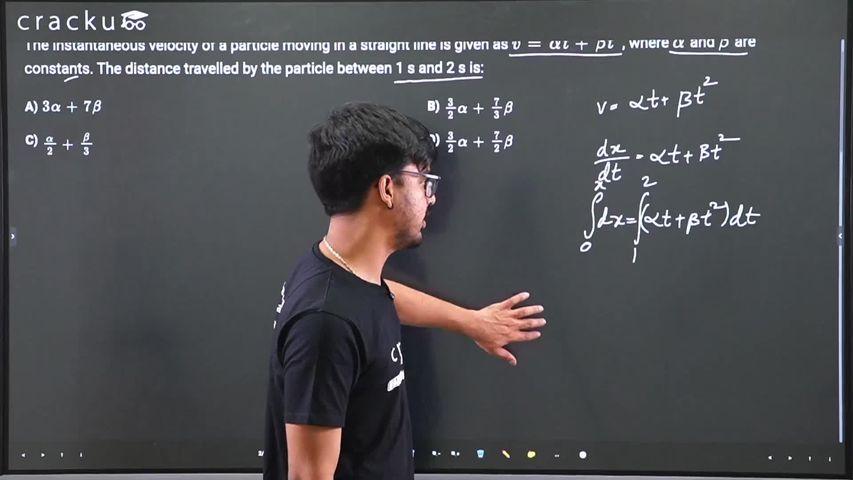
The instantaneous velocity of a particle moving in a straight line is given as $$v = \alpha t + \beta t^2$$, where $$\alpha$$ and $$\beta$$ are constants. The distance travelled by the particle between 1 s and 2 s is:
We are told that the instantaneous velocity of the particle is given by the time-dependent expression $$v = \alpha t + \beta t^{2}$$, where $$\alpha$$ and $$\beta$$ are constants.
To find the distance (strictly, the displacement along the straight line) travelled by the particle between the times $$t = 1\ \text{s}$$ and $$t = 2\ \text{s}$$, we recall the fundamental relation between velocity and displacement:
$$\displaystyle s = \int v\;dt.$$
This formula states that the displacement $$s$$ over a time interval is obtained by integrating the velocity with respect to time over that interval.
Substituting the given expression for $$v$$, we write the definite integral from $$t = 1$$ to $$t = 2$$:
$$\displaystyle s_{1\ \text{to}\ 2} = \int_{1}^{2} (\alpha t + \beta t^{2})\,dt.$$
Now we integrate term by term. First, we integrate $$\alpha t$$ with respect to $$t$$, and second, we integrate $$\beta t^{2}$$ with respect to $$t$$:
For the first term we use the power rule $$\int t\,dt = \frac{t^{2}}{2}$$:
$$\int \alpha t\,dt = \alpha \int t\,dt = \alpha\left(\frac{t^{2}}{2}\right) = \frac{\alpha t^{2}}{2}.$$
For the second term we again use the power rule $$\int t^{n}\,dt = \frac{t^{n+1}}{n+1}$$ (here $$n = 2$$):
$$\int \beta t^{2}\,dt = \beta \int t^{2}\,dt = \beta\left(\frac{t^{3}}{3}\right) = \frac{\beta t^{3}}{3}.$$
Combining both antiderivatives, the displacement function $$s(t)$$ (measured from any convenient reference) is
$$s(t) = \frac{\alpha t^{2}}{2} \;+\; \frac{\beta t^{3}}{3} + C,$$
where $$C$$ is an additive constant. However, since we are interested only in the difference $$s(2) - s(1)$$, this constant cancels out automatically and we do not need its explicit value.
We therefore evaluate $$s(t)$$ at the upper limit $$t = 2$$:
$$s(2) = \frac{\alpha (2)^{2}}{2} + \frac{\beta (2)^{3}}{3} = \frac{\alpha \cdot 4}{2} + \frac{\beta \cdot 8}{3} = 2\alpha + \frac{8\beta}{3}.$$
Next, we evaluate $$s(t)$$ at the lower limit $$t = 1$$:
$$s(1) = \frac{\alpha (1)^{2}}{2} + \frac{\beta (1)^{3}}{3} = \frac{\alpha}{2} + \frac{\beta}{3}.$$
The displacement (which, in this one-dimensional motion, equals the distance travelled) between 1 s and 2 s is the difference of these two values:
$$\begin{aligned} s_{1\ \text{to}\ 2} &= s(2) - s(1) \\ &= \left(2\alpha + \frac{8\beta}{3}\right) \;-\; \left(\frac{\alpha}{2} + \frac{\beta}{3}\right). \end{aligned}$$
We now subtract term by term, matching coefficients of $$\alpha$$ and $$\beta$$ separately.
For the $$\alpha$$ part:
$$2\alpha - \frac{\alpha}{2} = \frac{4\alpha}{2} - \frac{\alpha}{2} = \frac{3\alpha}{2}.$$
For the $$\beta$$ part:
$$\frac{8\beta}{3} - \frac{\beta}{3} = \frac{7\beta}{3}.$$
Putting both simplified results together, we obtain
$$s_{1\ \text{to}\ 2} = \frac{3\alpha}{2} + \frac{7\beta}{3}.$$
This matches option B in the list provided.
Hence, the correct answer is Option B.
Was this solution helpful?
Click on the Email ☝️ to Watch the Video Solution
Create a FREE account and get:
_1.webp)

Educational materials for JEE preparation

Ask our AI anything

AI can make mistakes. Please verify important information.
AI can make mistakes. Please verify important information.
