For the following questions answer them individually
Let L, R, C and V represent inductance, resistance, capacitance and voltage, respectively. The dimension of $$\frac{L}{RCV}$$ in SI units will be:
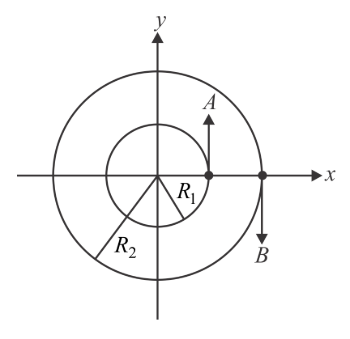
Two particles A, B are moving on two concentric circles of radii $$R_1$$ and $$R_2$$ with equal angular speed $$\omega$$. At $$t = 0$$, their positions and direction of motion are shown in the figure. The relative velocity $$\vec{V_A} - \vec{V_B}$$ at $$t = \frac{\pi}{2\omega}$$ is given by:
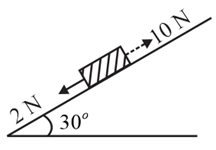
A block kept on a rough inclined plane, as shown in the figure, remains at rest upto a maximum force 2N down the inclined plane. The maximum external force up the inclined plane that does not move the block is 10N. The coefficient of static friction between the block and the plane is: [Take $$g = 10$$ m/s$$^2$$]
A vertical closed cylinder is separated into two parts by a frictionless piston of mass m and of negligible thickness. The piston is free to move along the length of the cylinder. The length of the cylinder above piston is $$l_1$$, and that below the piston is $$l_2$$, such that $$l_1 > l_2$$. Each part of the cylinder contains n moles of an ideal gas at equal temperature T. If the piston is stationary, its mass m will be given by: (R is universal gas constant and g is the acceleration due to gravity)
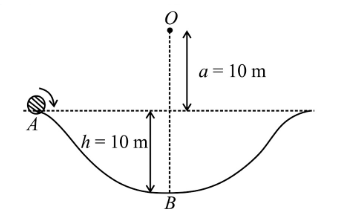
A particle of mass 20 g is released with an initial velocity 5 m s$$^{-1}$$ along the curve from the point A, as shown in the figure. The point A is at height h from point B. The particle slides along the frictionless surface. When the particle reaches point B, its angular momentum about O will be: (Take $$g = 10$$ m s$$^{-2}$$)
An alpha-particle of mass m suffers 1-dimensional elastic collision with a nucleus at rest of unknown mass. It is scattered directly backwards losing 64% of its initial kinetic energy. The mass of the nucleus is
A long cylindrical vessel is half filled with a liquid. When the vessel is rotated about its own vertical axis, the liquid rises up near the wall. If the radius of vessel is 5 cm and its rotational speed is 2 rotations per second, then the difference in the heights between the center and the sides, in cm, will be:
The moment of inertia of a solid sphere, about an axis parallel to its diameter and at a distance of x from it, is $$I(x)$$. Which one of the graphs represents the variation of $$I(x)$$ with x correctly?
Two satellites, A and B, have masses m and 2m respectively. A is in a circular orbit of radius R and B is in a circular orbit of radius 2R around the earth. The ratio of their kinetic energies, $$\frac{K_A}{K_B}$$ is:
A soap bubble, blown by a mechanical pump at the mouth of a tube increases in volume with time at a constant rate. The graph that correctly depicts the time dependence of pressure inside the bubble is given by:
An ideal gas is enclosed in a cylinder at pressure of 2 atm and temperature, 300 K. The mean time between two successive collisions is $$6 \times 10^{-8}$$ s. If the pressure is doubled and temperature is increased to 500 K, the mean time between two successive collisions will be close to:
A simple harmonic motion is represented by: $$y = 5(\sin 3\pi t + \sqrt{3} \cos 3\pi t)$$ cm. The amplitude and time period of the motion are:
A resonance tube is old and has a jagged end. It is still used in the laboratory to determine the velocity of sound in air. A tuning fork of frequency 512 Hz produces first resonance when the tube is filled with water to a mark 11 cm below a reference mark, near the open end of the tube. The experiment is repeated with another fork of frequency 256 Hz which produces first resonance when water reaches a mark 27 cm below the reference mark. The velocity of sound in air, obtained in the experiment, is close to
A parallel plate capacitor with plates of area 1 m$$^2$$ each, are at a separation of 0.1 m. If the electric field between the plates is 100 N/C, the magnitude of charge on each plate is: (Take $$\epsilon_0 = 8.85 \times 10^{-12} \frac{C^2}{N \cdot m^2}$$)
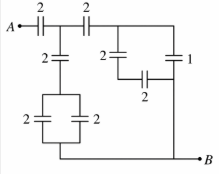
In the circuit shown, find C if the effective capacitance of the whole circuit is to be 0.5 $$\mu F$$. All values in the circuit are in $$\mu F$$.
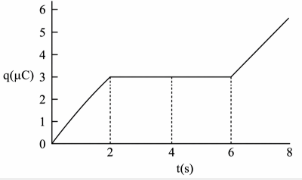
The charge on a capacitor plate in a circuit, as a function of time, is shown in the figure. What is the value of current at $$t = 4$$ s?
A galvanometer, whose resistance is 50 ohm, has 25 divisions in it. When a current of $$4 \times 10^{-4}$$ A passes through it, its needle (pointer) deflects by one division. To use this galvanometer as a voltmeter of range 2.5 V it should be connected to a resistance of:
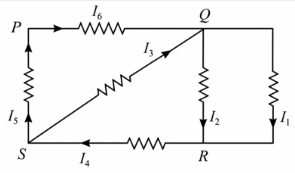
In the given circuit diagram, the currents, $$I_1 = -0.3$$ A, $$I_4 = 0.8$$ A and $$I_5 = 0.4$$ A, are flowing as shown. The currents $$I_2$$, $$I_3$$ and $$I_6$$, respectively, are:
A paramagnetic material has $$10^{28}$$ atoms m$$^{-3}$$. Its magnetic susceptibility at temperature 350 K is $$2.8Â \widetilde{A} \times 10^{-4}$$. Its susceptibility at 300 K is
A 10 m long horizontal wire extends from North East to South West. It is falling with a speed of 5.0 m s$$^{-1}$$, at right angles to the horizontal component of the earth's magnetic field of $$0.3 \times 10^{-4}$$ Wb m$$^{-2}$$. The value of the induced emf in the wire is:

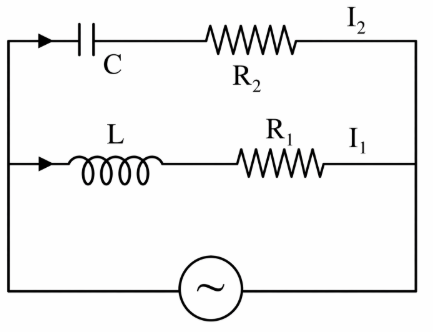
In the above circuit, $$C = \frac{\sqrt{3}}{2}\mu F$$, $$R_2 = 20 \Omega$$, $$L = \frac{\sqrt{3}}{10} H$$ and $$R_1 = 10 \Omega$$. Current in $$L$$-$$R_1$$ path is $$I_1$$ and in C-$$R_2$$ path it is $$I_2$$. The voltage of AC source is given by, $$V = 200\sqrt{2} \sin(100t)$$ volts. The phase difference between $$I_1$$ and $$I_2$$ is:
The mean intensity of radiation on the surface of the Sun is about $$10^8 W/m^2$$. The rms value of the corresponding magnetic field is closest to:
A plano-convex lens (focal length $$f_2$$, refractive index $$\mu_2$$, radius of curvature R) fits exactly into a plano-concave lens (focal length $$f_1$$, refractive index $$\mu_1$$, radius of curvature R). Their plane surfaces are parallel to each other. Then, the focal length of the combination will be:
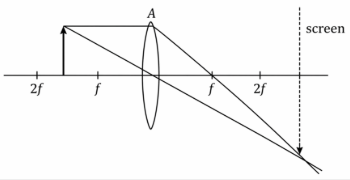
Formation of real image using a biconvex lens is shown below.

If the whole set up is immersed in water without disturbing the object and the screen positions, what will one observe on the screen?
When a certain photosensitive surface is illuminated with monochromatic light of frequency $$\nu$$, the stopping potential of the photo current is $$-\frac{V_0}{2}$$. When the surface is illuminated by monochromatic light of frequency $$\frac{\nu}{2}$$, the stopping potential is $$-V_0$$. The threshold frequency for photoelectric emission is
In a Frank-Hertz experiment, an electron of energy 5.6 eV passes through mercury vapour and emerges with an energy 0.7 eV. The minimum wavelength of photons emitted by mercury atoms is close to:
In a radioactive decay chain, the initial nucleus is $$^{232}_{90}Th$$. At the end, there are 6 $$\alpha$$-particles and 4$$\beta$$-particles which are emitted. If the end nucleus is $$^A_Z X$$, A and Z are given by:
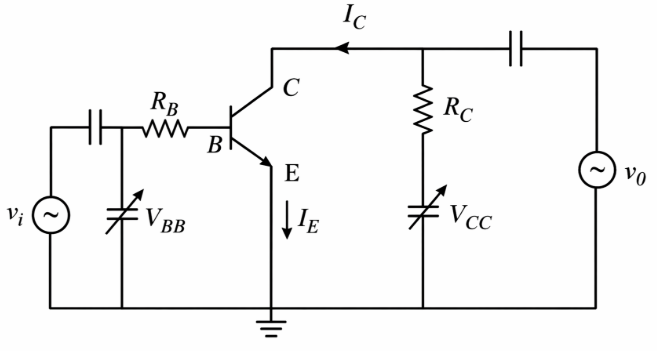
In the figure, given that $$V_{BB}$$ supply can vary from 0 to 5.0 V, $$V_{CC} = 5$$ V, $$\beta_{dc} = 200$$, $$R_B = 100$$ k$$\Omega$$, $$R_C = 1$$ k$$\Omega$$ and $$V_{BE} = 1.0$$ V. The minimum base current and the input voltage at which the transistor will go to saturation, will be, respectively:
To double the covering range of a TV transmitting tower, its height should be multiplied by:
A load of mass M kg is suspended from a steel wire of length 2m and radius 1.0 mm in Searle's apparatus experiment. The increase in length produced in the wire is 4.0 mm. Now the load is fully immersed in a liquid of relative density 2. The relative density of the material of load is 8. The new value of increase in length of the steel wire is: