
Join Our JEE Preparation Group
Prep with like-minded aspirants; Get access to free daily tests and study material.
Sign in
Please select an account to continue using cracku.in
↓ →
Join Our JEE Preparation Group
Prep with like-minded aspirants; Get access to free daily tests and study material.
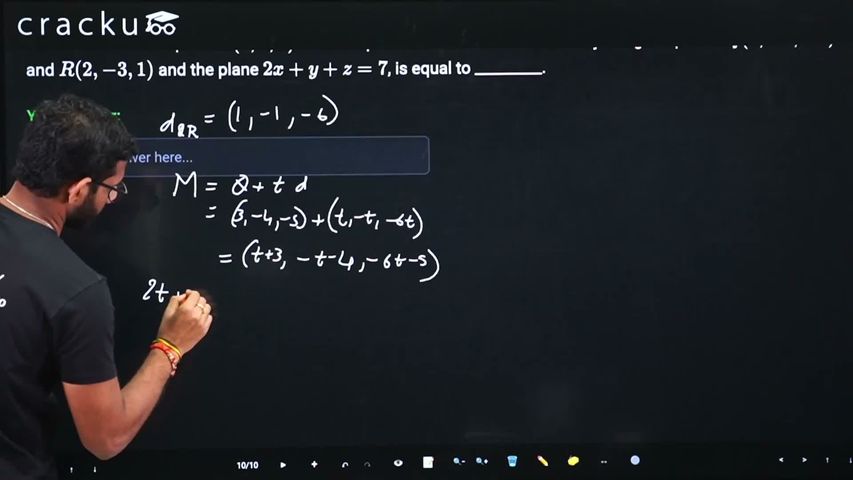
The distance of the point $$P(3, 4, 4)$$ from the point of intersection of the line joining the points $$Q(3, -4, -5)$$ and $$R(2, -3, 1)$$ and the plane $$2x + y + z = 7$$, is equal to _________.
Correct Answer: 7
We are given the three-dimensional points $$Q(3,-4,-5)$$ and $$R(2,-3,1)$$. The straight line that passes through these two points can be written in the symmetric or parametric form. We first find its direction vector.
The direction vector $$\vec d$$ is obtained by subtracting the coordinates of $$Q$$ from those of $$R$$: $$\vec d = R - Q = (\,2-3,\;-3-(-4),\;1-(-5)\,) = (-1,\;1,\;6).$$
Using this direction vector and taking $$Q(3,-4,-5)$$ as the initial point, the parametric equation of the line is $$\bigl(x,\;y,\;z\bigr) \;=\; (3,-4,-5)\;+\;t\,(-1,1,6),$$ where $$t$$ is a real parameter. Writing each coordinate separately, we get $$x = 3 - t,\quad y = -4 + t,\quad z = -5 + 6t.$$
The required point of intersection of this line with the plane $$2x + y + z = 7$$ will satisfy both the parametric equations above and the plane equation. So we substitute $$x, y, z$$ from the line into the plane.
Substituting, we have $$2(3 - t) + (-4 + t) + (-5 + 6t) = 7.$$
Now we expand and collect like terms step by step: $$2(3 - t) = 6 - 2t,$$ so the left‐hand side becomes $$(6 - 2t)\;+\;(-4 + t)\;+\;(-5 + 6t).$$
Combining the constant terms: $$6 \;-\;4 \;-\;5 \;=\;-3,$$ and combining the coefficients of $$t$$: $$-2t \;+\; t \;+\; 6t \;=\; 5t.$$
Thus the plane equation reduces to $$-3 + 5t = 7.$$
Solving for $$t$$, we add $$3$$ to both sides: $$5t = 10,$$ and divide by $$5$$: $$t = 2.$$
We substitute $$t = 2$$ back into the parametric equations of the line to get the actual point of intersection, say $$S(x_S, y_S, z_S)$$:
$$x_S = 3 - t = 3 - 2 = 1,$$ $$y_S = -4 + t = -4 + 2 = -2,$$ $$z_S = -5 + 6t = -5 + 6\!\times\!2 = -5 + 12 = 7.$$
So the intersection point is $$S(1,\,-2,\;7).$$
We now need the distance between the given point $$P(3,4,4)$$ and the point $$S(1,-2,7)$$. The distance formula in three dimensions is $$\text{Distance} = \sqrt{(x_2 - x_1)^2 + (y_2 - y_1)^2 + (z_2 - z_1)^2}.$$
Substituting the coordinates of $$P(3,4,4)$$ and $$S(1,-2,7)$$:
$$ \begin{aligned} \text{Distance} &= \sqrt{(3 - 1)^2 + (4 - (-2))^2 + (4 - 7)^2} \\ &= \sqrt{(2)^2 + (6)^2 + (-3)^2} \\ &= \sqrt{4 + 36 + 9} \\ &= \sqrt{49} \\ &= 7. \end{aligned} $$
So, the answer is $$7$$.
Was this solution helpful?
Click on the Email ☝️ to Watch the Video Solution
Create a FREE account and get:
_1.webp)

Educational materials for JEE preparation

Ask our AI anything

AI can make mistakes. Please verify important information.
AI can make mistakes. Please verify important information.
