
Join Our JEE Preparation Group
Prep with like-minded aspirants; Get access to free daily tests and study material.
Sign in
Please select an account to continue using cracku.in
↓ →
Join Our JEE Preparation Group
Prep with like-minded aspirants; Get access to free daily tests and study material.
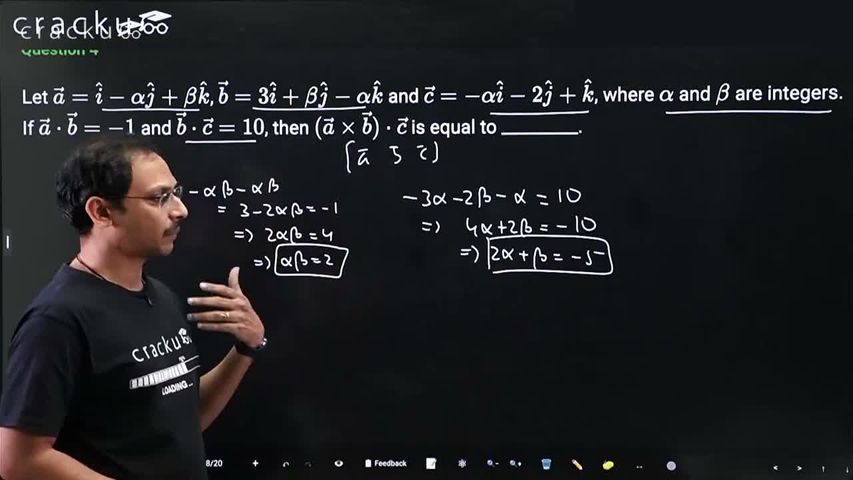
Let $$\vec{a} = \hat{i} - \alpha\hat{j} + \beta\hat{k}$$, $$\vec{b} = 3\hat{i} + \beta\hat{j} - \alpha\hat{k}$$ and $$\vec{c} = -\alpha\hat{i} - 2\hat{j} + \hat{k}$$, where $$\alpha$$ and $$\beta$$ are integers. If $$\vec{a} \cdot \vec{b} = -1$$ and $$\vec{b} \cdot \vec{c} = 10$$, then $$(\vec{a} \times \vec{b}) \cdot \vec{c}$$ is equal to _________.
Correct Answer: 9
We have the three vectors
$$\vec a = \hat i - \alpha\,\hat j + \beta\,\hat k,\qquad \vec b = 3\hat i + \beta\,\hat j - \alpha\,\hat k,\qquad \vec c = -\alpha\,\hat i - 2\hat j + \hat k.$$
The first condition is given as $$\vec a\cdot\vec b = -1.$$
Using the dot-product formula $$\vec p\cdot\vec q = p_xq_x + p_yq_y + p_zq_z,$$ we write
$$\vec a\cdot\vec b = \bigl(1\bigr)(3) + \bigl(-\alpha\bigr)(\beta) + \bigl(\beta\bigr)(-\alpha) = 3 - \alpha\beta - \alpha\beta = 3 - 2\alpha\beta.$$
Equating this to $$-1$$ gives
$$3 - 2\alpha\beta = -1 \;\Longrightarrow\; 2\alpha\beta = 4 \;\Longrightarrow\; \alpha\beta = 2. \quad -(1)$$
The second condition is $$\vec b\cdot\vec c = 10.$$
Again applying the dot-product formula,
$$\vec b\cdot\vec c = (3)(-\alpha) + (\beta)(-2) + (-\alpha)(1) = -3\alpha - 2\beta - \alpha = -4\alpha - 2\beta.$$
Setting this equal to 10 we obtain
$$-4\alpha - 2\beta = 10 \;\Longrightarrow\; 2\alpha + \beta = -5. \quad -(2)$$
We now have to solve the simultaneous integer equations (1) and (2):
$$\alpha\beta = 2$$, $$\qquad 2\alpha + \beta = -5.$$
Because the product $$\alpha\beta=2$$, the integer possibilities for $$(\alpha,\beta)$$ are $$(1,2),(2,1),(-1,-2),(-2,-1).$$
Substituting each pair into $$2\alpha+\beta$$:
For $$(1,2):\;2(1)+2 = 4\neq -5,$$
For $$(2,1):\;2(2)+1 = 5\neq -5,$$
For $$(-1,-2):\;2(-1)+(-2) = -4\neq -5,$$
For $$(-2,-1):\;2(-2)+(-1) = -5.$$
Only $$\alpha=-2,\;\beta=-1$$ satisfies both equations, so these are the required values.
Next we must find $$(\vec a\times\vec b)\cdot\vec c.$$ The scalar triple product formula is
$$ (\vec a\times\vec b)\cdot\vec c = \begin{vmatrix} a_x & a_y & a_z\\ b_x & b_y & b_z\\ c_x & c_y & c_z \end{vmatrix},$$
that is, the determinant whose rows are the components of $$\vec a,\vec b,\vec c.$$
With $$\alpha=-2,\;\beta=-1$$ the components become
$$\vec a = \langle 1$$, $$\; -\alpha$$, $$\; \beta\rangle = \langle 1$$, $$\;2$$, $$\;-1\rangle$$
$$\vec b = \langle 3$$, $$\; \beta$$, $$\; -\alpha\rangle = \langle 3$$, $$\;-1$$, $$\;2\rangle$$
$$\vec c = \langle -\alpha$$, $$\; -2$$, $$\; 1\rangle = \langle 2$$, $$\;-2$$, $$\;1\rangle.$$
Thus
$$ (\vec a\times\vec b)\cdot\vec c = \begin{vmatrix} 1 & 2 & -1\\ 3 & -1 & 2\\ 2 & -2 & 1 \end{vmatrix}. $$
Expanding along the first row:
$$\begin{aligned} &= 1\;\begin{vmatrix}-1 & 2\\ -2 & 1\end{vmatrix} \;-\;2\;\begin{vmatrix}3 & 2\\ 2 & 1\end{vmatrix} \;+\;(-1)\;\begin{vmatrix}3 & -1\\ 2 & -2\end{vmatrix}\\[4pt] &= 1\,[(-1)(1) - (2)(-2)] \;-\;2\,[3(1) - 2(2)] \;-\;1\,[3(-2) - (-1)(2)]\\[4pt] &= 1\,[-1 + 4] \;-\;2\,[3 - 4] \;-\;1\,[-6 + 2]\\[4pt] &= 1\,(3) \;-\;2\,(-1) \;-\;1\,(-4)\\[4pt] &= 3 + 2 + 4\\[4pt] &= 9. \end{aligned}$$
Therefore, $$(\vec a \times \vec b)\cdot \vec c = 9.$$
So, the answer is $$9$$.
Was this solution helpful?
Click on the Email ☝️ to Watch the Video Solution
Create a FREE account and get:
_1.webp)

Educational materials for JEE preparation

Ask our AI anything

AI can make mistakes. Please verify important information.
AI can make mistakes. Please verify important information.
