
Join Our JEE Preparation Group
Prep with like-minded aspirants; Get access to free daily tests and study material.
Sign in
Please select an account to continue using cracku.in
↓ →
Join Our JEE Preparation Group
Prep with like-minded aspirants; Get access to free daily tests and study material.
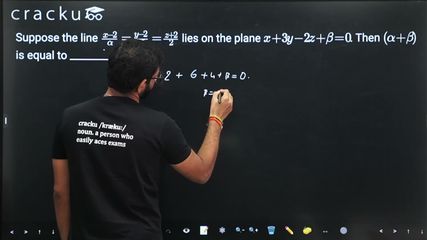
Suppose the line $$\frac{x-2}{\alpha} = \frac{y-2}{-5} = \frac{z+2}{2}$$ lies on the plane $$x + 3y - 2z + \beta = 0$$. Then $$(\alpha + \beta)$$ is equal to _________.
Correct Answer: 7
We have the line given in symmetric form as $$\frac{x-2}{\alpha}= \frac{y-2}{-5}= \frac{z+2}{2}$$.
To convert this into parametric form, we introduce a parameter, say $$t$$, and write
$$\frac{x-2}{\alpha}=t,\qquad \frac{y-2}{-5}=t,\qquad \frac{z+2}{2}=t.$$
So,
$$x-2=\alpha t\;\Longrightarrow\;x=2+\alpha t,$$
$$y-2=-5t\;\Longrightarrow\;y=2-5t,$$
$$z+2=2t\;\Longrightarrow\;z=-2+2t.$$
From these expressions it is clear that
• one point on the line (obtained by taking $$t=0$$) is $$P(2,\,2,\,-2),$$ and
• the direction vector of the line is $$\vec d=\langle\alpha,\,-5,\,2\rangle.$$
The plane is given by $$x+3y-2z+\beta=0.$$
For a plane written as $$Ax+By+Cz+D=0,$$ the normal vector is $$\vec n=\langle A,\,B,\,C\rangle.$$
Thus, for our plane, the normal vector is $$\vec n=\langle1,\,3,\,-2\rangle.$$
Since the entire line lies on the plane, two conditions must hold:
(i) The direction vector $$\vec d$$ is perpendicular to the normal vector $$\vec n,$$ so their dot-product is zero.
(ii) At least one specific point of the line (for instance the point $$P$$ we already have) must satisfy the plane’s equation.
We first use condition (i).
The dot-product formula is $$\vec n\cdot\vec d = n_xd_x+n_yd_y+n_zd_z.$$ Substituting $$\vec n=\langle1,3,-2\rangle$$ and $$\vec d=\langle\alpha,-5,2\rangle,$$ we get
$$\vec n\cdot\vec d = 1\cdot\alpha + 3\cdot(-5) + (-2)\cdot2.$$
Evaluating each product,
$$1\cdot\alpha = \alpha,$$
$$3\cdot(-5) = -15,$$
$$(-2)\cdot2 = -4.$$
Adding these three numbers,
$$\vec n\cdot\vec d = \alpha - 15 - 4 = \alpha - 19.$$
Perpendicularity demands $$\vec n\cdot\vec d = 0,$$ hence
$$\alpha - 19 = 0.$$
So,
$$\alpha = 19.$$
Now we use condition (ii): the point $$P(2,\,2,\,-2)$$ must satisfy the plane equation $$x+3y-2z+\beta=0.$$ Substituting the coordinates of $$P$$ gives
$$2 + 3(2) - 2(-2) + \beta = 0.$$
Compute each term step by step:
$$3(2)=6,$$
$$-2(-2)=+4.$$
Adding them inside the left side,
$$2 + 6 + 4 + \beta = 0.$$
That simplifies to
$$12 + \beta = 0.$$
Therefore,
$$\beta = -12.$$
We are asked to find $$(\alpha+\beta).$$ Substituting $$\alpha=19$$ and $$\beta=-12$$ gives
$$(\alpha+\beta)=19+(-12)=7.$$
Hence, the correct answer is Option 7.
Click on the Email ☝️ to Watch the Video Solution
Create a FREE account and get:
_1.webp)

Educational materials for JEE preparation

Ask our AI anything

AI can make mistakes. Please verify important information.
AI can make mistakes. Please verify important information.


