
Join Our JEE Preparation Group
Prep with like-minded aspirants; Get access to free daily tests and study material.
Sign in
Please select an account to continue using cracku.in
↓ →
Join Our JEE Preparation Group
Prep with like-minded aspirants; Get access to free daily tests and study material.
Let the point $$(-1, \alpha, \beta)$$ lie on the line of the shortest distance between the lines $$\frac{x+2}{-3} = \frac{y-2}{4} = \frac{z-5}{2}$$ and $$\frac{x+2}{-1} = \frac{y+6}{2} = \frac{z-1}{0}$$. Then $$(\alpha - \beta)^2$$ is equal to __________
Correct Answer: 25
The two given skew lines are
$$\dfrac{x+2}{-3}=\dfrac{y-2}{4}=\dfrac{z-5}{2}$$
and
$$\dfrac{x+2}{-1}=\dfrac{y+6}{2}=\dfrac{z-1}{0}\;.$$
Write each line in vector form:
$$\mathbf{r}_1=(-2,\,2,\,5)+t\,(-3,\,4,\,2)$$
$$\mathbf{r}_2=(-2,\,-6,\,1)+s\,(-1,\,2,\,0)\;.$$
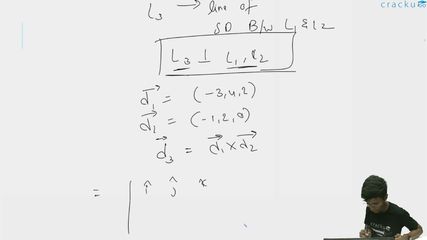
The direction vectors are $$\mathbf{a}=(-3,\,4,\,2)$$ and $$\mathbf{b}=(-1,\,2,\,0)$$.
The line of shortest distance is perpendicular to both lines, so its direction vector is
$$\mathbf{n}=\mathbf{a}\times\mathbf{b}\;.$$
Compute the cross-product:
$$\mathbf{n}=(-4,\,-2,\,-2)\;.$$
For convenience, use the proportional direction $$\mathbf{n}=(2,\,1,\,1)$$.
Let $$P=(-2-3t,\;2+4t,\;5+2t)$$ be a point on the first line and
$$Q=(-2-s,\;-6+2s,\;1)$$ be a point on the second line.
The vector $$\overrightarrow{PQ}=Q-P$$ must be parallel to $$\mathbf{n}$$:
$$\overrightarrow{PQ}=(3t-s,\,-8+2s-4t,\,-4-2t)=k\,(2,\,1,\,1)\;.$$
Equating components gives the system
$$3t-s=2k\;,$$
$$-8+2s-4t=k\;,$$
$$-4-2t=k\;.$$
Set the last two equal:
$$-8+2s-4t=-4-2t\;\Longrightarrow\;s-t-2=0\;\Longrightarrow\;s=t+2\;.$$
From $$k=-4-2t$$ (third equation) and the first equation, substitute $$s=t+2$$:
$$3t-(t+2)=2(-4-2t)\;.$$
Simplify:
$$2t-2=-8-4t\;\Longrightarrow\;6t=-6\;\Longrightarrow\;t=-1\;.$$
Hence $$s=t+2=1$$ and $$k=-4-2t=-2\;.$$
Thus the point on the first line is
$$P=(-2-3(-1),\;2+4(-1),\;5+2(-1))=(1,\,-2,\,3)\;,$$
and the required common perpendicular (shortest-distance) line is
$$\mathbf{r}=(1,\,-2,\,3)+\lambda\,(2,\,1,\,1)\;.$$
The point $$(-1,\alpha,\beta)$$ lies on this line, so
$$1+2\lambda=-1,\quad -2+\lambda=\alpha,\quad 3+\lambda=\beta\;.$$
From $$1+2\lambda=-1$$ we get $$\lambda=-1$$. Substituting:
$$\alpha=-2+(-1)=-3,\qquad \beta=3+(-1)=2\;.$$
Therefore
$$(\alpha-\beta)^2=(-3-2)^2=(-5)^2=25\;.$$
Hence, $$(\alpha-\beta)^2 = 25.$$
Was this solution helpful?
Click on the Email ☝️ to Watch the Video Solution
Create a FREE account and get:
_1.webp)

Educational materials for JEE preparation

Ask our AI anything

AI can make mistakes. Please verify important information.
AI can make mistakes. Please verify important information.
