
Join Our JEE Preparation Group
Prep with like-minded aspirants; Get access to free daily tests and study material.
Sign in
Please select an account to continue using cracku.in
↓ →
Join Our JEE Preparation Group
Prep with like-minded aspirants; Get access to free daily tests and study material.
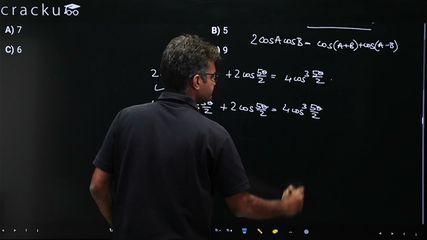
The number of solutions of the equation $$\cos 2\theta \cos\frac{\theta}{2} + \cos\frac{5\theta}{2} = 2\cos^3\frac{5\theta}{2}$$ in $$\left[-\frac{\pi}{2}, \frac{\pi}{2}\right]$$ is :
The given equation is
$$\cos 2\theta \,\cos\frac{\theta}{2}+\cos\frac{5\theta}{2}=2\cos^{3}\frac{5\theta}{2},\qquad
\theta\in\left[-\frac{\pi}{2},\frac{\pi}{2}\right].$$
Put $$t=\frac{\theta}{2}.$$
Then $$\theta=2t$$ and the interval becomes $$t\in\left[-\frac{\pi}{4},\frac{\pi}{4}\right].$$
The equation turns into
$$\cos 4t\;\cos t+\cos 5t=2\cos^{3}5t \quad -(1).$$
Use the product-to-sum identity $$\cos A\cos B=\tfrac{1}{2}\bigl[\cos(A+B)+\cos(A-B)\bigr]$$ on the first term:
$$\cos 4t\;\cos t=\tfrac{1}{2}\bigl[\cos(4t+t)+\cos(4t-t)\bigr]
=\tfrac{1}{2}\bigl[\cos 5t+\cos 3t\bigr].$$
Substitute this in $$(1):$$
$$\tfrac{1}{2}\bigl[\cos 5t+\cos 3t\bigr]+\cos 5t
=2\cos^{3}5t.$$
Combine like terms:
$$(\tfrac{1}{2}+1)\cos 5t+\tfrac{1}{2}\cos 3t
=2\cos^{3}5t,$$
$$\tfrac{3}{2}\cos 5t+\tfrac{1}{2}\cos 3t
=2\cos^{3}5t.$$
Multiply by $$2:$$
$$3\cos 5t+\cos 3t=4\cos^{3}5t \quad -(2).$$
Recall the triple-angle identity $$\cos 3x=4\cos^{3}x-3\cos x,$$ which can be rearranged as
$$4\cos^{3}x=\cos 3x+3\cos x.$$
Putting $$x=5t$$ gives
$$4\cos^{3}5t=\cos 15t+3\cos 5t.$$
Replace the right side of $$(2)$$ with this expression:
$$3\cos 5t+\cos 3t=\cos 15t+3\cos 5t.$$
The terms $$3\cos 5t$$ cancel, leaving the simple equation
$$\cos 3t=\cos 15t \quad -(3).$$
For $$\cos\alpha=\cos\beta,$$ the solutions are
$$\alpha=2k\pi\pm\beta,\qquad k\in\mathbb{Z}.$$
Apply this to $$(3)$$:
Case 1:
$$3t=2k\pi+15t \;\Longrightarrow\; -12t=2k\pi
\;\Longrightarrow\; t=-\frac{k\pi}{6}.$$
With $$t\in\left[-\frac{\pi}{4},\frac{\pi}{4}\right],$$ choose integers $$k$$ so that $$-\frac{k\pi}{6}$$ lies in the interval.
• $$k=0:\;t=0$$
• $$k=1:\;t=-\frac{\pi}{6}$$
• $$k=-1:\;t=\frac{\pi}{6}$$
Further $$|k|\ge 2$$ gives $$|t|\gt\pi/4,$$ so they are rejected.
Thus Case 1 contributes $$t=-\frac{\pi}{6},\,0,\,\frac{\pi}{6}.$$
Case 2:
$$3t=2k\pi-15t \;\Longrightarrow\;18t=2k\pi
\;\Longrightarrow\; t=\frac{k\pi}{9}.$$
Again keep the values inside $$\left[-\frac{\pi}{4},\frac{\pi}{4}\right]:$$
• $$k=0:\;t=0$$ (already counted)
• $$k=\pm1:\;t=\pm\frac{\pi}{9}$$
• $$k=\pm2:\;t=\pm\frac{2\pi}{9}$$
• $$|k|\ge3$$ violates the interval.
Case 2 contributes $$t=-\frac{2\pi}{9},\,-\frac{\pi}{9},\,0,\,\frac{\pi}{9},\,\frac{2\pi}{9}.$$
Collecting distinct solutions of $$t$$ inside the interval:
$$t=-\frac{2\pi}{9},\;-\frac{\pi}{6},\;-\frac{\pi}{9},\;0,\;\frac{\pi}{9},\;\frac{\pi}{6},\;\frac{2\pi}{9}.$$
Thus there are $$7$$ valid $$t$$ values.
Since $$\theta=2t,$$ each $$t$$ gives a unique $$\theta$$ in the original interval $$\left[-\frac{\pi}{2},\frac{\pi}{2}\right]$$, so the number of solutions for $$\theta$$ is also $$7$$.
Hence, the correct option is Option A (7).
Click on the Email ☝️ to Watch the Video Solution
Create a FREE account and get:
_1.webp)

Educational materials for JEE preparation

Ask our AI anything

AI can make mistakes. Please verify important information.
AI can make mistakes. Please verify important information.


