
Join Our JEE Preparation Group
Prep with like-minded aspirants; Get access to free daily tests and study material.
Sign in
Please select an account to continue using cracku.in
↓ →
Join Our JEE Preparation Group
Prep with like-minded aspirants; Get access to free daily tests and study material.
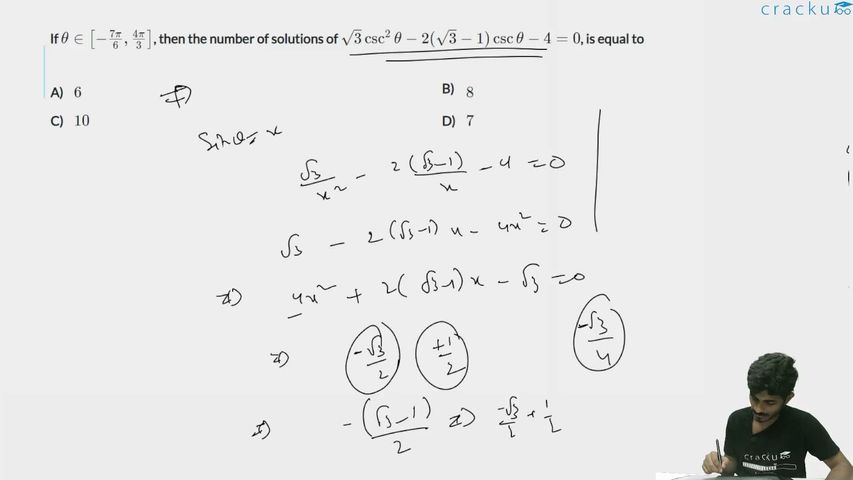
If $$\theta \in \left[-\frac{7\pi}{6}, \frac{4\pi}{3}\right]$$, then the number of solutions of $$\sqrt{3}\csc^2\theta - 2(\sqrt{3} - 1)\csc\theta - 4 = 0$$, is equal to
Rewrite the equation in a single trigonometric variable.
Let $$x=\csc\theta$$. Then the given equation becomes
$$\sqrt3\,x^{2}-2(\sqrt3-1)\,x-4=0\qquad -(1)$$
Solve the quadratic for $$x$$.
For a quadratic $$ax^{2}+bx+c=0$$ the roots are $$x=\dfrac{-b\pm\sqrt{b^{2}-4ac}}{2a}$$.
Here $$a=\sqrt3,\; b=-2(\sqrt3-1)=-2\sqrt3+2,\; c=-4$$.
Compute the discriminant:
$$D=b^{2}-4ac$$
$$=( -2\sqrt3+2 )^{2}-4(\sqrt3)(-4)$$
$$=16-8\sqrt3+16\sqrt3$$
$$=16+8\sqrt3\;.\qquad -(2)$$
Simplify $$\sqrt{D}$$ by expressing it as $$\sqrt{m}+\sqrt{n}$$:
Find $$m,n$$ such that $$m+n=16$$ and $$2\sqrt{mn}=8\sqrt3\Rightarrow mn=48$$.
The numbers satisfying these are $$m=12,\;n=4$$.
Hence $$\sqrt D=\sqrt{12}+\sqrt4=2\sqrt3+2\;.\qquad -(3)$$
Substitute into the quadratic-formula expression:
$$x=\frac{-b\pm\sqrt D}{2a}=\frac{2\sqrt3-2\;\pm\;(2\sqrt3+2)}{2\sqrt3}$$
Case 1: with $$+$$ sign
$$x=\frac{2\sqrt3-2+2\sqrt3+2}{2\sqrt3}=\frac{4\sqrt3}{2\sqrt3}=2$$
Case 2: with $$-$$ sign
$$x=\frac{2\sqrt3-2-(2\sqrt3+2)}{2\sqrt3}=\frac{-4}{2\sqrt3}=-\frac{2}{\sqrt3}=-\frac{2\sqrt3}{3}$$
Therefore the two admissible csc-values are
$$\csc\theta=2\qquad\text{or}\qquad\csc\theta=-\frac{2\sqrt3}{3}\;.\qquad -(4)$$
Convert each value to a sine condition (remember $$\csc\theta=\frac1{\sin\theta}$$):
$$\csc\theta=2\;\Longrightarrow\;\sin\theta=\frac12$$
$$\csc\theta=-\frac{2\sqrt3}{3}\;\Longrightarrow\;\sin\theta=-\frac{\sqrt3}{2}\qquad -(5)$$
Now list all angles in the interval $$\left[-\frac{7\pi}{6},\,\frac{4\pi}{3}\right]$$ (i.e. from $$-210^{\circ}$$ to $$240^{\circ}$$) satisfying each sine value, taking care to keep the interval end-points because sine is non-zero there.
For $$\sin\theta=\frac12$$:
Standard positions: $$\theta=\frac{\pi}{6},\; \frac{5\pi}{6}$$.
Adding or subtracting integral multiples of $$2\pi$$ gives other coterminal angles. Within the required interval we obtain
$$\theta=-\frac{7\pi}{6},\; \frac{\pi}{6},\; \frac{5\pi}{6}$$
Thus, 3 solutions from this case.
For $$\sin\theta=-\frac{\sqrt3}{2}$$:
Standard positions: $$\theta=\frac{4\pi}{3},\; \frac{5\pi}{3}$$.
Again using periodicity and checking the interval boundaries, the admissible angles are
$$\theta=-\frac{2\pi}{3},\; -\frac{\pi}{3},\; \frac{4\pi}{3}$$
Thus, 3 solutions from this case as well.
Add the counts from both cases:
Total number of solutions $$=3+3=6$$
Hence the required number of solutions is $$6$$, which corresponds to Option A.
Was this solution helpful?
Click on the Email ☝️ to Watch the Video Solution
Create a FREE account and get:
_1.webp)

Educational materials for JEE preparation

Ask our AI anything

AI can make mistakes. Please verify important information.
AI can make mistakes. Please verify important information.


