
Join Our JEE Preparation Group
Prep with like-minded aspirants; Get access to free daily tests and study material.
Sign in
Please select an account to continue using cracku.in
↓ →
Join Our JEE Preparation Group
Prep with like-minded aspirants; Get access to free daily tests and study material.
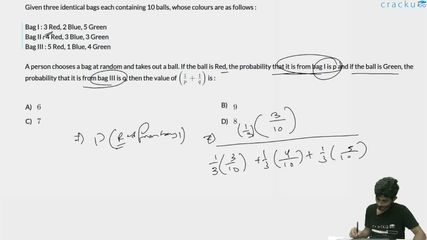
Given three identical bags each containing 10 balls, whose colours are as follows :
Bag I : 3 Red, 2 Blue, 5 Green
Bag II : 4 Red, 3 Blue, 3 Green
Bag III : 5 Red, 1 Blue, 4 Green
A person chooses a bag at random and takes out a ball. If the ball is Red, the probability that it is from bag I is p and if the ball is Green, the probability that it is from bag III is q, then the value of $$\left(\frac{1}{p} + \frac{1}{q}\right)$$ is :
Let the events be:
$$B_1$$ : bag I is selected, $$B_2$$ : bag II is selected, $$B_3$$ : bag III is selected.
$$R$$ : the ball drawn is Red, $$G$$ : the ball drawn is Green.
Because the person picks a bag at random, $$P(B_1)=P(B_2)=P(B_3)=\frac13$$.
Conditional probabilities for drawing a Red ball from the three bags are
$$P(R\mid B_1)=\frac{3}{10},\qquad P(R\mid B_2)=\frac{4}{10},\qquad P(R\mid B_3)=\frac{5}{10}$$
1. Total probability of drawing a Red ball (use the law of total probability):
$$P(R)=P(B_1)P(R\mid B_1)+P(B_2)P(R\mid B_2)+P(B_3)P(R\mid B_3)$$
$$=\frac13\left(\frac{3}{10}+\frac{4}{10}+\frac{5}{10}\right)=\frac13\cdot\frac{12}{10}=\frac{12}{30}=\frac25\;-(1)$$
2. Probability that the Red ball came from bag I (Bayes’ theorem):
$$p=P(B_1\mid R)=\frac{P(B_1)P(R\mid B_1)}{P(R)}=\frac{\frac13\cdot\frac{3}{10}}{\frac25}=\frac{1}{10}\cdot\frac{5}{2}=\frac14\;-(2)$$
Similarly, for Green balls we have the conditional probabilities
$$P(G\mid B_1)=\frac{5}{10},\qquad P(G\mid B_2)=\frac{3}{10},\qquad P(G\mid B_3)=\frac{4}{10}$$
3. Total probability of drawing a Green ball:
$$P(G)=\frac13\left(\frac{5}{10}+\frac{3}{10}+\frac{4}{10}\right)=\frac13\cdot\frac{12}{10}=\frac{12}{30}=\frac25\;-(3)$$
4. Probability that the Green ball came from bag III:
$$q=P(B_3\mid G)=\frac{P(B_3)P(G\mid B_3)}{P(G)}=\frac{\frac13\cdot\frac{4}{10}}{\frac25}=\frac{4}{30}\cdot\frac{5}{2}=\frac13\;-(4)$$
5. Required expression:
$$\frac1p+\frac1q=\frac1{\frac14}+\frac1{\frac13}=4+3=7$$
Therefore, $$\left(\frac1p+\frac1q\right)=7$$, which corresponds to Option C.
Was this solution helpful?
Click on the Email ☝️ to Watch the Video Solution
Create a FREE account and get:
_1.webp)

Educational materials for JEE preparation

Ask our AI anything

AI can make mistakes. Please verify important information.
AI can make mistakes. Please verify important information.


