
Join Our JEE Preparation Group
Prep with like-minded aspirants; Get access to free daily tests and study material.
Sign in
Please select an account to continue using cracku.in
↓ →
Join Our JEE Preparation Group
Prep with like-minded aspirants; Get access to free daily tests and study material.
The area of the region $$S = \{(x, y) : 3x^2 \leq 4y \leq 6x + 24\}$$ is _________
Correct Answer: 27
We have the set of points
$$S=\{(x,y):\;3x^{2}\le 4y\le 6x+24\}.$$
The double inequality means that for every admissible abscissa $$x$$ the ordinate $$y$$ must lie between a lower curve and an upper curve. First we isolate $$y$$ in both inequalities.
From $$3x^{2}\le 4y$$ we get the lower bound
$$y\ge \dfrac{3x^{2}}{4}.$$
From $$4y\le 6x+24$$ we get the upper bound
$$y\le\dfrac{6x+24}{4}= \dfrac{3x}{2}+6.$$
Thus the region is bounded below by the parabola
$$y=\dfrac{3x^{2}}{4}$$
and above by the straight line
$$y=\dfrac{3x}{2}+6.$$
To know for which $$x$$-values the strip exists, we find the points where the two boundary curves meet. These are obtained by equating the two expressions for $$y$$.
$$\dfrac{3x^{2}}{4}=\dfrac{3x}{2}+6.$$
Multiply both sides by $$4$$ (so that all fractions disappear):
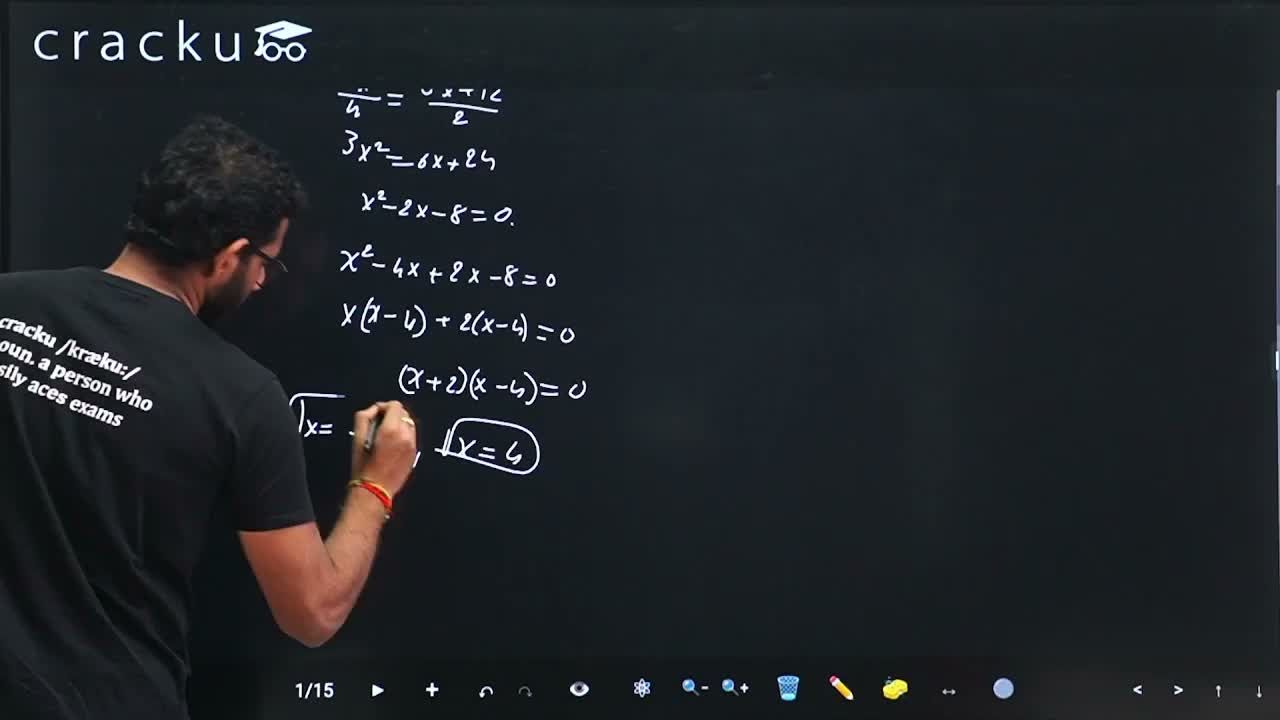
$$3x^{2}=6x+24.$$
Now divide every term by $$3$$ to simplify:
$$x^{2}=2x+8.$$
Bring all terms to the left to form a quadratic equation equal to zero:
$$x^{2}-2x-8=0.$$
The quadratic formula, $$x=\dfrac{-b\pm\sqrt{b^{2}-4ac}}{2a}$$ for $$ax^{2}+bx+cx=0,$$ here has $$a=1,\;b=-2,\;c=-8.$$ Substituting these values we obtain
$$x=\dfrac{-(-2)\pm\sqrt{(-2)^{2}-4\cdot1\cdot(-8)}}{2\cdot1} =\dfrac{2\pm\sqrt{4+32}}{2} =\dfrac{2\pm\sqrt{36}}{2} =\dfrac{2\pm6}{2}.$$
Hence the two solutions are
$$x_{1}=\dfrac{2-6}{2}=-2,\qquad x_{2}=\dfrac{2+6}{2}=4.$$
Therefore the admissible $$x$$-values run from $$-2$$ to $$4.$$ For any such $$x$$ the vertical distance between the upper and lower curves gives the height of an infinitesimal strip.
This height is
$$\left(\dfrac{3x}{2}+6\right)-\left(\dfrac{3x^{2}}{4}\right) =-\dfrac{3}{4}x^{2}+\dfrac{3}{2}x+6.$$
To find the total area, we integrate this height with respect to $$x$$ from $$-2$$ to $$4$$.
$$A=\int_{-2}^{4}\left(-\dfrac{3}{4}x^{2}+\dfrac{3}{2}x+6\right)\,dx.$$
We integrate term by term. Recall the basic antiderivatives: $$\int x^{n}\,dx=\dfrac{x^{n+1}}{n+1},\quad \int k\,dx=kx,$$ where $$k$$ is a constant.
Using these, the antiderivative of the integrand is
$$\begin{aligned} \int\!\left(-\frac{3}{4}x^{2}\right)\!dx &= -\frac{3}{4}\cdot\frac{x^{3}}{3}=-\frac{x^{3}}{4},\\[4pt] \int\!\left(\frac{3}{2}x\right)\!dx &= \frac{3}{2}\cdot\frac{x^{2}}{2}=\frac{3x^{2}}{4},\\[4pt] \int 6\,dx &= 6x. \end{aligned}$$
Adding them, an antiderivative $$F(x)$$ of the whole expression is
$$F(x)=-\frac{x^{3}}{4}+\frac{3x^{2}}{4}+6x.$$
Now we evaluate $$F(x)$$ at the two limits and subtract:
$$A = F(4)-F(-2).$$
First, at $$x=4$$:
$$\begin{aligned} F(4) &= -\frac{4^{3}}{4}+\frac{3\cdot4^{2}}{4}+6\cdot4\\[4pt] &= -\frac{64}{4}+\frac{3\cdot16}{4}+24\\[4pt] &= -16+\frac{48}{4}+24\\[4pt] &= -16+12+24\\[4pt] &= 20. \end{aligned}$$
Next, at $$x=-2$$:
$$\begin{aligned} F(-2) &= -\frac{(-2)^{3}}{4}+\frac{3(-2)^{2}}{4}+6(-2)\\[4pt] &= -\frac{-8}{4}+\frac{3\cdot4}{4}-12\\[4pt] &= 2+3-12\\[4pt] &= -7. \end{aligned}$$
Finally, take the difference:
$$A = F(4)-F(-2)=20-(-7)=27.$$
Thus the area of the region $$S$$ is
$$27.$$
So, the answer is $$27$$.
Was this solution helpful?
Click on the Email ☝️ to Watch the Video Solution
Create a FREE account and get:
_1.webp)

Educational materials for JEE preparation

Ask our AI anything

AI can make mistakes. Please verify important information.
AI can make mistakes. Please verify important information.
