
Join Our JEE Preparation Group
Prep with like-minded aspirants; Get access to free daily tests and study material.
Sign in
Please select an account to continue using cracku.in
↓ →
Join Our JEE Preparation Group
Prep with like-minded aspirants; Get access to free daily tests and study material.
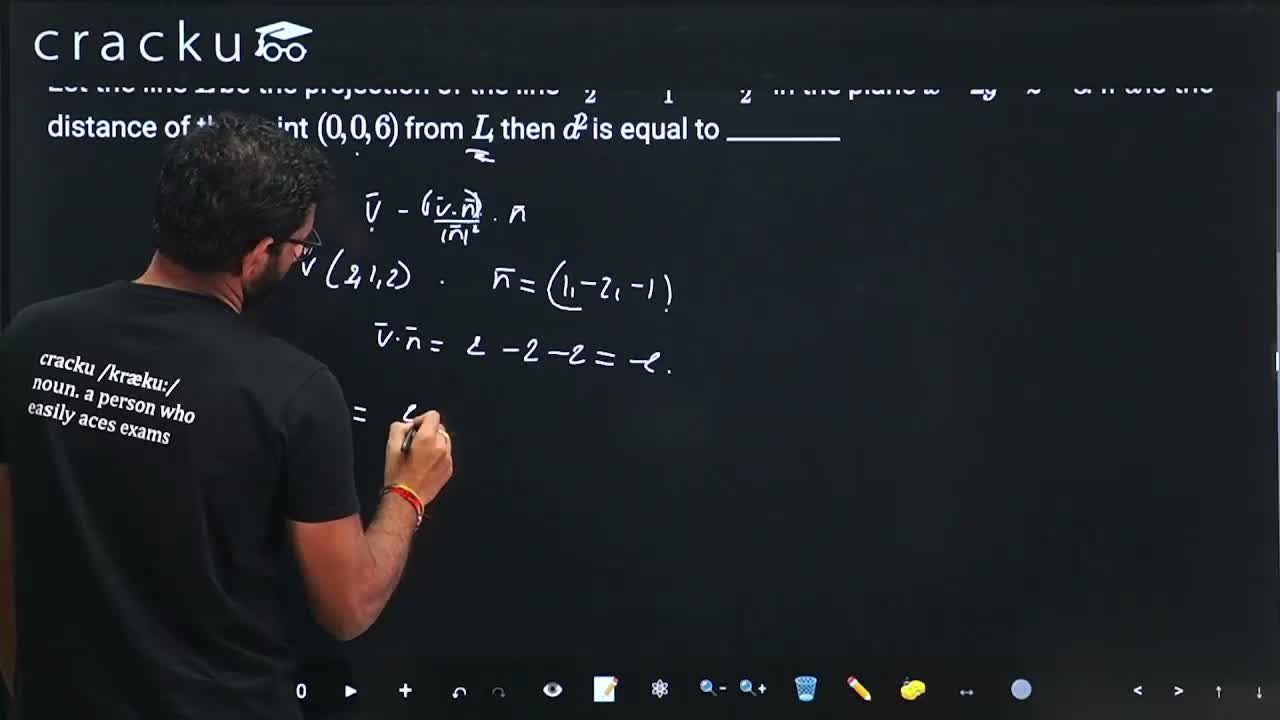
Let the line $$L$$ be the projection of the line $$\frac{x-1}{2} = \frac{y-3}{1} = \frac{z-4}{2}$$ in the plane $$x - 2y - z = 3$$. If $$d$$ is the distance of the point $$(0, 0, 6)$$ from $$L$$, then $$d^2$$ is equal to _________
Correct Answer: 26
We have the given line whose symmetric form is $$\dfrac{x-1}{2}=\dfrac{y-3}{1}=\dfrac{z-4}{2}$$. A convenient way to read this is that a point $$\bigl(x,y,z\bigr)$$ on the line can be generated from the parameter $$t$$ by writing $$x=1+2t,\;y=3+t,\;z=4+2t$$. The direction vector of this line is therefore $$\vec v=\langle 2,\,1,\,2\rangle$$.
The plane on which we must project this line is $$x-2y-z=3$$. The normal vector of this plane is obtained directly from the coefficients of $$x,y,z$$, namely $$\vec n=\langle 1,\,-2,\,-1\rangle$$.
To obtain the direction vector of the projected line $$L$$, we first recall the formula that removes the component of any vector along the normal: $$ \text{Component of }\vec v\text{ parallel to plane}=\vec v-\frac{\vec v\cdot\vec n}{\lVert\vec n\rVert^{2}}\;\vec n. $$
Now, $$\vec v\cdot\vec n = 2(1)+1(-2)+2(-1)=2-2-2=-2$$, and $$\lVert\vec n\rVert^{2}=1^{2}+(-2)^{2}+(-1)^{2}=6$$. Substituting, $$ \vec v_{\parallel}= \vec v - \left(\frac{-2}{6}\right)\vec n = \vec v + \frac{1}{3}\vec n = \langle 2,1,2\rangle + \frac{1}{3}\langle 1,-2,-1\rangle = \left\langle 2+\frac13,\;1-\frac23,\;2-\frac13\right\rangle = \left\langle \frac73,\;\frac13,\;\frac53\right\rangle. $$ Multiplying by 3 for simplicity, we take $$\vec d=\langle 7,\,1,\,5\rangle$$ as the direction vector of the required line $$L$$.
Next we need one point of $$L$$. We start from any point of the original line; the easiest is when $$t=0$$, giving the point $$A(1,3,4)$$. To project $$A$$ onto the plane, we move along the normal direction $$\vec n$$. Writing $$ (x,y,z)=(1,3,4)+\lambda\langle 1,-2,-1\rangle=(1+\lambda,\;3-2\lambda,\;4-\lambda), $$ we enforce the plane equation: $$ (1+\lambda)-2(3-2\lambda)-(4-\lambda)=3. $$ Expanding gives $$ 1+\lambda-6+4\lambda-4+\lambda=3 \;\;\Longrightarrow\;\; 6\lambda-9=3 \;\;\Longrightarrow\;\; \lambda=2. $$ Substituting $$\lambda=2$$ gives the projection point $$ P(1+2,\;3-4,\;4-2)=(3,-1,2). $$
Hence line $$L$$ lies in the plane, passes through $$P(3,-1,2)$$, and has direction $$\vec d=\langle 7,1,5\rangle$$. We now compute the distance from the external point $$Q(0,0,6)$$ to this line.
The formula for distance from a point to a line in space is $$ \text{Distance}= \frac{\lVert (\overrightarrow{QP})\times\vec d\rVert}{\lVert\vec d\rVert}, $$ where $$\overrightarrow{QP}= \langle 0-3,\;0-(-1),\;6-2\rangle = \langle -3,\,1,\,4\rangle.$$ We evaluate the cross product: $$ (\overrightarrow{QP})\times\vec d = \begin{vmatrix} \mathbf i & \mathbf j & \mathbf k\\[4pt] -3 & 1 & 4\\ 7 & 1 & 5 \end{vmatrix} = \mathbf i(1\cdot5-4\cdot1)-\mathbf j(-3\cdot5-4\cdot7)+\mathbf k(-3\cdot1-1\cdot7) = \langle 1,\;43,\;-10\rangle. $$ Hence $$ \lVert (\overrightarrow{QP})\times\vec d\rVert^{2}=1^{2}+43^{2}+(-10)^{2}=1+1849+100=1950, $$ and $$ \lVert\vec d\rVert^{2}=7^{2}+1^{2}+5^{2}=49+1+25=75. $$ Therefore $$ d^{2}=\frac{1950}{75}=26. $$
So, the answer is $$26$$.
Was this solution helpful?
Click on the Email ☝️ to Watch the Video Solution
Create a FREE account and get:
_1.webp)

Educational materials for JEE preparation

Ask our AI anything

AI can make mistakes. Please verify important information.
AI can make mistakes. Please verify important information.
