
Join Our JEE Preparation Group
Prep with like-minded aspirants; Get access to free daily tests and study material.
Sign in
Please select an account to continue using cracku.in
↓ →
Join Our JEE Preparation Group
Prep with like-minded aspirants; Get access to free daily tests and study material.
A wire of length 36 m is cut into two pieces, one of the pieces is bent to form a square and the other is bent to form a circle. If the sum of the areas of the two figures is minimum, and the circumference of the circle is $$k$$ (meter), then $$\left(\frac{4}{\pi} + 1\right)k$$ is equal to _________
Correct Answer: 36
Let the total length of the wire be 36 m. Suppose $$k$$ metres of the wire are used to form the circle, so the remaining $$36-k$$ metres form the square.
If the side of the square is $$x$$, we have the perimeter-side relation for a square: $$4x = 36-k$$, therefore
$$x = \dfrac{36-k}{4}.$$
The circle whose circumference is $$k$$ has radius $$r$$ given by the circumference formula $$2\pi r = k$$, so
$$r = \dfrac{k}{2\pi}.$$
Now, write the total area $$A$$ of the two figures. The area of the square is $$x^{2}$$ and the area of the circle is $$\pi r^{2}$$. Thus
$$A = x^{2} + \pi r^{2}.$$
Substituting the expressions for $$x$$ and $$r$$, we get
$$A = \left(\dfrac{36-k}{4}\right)^{2} + \pi\left(\dfrac{k}{2\pi}\right)^{2}.$$
Simplifying the second term first:
$$\pi\left(\dfrac{k}{2\pi}\right)^{2} = \pi \cdot \dfrac{k^{2}}{4\pi^{2}} = \dfrac{k^{2}}{4\pi}.$$
Therefore
$$A(k) = \left(\dfrac{36-k}{4}\right)^{2} + \dfrac{k^{2}}{4\pi}.$$
To minimise the area, differentiate $$A$$ with respect to $$k$$ and set the derivative equal to zero.
First expand the square term and differentiate directly:
$$A(k) = \dfrac{(36-k)^{2}}{16} + \dfrac{k^{2}}{4\pi}.$$
Differentiate term-by-term:
$$\dfrac{dA}{dk} = \dfrac{1}{16}\cdot 2(36-k)(-1) + \dfrac{1}{4\pi}\cdot 2k.$$
Simplify each part:
$$\dfrac{dA}{dk} = -\dfrac{36-k}{8} + \dfrac{k}{2\pi}.$$
Set the derivative to zero for a minimum:
$$-\dfrac{36-k}{8} + \dfrac{k}{2\pi} = 0.$$
Multiply through by the common denominator $$8\pi$$ to clear fractions:
$$-\pi(36-k) + 4k = 0.$$
Expand the first product:
$$-36\pi + \pi k + 4k = 0.$$
Group the $$k$$ terms:
$$(\pi + 4)k = 36\pi.$$
Solve for $$k$$:
$$k = \dfrac{36\pi}{\pi + 4}.$$
The expression asked for in the problem is $$\left(\dfrac{4}{\pi} + 1\right)k$$. Compute it by direct substitution:
$$\left(\dfrac{4}{\pi} + 1\right)k = \left(\dfrac{4 + \pi}{\pi}\right)\left(\dfrac{36\pi}{\pi + 4}\right).$$
The numerator and denominator each contain the common factor $$\pi + 4$$, which cancels neatly with $$4 + \pi$$, leaving
$$\left(\dfrac{4 + \pi}{\pi}\right)\left(\dfrac{36\pi}{\pi + 4}\right) = 36.$$
So, the answer is $$36$$.
Was this solution helpful?
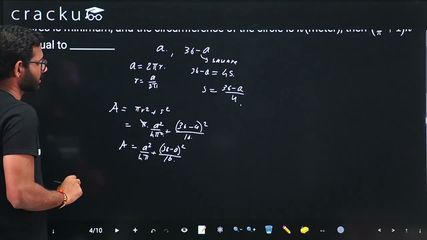
Click on the Email ☝️ to Watch the Video Solution
Create a FREE account and get:
_1.webp)

Educational materials for JEE preparation

Ask our AI anything

AI can make mistakes. Please verify important information.
AI can make mistakes. Please verify important information.
