
Join Our JEE Preparation Group
Prep with like-minded aspirants; Get access to free daily tests and study material.
Sign in
Please select an account to continue using cracku.in
↓ →
Join Our JEE Preparation Group
Prep with like-minded aspirants; Get access to free daily tests and study material.
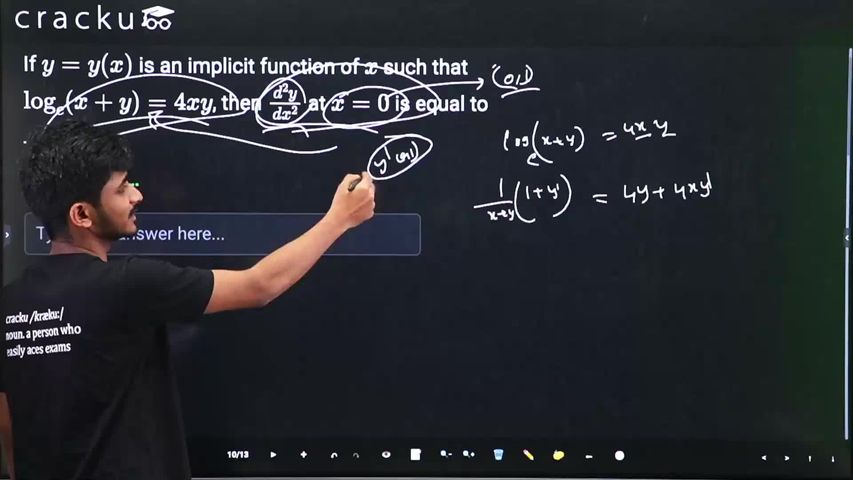
If $$y = y(x)$$ is an implicit function of $$x$$ such that $$\log_e(x + y) = 4xy$$, then $$\frac{d^2y}{dx^2}$$ at $$x = 0$$ is equal to _________
Correct Answer: 40
Given the implicit relation $$\log_e (x + y) = 4xy$$, we first identify the value of $$y$$ at $$x = 0$$. Substituting $$x = 0$$ gives
$$\log_e(0 + y) = 4 \cdot 0 \cdot y \;\Longrightarrow\; \log_e y = 0 \;\Longrightarrow\; y = e^{0} = 1.$$
Hence $$y(0)=1.$$
Now we differentiate both sides with respect to $$x$$. Using the formula $$\dfrac{d}{dx}\bigl[\log_e u\bigr] = \dfrac{1}{u}\dfrac{du}{dx}$$ on the left and the product rule $$\dfrac{d}{dx}[uv]=u\dfrac{dv}{dx}+v\dfrac{du}{dx}$$ on the right, we get
$$\frac{1}{x + y}\bigl(1 + y'\bigr) = 4y + 4x\,y'.$$
(Here and henceforth we write $$y' = \dfrac{dy}{dx}$$ and $$y'' = \dfrac{d^{2}y}{dx^{2}}$$.)
Putting $$x = 0,\,y = 1$$ into this first-derivative equation, we obtain
$$\frac{1 + y'(0)}{0 + 1} = 4\cdot1 + 4\cdot0\cdot y'(0) \;\Longrightarrow\; 1 + y'(0) = 4 \;\Longrightarrow\; y'(0) = 3.$$
To reach the second derivative, we again differentiate the equation
$$\frac{1 + y'}{x + y} = 4y + 4x\,y'.$$
Let us differentiate the left side by the quotient rule. With $$N = 1 + y', \quad D = x + y,$$ the quotient rule states $$\frac{d}{dx}\!\left(\frac{N}{D}\right) = \frac{N'D - ND'}{D^{2}},$$ where $$N' = y''$$ and $$D' = 1 + y'$$. Therefore
$$\frac{d}{dx}\!\left(\frac{1 + y'}{x + y}\right) = \frac{y''(x + y) - (1 + y')^{2}}{(x + y)^{2}}.$$
The right side $$4y + 4x\,y'$$ differentiates to
$$4y' + 4y' + 4x\,y'' = 8y' + 4x\,y''.$$ (Here we used the product rule on $$4x\,y'$$.)
Equating the two derivatives gives
$$\frac{y''(x + y) - (1 + y')^{2}}{(x + y)^{2}} = 8y' + 4x\,y''.$$ Multiplying across by $$(x + y)^{2}$$ simplifies this to
$$y''(x + y) - \bigl(1 + y'\bigr)^{2} = \bigl(8y' + 4x\,y''\bigr)(x + y)^{2}.$$
We wish to evaluate at $$x = 0$$. Substituting $$x = 0,\;y = 1,\;y' = 3$$ into the simpler fractional form is easiest:
$$\frac{y''(0 + 1) - (1 + 3)^{2}}{(0 + 1)^{2}} = 8\cdot3 + 4\cdot0\cdot y'',$$ which reduces to
$$y'' - 16 = 24.$$
Solving for $$y''$$ yields
$$y'' = 40.$$
Therefore, the second derivative of $$y$$ with respect to $$x$$ at $$x = 0$$ is $$40$$.
So, the answer is $$40$$.
Was this solution helpful?
Click on the Email ☝️ to Watch the Video Solution
Create a FREE account and get:
_1.webp)

Educational materials for JEE preparation

Ask our AI anything

AI can make mistakes. Please verify important information.
AI can make mistakes. Please verify important information.
