
Join Our JEE Preparation Group
Prep with like-minded aspirants; Get access to free daily tests and study material.
Sign in
Please select an account to continue using cracku.in
↓ →
Join Our JEE Preparation Group
Prep with like-minded aspirants; Get access to free daily tests and study material.
Let $$a, b \in R$$, $$b \neq 0$$. Defined a function, $$f(x) = \begin{cases} a\sin\frac{\pi}{2}(x-1), & \text{for } x \leq 0 \\ \frac{\tan 2x - \sin 2x}{bx^3}, & \text{for } x > 0 \end{cases}$$
If $$f$$ is continuous at $$x = 0$$, then $$10 - ab$$ is equal to _________
Correct Answer: 14
We are given the real-valued function
$$f(x)= \begin{cases} a\sin\left(\dfrac{\pi}{2}(x-1)\right), & x\le 0\\[6pt] \dfrac{\tan 2x-\sin 2x}{b\,x^{3}}, & x\gt0 \end{cases}$$
and we know that $$b\neq 0$$. For continuity at $$x=0$$ we must have
$$\lim_{x\to 0^-}f(x)=f(0)=\lim_{x\to 0^+}f(x).$$
Left-hand value and limit
Because the first branch is defined for $$x\le 0$$, the value of the function at the point itself is obtained from that branch:
$$f(0)=a\sin\left(\frac{\pi}{2}(0-1)\right)=a\sin\left(-\frac{\pi}{2}\right).$$
Using $$\sin(-\theta)=-\sin\theta$$ and the fact that $$\sin\frac{\pi}{2}=1$$, we get
$$f(0)=a(-1)=-a.$$
Since the formula is the same for all $$x\le 0$$, the left-hand limit as $$x\to 0^-$$ is also $$-a$$.
Right-hand limit
For $$x\gt0$$ the function is
$$f(x)=\frac{\tan 2x-\sin 2x}{b\,x^{3}}.$$ To find $$\displaystyle\lim_{x\to 0^+}f(x)$$, we expand the numerator in powers of $$x$$ (Maclaurin series).
Standard Maclaurin series (stated first):
$$\sin\theta=\theta-\frac{\theta^{3}}{6}+O(\theta^{5}),\qquad \tan\theta=\theta+\frac{\theta^{3}}{3}+O(\theta^{5}).$$
Now substitute $$\theta=2x$$.
We have $$$ \begin{aligned} \tan 2x &= 2x+\frac{(2x)^{3}}{3}+O(x^{5}) = 2x+\frac{8x^{3}}{3}+O(x^{5}),\\[4pt] \sin 2x &= 2x-\frac{(2x)^{3}}{6}+O(x^{5}) = 2x-\frac{8x^{3}}{6}+O(x^{5}) = 2x-\frac{4x^{3}}{3}+O(x^{5}). \end{aligned} $$$
Subtracting term by term:
$$\tan 2x-\sin 2x =\bigl(2x+\frac{8x^{3}}{3}\bigr)-\bigl(2x-\frac{4x^{3}}{3}\bigr)+O(x^{5}) =(2x-2x)+\frac{8x^{3}}{3}+\frac{4x^{3}}{3}+O(x^{5}) =4x^{3}+O(x^{5}).$$
Therefore, near $$x=0$$,
$$\tan 2x-\sin 2x \;=\;4x^{3}+O(x^{5}).$$
Substituting this into the expression for $$f(x)$$ when $$x\gt0$$, we obtain
$$f(x)=\frac{4x^{3}+O(x^{5})}{b\,x^{3}} =\frac{4}{b}+O(x^{2}).$$
Hence
$$\lim_{x\to 0^+}f(x)=\frac{4}{b}.$$
Imposing continuity
Continuity at $$x=0$$ requires
$$-a=\frac{4}{b}.$$
Rewriting, we get
$$ab=-4.$$
We are asked to evaluate $$10-ab$$. Substituting $$ab=-4$$ gives
$$10-ab=10-(-4)=14.$$
So, the answer is $$14$$.
Was this solution helpful?
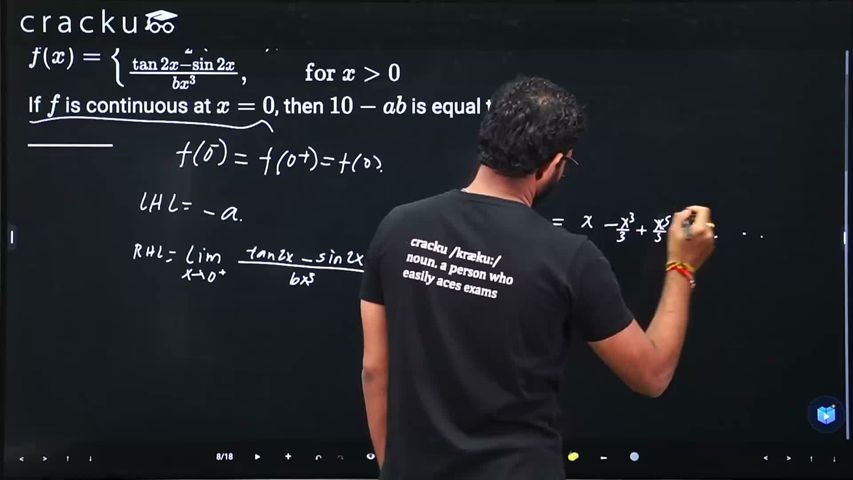
Click on the Email ☝️ to Watch the Video Solution
Create a FREE account and get:
_1.webp)

Educational materials for JEE preparation

Ask our AI anything

AI can make mistakes. Please verify important information.
AI can make mistakes. Please verify important information.
