
Join Our JEE Preparation Group
Prep with like-minded aspirants; Get access to free daily tests and study material.
Sign in
Please select an account to continue using cracku.in
↓ →
Join Our JEE Preparation Group
Prep with like-minded aspirants; Get access to free daily tests and study material.
The locus of a point, which moves such that the sum of squares of its distances from the points $$(0, 0)$$, $$(1, 0)$$, $$(0, 1)$$, $$(1, 1)$$ is 18 units, is a circle of diameter $$d$$. Then $$d^2$$ is equal to _________
Correct Answer: 16
Let the moving point be $$P(x,y)$$. We first write the square of its distance from each of the four given points.
Distance-square from $$(0,0)$$ is $$x^{2}+y^{2}$$.
Distance-square from $$(1,0)$$ is $$(x-1)^{2}+y^{2}$$.
Distance-square from $$(0,1)$$ is $$x^{2}+(y-1)^{2}$$.
Distance-square from $$(1,1)$$ is $$(x-1)^{2}+(y-1)^{2}$$.
The question states that the sum of these four expressions equals $$18$$. Hence we have
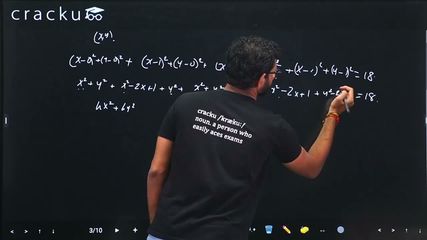
$$x^{2}+y^{2}+(x-1)^{2}+y^{2}+x^{2}+(y-1)^{2}+(x-1)^{2}+(y-1)^{2}=18.$$
Now we expand every bracket carefully:
$$x^{2}+y^{2}+x^{2}-2x+1+y^{2}+x^{2}+y^{2}-2y+1+x^{2}-2x+1+y^{2}-2y+1=18.$$
Next we collect like terms.
• For $$x^{2}$$: there are four of them, so $$4x^{2}.$$
• For $$y^{2}$$: again four of them, so $$4y^{2}.$$
• For $$x$$: the coefficients are $$-2x-2x=-4x.$$
• For $$y$$: the coefficients are $$-2y-2y=-4y.$$
• Constant terms: $$1+1+1+1=4.$$
Therefore the equation becomes
$$4x^{2}+4y^{2}-4x-4y+4=18.$$
We divide the whole equation by $$4$$ to simplify:
$$x^{2}+y^{2}-x-y+1=\dfrac{18}{4}=4.5.$$
So
$$x^{2}-x+y^{2}-y=4.5-1=3.5.$$
To recognise the locus, we complete the square in both $$x$$ and $$y$$. We recall the algebraic identity $$a^{2}-2ab+b^{2}=(a-b)^{2}$$. For completing the square in an expression of the form $$u^{2}-u$$, we add and subtract $$\left(\dfrac12\right)^{2}=0.25.$$
We add $$0.25$$ for the $$x$$-terms and another $$0.25$$ for the $$y$$-terms on both sides:
$$x^{2}-x+0.25+y^{2}-y+0.25=3.5+0.25+0.25.$$
Simplifying each side gives
$$\bigl(x-0.5\bigr)^{2}+\bigl(y-0.5\bigr)^{2}=4.$$
This is the standard form of the equation of a circle: $$\bigl(x-h\bigr)^{2}+\bigl(y-k\bigr)^{2}=r^{2}$$, where $$(h,k)$$ is the centre and $$r$$ the radius. Comparing, we have centre $$(0.5,0.5)$$ and radius $$r=2$$ because $$r^{2}=4.$
The diameter $$d$$ of the circle is twice the radius:
$$d=2r=2\times2=4.$$
Finally, the square of the diameter is
$$d^{2}=4^{2}=16.$$
So, the answer is $$16$$.
Was this solution helpful?
Click on the Email ☝️ to Watch the Video Solution
Create a FREE account and get:
_1.webp)

Educational materials for JEE preparation

Ask our AI anything

AI can make mistakes. Please verify important information.
AI can make mistakes. Please verify important information.
