
Join Our JEE Preparation Group
Prep with like-minded aspirants; Get access to free daily tests and study material.
Sign in
Please select an account to continue using cracku.in
↓ →
Join Our JEE Preparation Group
Prep with like-minded aspirants; Get access to free daily tests and study material.
If $$^1P_1 + 2 \cdot ^2P_2 + 3 \cdot ^3P_3 + \ldots + 15 \cdot ^{15}P_{15} = ^qP_r - s$$, $$0 \leq s \leq 1$$, then $$^{q+s}C_{r-s}$$ is equal to _________
Correct Answer: 136
We have to evaluate the expression
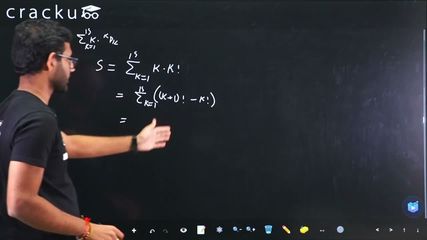
$$1\cdot{}^1P_1+2\cdot{}^2P_2+3\cdot{}^3P_3+\ldots+15\cdot{}^{15}P_{15}$$
and compare it with $$^qP_r-s$$ where $$0\le s\le1$$. After finding $$q,\;r,\;s$$ we shall compute $$^{\,q+s}C_{\,r-s}$$.
First recall the definition of permutations:
$$^nP_r=\frac{n!}{(n-r)!}.$$
In every term of our sum the two numbers are the same, i.e. $$r=n$$, so we get
$$^kP_k=\frac{k!}{(k-k)!}=\frac{k!}{0!}=k!.$$
Hence every term simplifies to $$k\cdot k!$$ and the entire left‐hand side becomes
$$\sum_{k=1}^{15}k\cdot k!.$$
There is a standard identity:
$$\sum_{k=1}^{n}k\cdot k!=(n+1)!-1.$$ This can be proved quickly by mathematical induction, but we shall accept it as known.
Putting $$n=15$$ we obtain
$$\sum_{k=1}^{15}k\cdot k!=(15+1)!-1=16!-1.$$
So the given equality becomes
$$^qP_r-s=16!-1.$$
Now $$s$$ can be only $$0$$ or $$1$$. If $$s=0$$ we would need $$^qP_r=16!-0=16!-1,$$ which is not a factorial and very unlikely to be a permutation value. Choosing $$s=1$$ gives
$$^qP_r=16!.$$
To realise a value of exactly $$16!$$ with a permutation, the simplest way is to take $$r=q$$. Then
$$^qP_q=q!,$$
and the equation $$q!=16!$$ forces
$$q=16,\qquad r=16.$$
Therefore we have found
$$q=16,\qquad r=16,\qquad s=1.$$
We are asked to compute
$$^{\,q+s}C_{\,r-s}.$$
Substituting the values just obtained, we get
$$^{\,q+s}C_{\,r-s}=^{\,16+1}C_{\,16-1}=^{17}C_{15}.$$
The binomial coefficient satisfies $$^nC_r=^nC_{n-r},$$ so
$$^{17}C_{15}=^{17}C_{2}.$$
Using the combination formula
$$^nC_r=\frac{n!}{r!\,(n-r)!},$$
we calculate
$$^{17}C_2=\frac{17!}{2!\,15!}=\frac{17\cdot16\cdot15!}{2\cdot15!}=\frac{17\cdot16}{2}=136.$$
Hence, the correct answer is Option 136.
Was this solution helpful?
Click on the Email ☝️ to Watch the Video Solution
Create a FREE account and get:
_1.webp)

Educational materials for JEE preparation

Ask our AI anything

AI can make mistakes. Please verify important information.
AI can make mistakes. Please verify important information.
