
Join Our JEE Preparation Group
Prep with like-minded aspirants; Get access to free daily tests and study material.
Sign in
Please select an account to continue using cracku.in
↓ →
Join Our JEE Preparation Group
Prep with like-minded aspirants; Get access to free daily tests and study material.
Let a line having direction ratios $$1, -4, 2$$ intersect the lines $$\frac{x-7}{3} = \frac{y-1}{-1} = \frac{z+2}{1}$$ and $$\frac{x}{2} = \frac{y-7}{3} = \frac{z}{1}$$ at the points $$A$$ and $$B$$. Then $$(AB)^2$$ is equal to ______
Correct Answer: 84
A line with direction ratios $$(1, -4, 2)$$ intersects the lines $$L_1: \frac{x-7}{3} = \frac{y-1}{-1} = \frac{z+2}{1}$$ and $$L_2: \frac{x}{2} = \frac{y-7}{3} = \frac{z}{1}$$ at points $$A$$ and $$B$$.
First, parametrize the given lines as follows.
$$L_1: (7+3s,\, 1-s,\, -2+s)$$
$$L_2: (2t,\, 7+3t,\, t)$$
Next, the vector from $$A$$ to $$B$$ is
$$\vec{AB} = B - A = (2t - 7 - 3s,\, 6 + 3t + s,\, t + 2 - s).$$
This must be proportional to $$(1, -4, 2)$$:
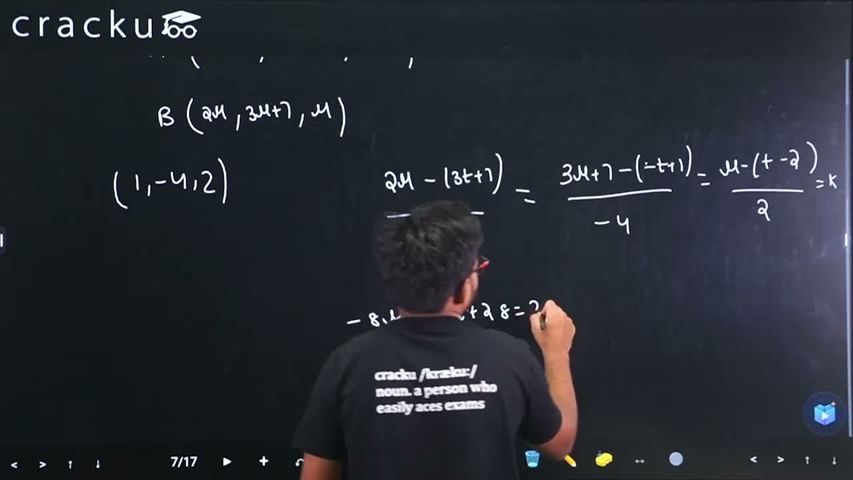
$$\frac{2t - 7 - 3s}{1} = \frac{6 + 3t + s}{-4} = \frac{t + 2 - s}{2} = \lambda$$
From the first and third parts we have
$$2(2t - 7 - 3s) = t + 2 - s \implies 4t - 14 - 6s = t + 2 - s \implies 3t - 5s = 16 \quad \cdots (i)$$
From the first and second parts we get
$$-4(2t - 7 - 3s) = 6 + 3t + s \implies -8t + 28 + 12s = 6 + 3t + s \implies -11t + 11s = -22 \implies t - s = 2 \quad \cdots (ii)$$
Substituting $$t = s + 2$$ from (ii) into (i) gives
$$3(s + 2) - 5s = 16 \implies -2s = 10 \implies s = -5,\, t = -3$$
Now the points are
$$A = (7 - 15,\, 1 + 5,\, -2 - 5) = (-8, 6, -7)$$
$$B = (-6,\, 7 - 9,\, -3) = (-6, -2, -3)$$
Finally,
$$ (AB)^2 = (-6 + 8)^2 + (-2 - 6)^2 + (-3 + 7)^2 = 4 + 64 + 16 = 84$$
Therefore, the answer is $$84$$.
Was this solution helpful?
Click on the Email ☝️ to Watch the Video Solution
Create a FREE account and get:
_1.webp)

Educational materials for JEE preparation

Ask our AI anything

AI can make mistakes. Please verify important information.
AI can make mistakes. Please verify important information.
