
Join Our JEE Preparation Group
Prep with like-minded aspirants; Get access to free daily tests and study material.
Sign in
Please select an account to continue using cracku.in
↓ →
Join Our JEE Preparation Group
Prep with like-minded aspirants; Get access to free daily tests and study material.
If $$\displaystyle\lim_{n \to \infty} \dfrac{(n+1)^{k-1}}{n^{k+1}} \left[(nk+1) + (nk+2) + \ldots + (nk+n)\right] = 33 \cdot \lim_{n \to \infty} \dfrac{1}{n^{k+1}} \left(1^k + 2^k + 3^k + \ldots + n^k\right)$$, then the integral value of $$k$$ is equal to ______.
Correct Answer: 5
We need to find the integral value of $$k$$ satisfying:
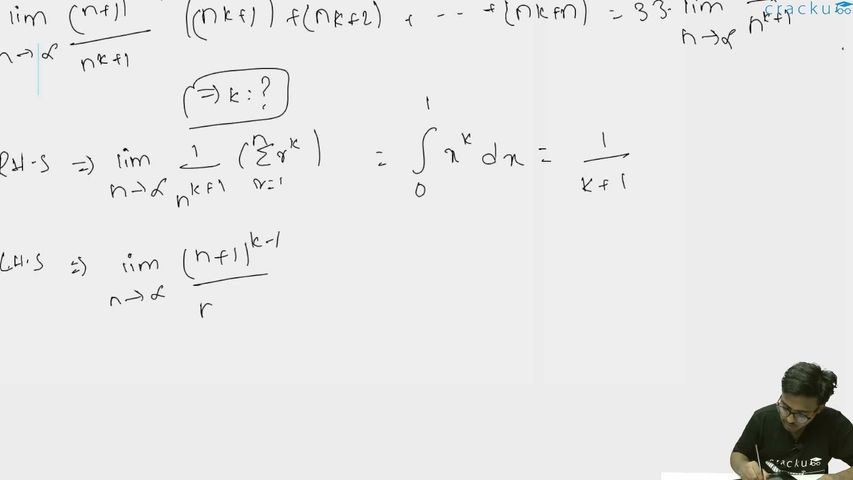
$$\lim_{n \to \infty} \dfrac{(n+1)^{k-1}}{n^{k+1}} [(nk+1) + (nk+2) + \ldots + (nk+n)] = 33 \cdot \lim_{n \to \infty} \dfrac{1}{n^{k+1}} [1^k + 2^k + \ldots + n^k]$$
On the left-hand side, the sum $$(nk+1) + (nk+2) + \ldots + (nk+n)$$ can be written as $$\sum_{r=1}^{n}(nk + r) = n^2k + \dfrac{n(n+1)}{2}$$.
LHS $$= \lim_{n \to \infty} \dfrac{(n+1)^{k-1}}{n^{k+1}} \left(n^2 k + \dfrac{n(n+1)}{2}\right)$$
As $$n$$ becomes large, $$(n+1)^{k-1} \approx n^{k-1}$$ and $$n^2k + \dfrac{n(n+1)}{2} \approx n^2\left(k + \dfrac{1}{2}\right)$$, so
LHS $$= \lim_{n \to \infty} \dfrac{n^{k-1} \cdot n^2 (k + 1/2)}{n^{k+1}} = k + \dfrac{1}{2} = \dfrac{2k+1}{2}$$
On the right-hand side, we use the standard limit:
$$\lim_{n \to \infty} \dfrac{1^k + 2^k + \ldots + n^k}{n^{k+1}} = \int_0^1 x^k\, dx = \dfrac{1}{k+1}$$
$$\text{RHS} = 33 \cdot \dfrac{1}{k+1}$$
Equating the two results gives
$$\dfrac{2k+1}{2} = \dfrac{33}{k+1}$$
$$(2k+1)(k+1) = 66$$
$$2k^2 + 3k + 1 = 66$$
$$2k^2 + 3k - 65 = 0$$
$$k = \dfrac{-3 \pm \sqrt{9 + 520}}{4} = \dfrac{-3 \pm \sqrt{529}}{4} = \dfrac{-3 \pm 23}{4}$$
$$k = \dfrac{20}{4} = 5 \quad \text{or} \quad k = \dfrac{-26}{4}$$ (rejected)
Hence, the integral value of $$k$$ is $$5$$.
Was this solution helpful?
Click on the Email ☝️ to Watch the Video Solution
Create a FREE account and get:
_1.webp)

Educational materials for JEE preparation

Ask our AI anything

AI can make mistakes. Please verify important information.
AI can make mistakes. Please verify important information.
