
Join Our JEE Preparation Group
Prep with like-minded aspirants; Get access to free daily tests and study material.
Sign in
Please select an account to continue using cracku.in
↓ →
Join Our JEE Preparation Group
Prep with like-minded aspirants; Get access to free daily tests and study material.
Consider a line $$L$$ passing through the points $$P(1, 2, 1)$$ and $$Q(2, 1, -1)$$. If the mirror image of the point $$A(2, 2, 2)$$ in the line $$L$$ is $$(\alpha, \beta, \gamma)$$, then $$\alpha + \beta + 6\gamma$$ is equal to _____
Correct Answer: 6
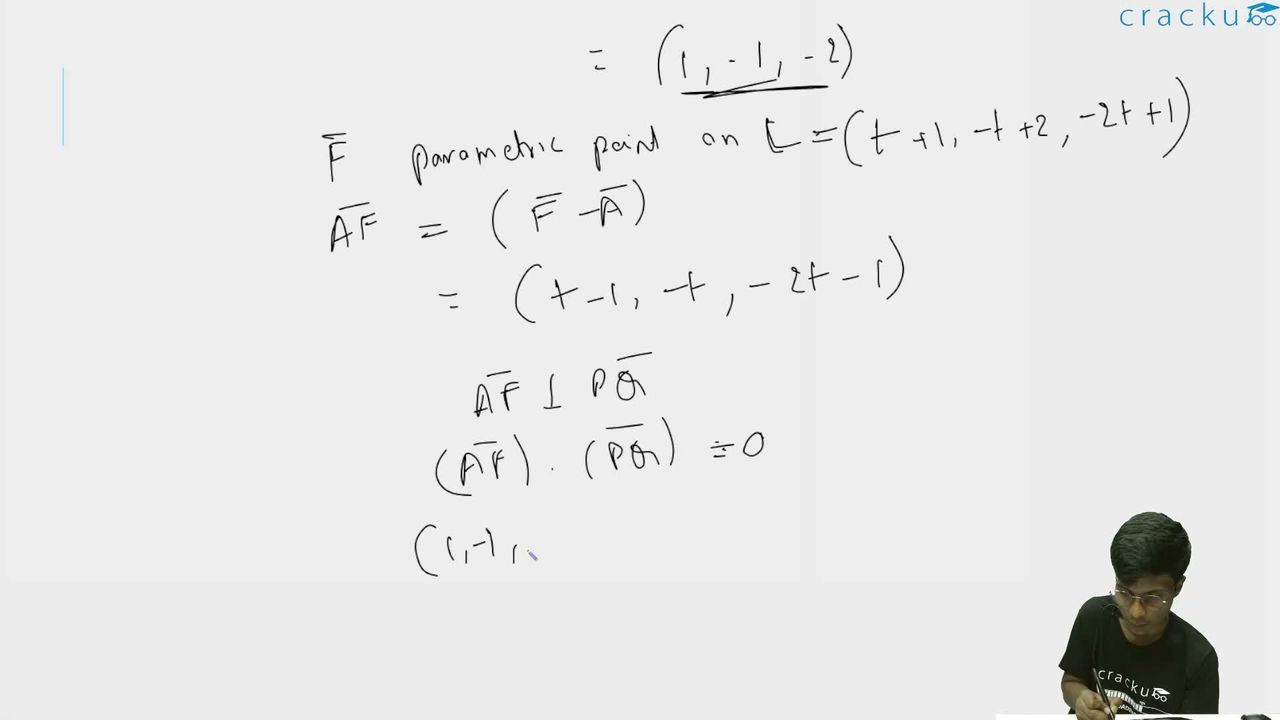
We need to find $$\alpha + \beta + 6\gamma$$ where $$(\alpha,\beta,\gamma)$$ is the mirror image of $$A(2,2,2)$$ in the line through $$P(1,2,1)$$ and $$Q(2,1,-1)$$. To begin, the direction vector of the line $$PQ$$ is $$(1,-1,-2)\,.$$
First, we determine the foot of the perpendicular from $$A$$ to this line. The parametric form of the line is $$(1+t,\,2-t,\,1-2t)\,, $$ so the vector from $$A$$ to a general point on the line is $$\vec{AF}=(1+t-2,\;2-t-2,\;1-2t-2)=(t-1,\,-t,\,-1-2t)\,. $$ Since this vector must be perpendicular to the direction vector $$(1,-1,-2)\,$$, their dot product vanishes: $$(t-1)\cdot1 + (-t)\cdot(-1) + (-1-2t)\cdot(-2)=0\,. $$ Expanding gives $$t-1 + t + 2 + 4t = 0\,, $$ so $$6t + 1 = 0\,, $$ and hence $$t = -\tfrac{1}{6}\,. $$
Substituting $$t = -\tfrac{1}{6}$$ into the parametric equations yields the foot of the perpendicular $$F = \Bigl(1-\tfrac{1}{6},\;2+\tfrac{1}{6},\;1+\tfrac{2}{6}\Bigr) =\Bigl(\tfrac{5}{6},\;\tfrac{13}{6},\;\tfrac{4}{3}\Bigr)\,. $$
The mirror image of $$A$$ across the line is given by $$(\alpha,\beta,\gamma) = 2F - A\,, $$ so $$(\alpha,\beta,\gamma) =\Bigl(\tfrac{10}{6}-2,\;\tfrac{26}{6}-2,\;\tfrac{8}{3}-2\Bigr) =\Bigl(-\tfrac{1}{3},\;\tfrac{7}{3},\;\tfrac{2}{3}\Bigr)\,. $$
Finally, we compute $$\alpha + \beta + 6\gamma =-\tfrac{1}{3} + \tfrac{7}{3} + 6\times\tfrac{2}{3} =-\tfrac{1}{3} + \tfrac{7}{3} + 4 =\tfrac{6}{3} + 4 =2 + 4 =6\,. $$
Therefore, the answer is 6.
Was this solution helpful?
Click on the Email ☝️ to Watch the Video Solution
Create a FREE account and get:
_1.webp)

Educational materials for JEE preparation

Ask our AI anything

AI can make mistakes. Please verify important information.
AI can make mistakes. Please verify important information.
