
Join Our JEE Preparation Group
Prep with like-minded aspirants; Get access to free daily tests and study material.
Sign in
Please select an account to continue using cracku.in
↓ →
Join Our JEE Preparation Group
Prep with like-minded aspirants; Get access to free daily tests and study material.
Let $$a$$ and $$b$$ respectively be the points of local maximum and local minimum of the function $$f(x) = 2x^3 - 3x^2 - 12x$$. If $$A$$ is the total area of the region bounded by $$y = f(x)$$, the $$x$$-axis and the lines $$x = a$$ and $$x = b$$, then 4A is equal to _________
Correct Answer: 114
We have the cubic function $$f(x)=2x^3-3x^2-12x.$$
To locate its turning points we first differentiate. The rule is: for any power term $$kx^n,$$ the derivative is $$knx^{\,n-1}.$$ So,
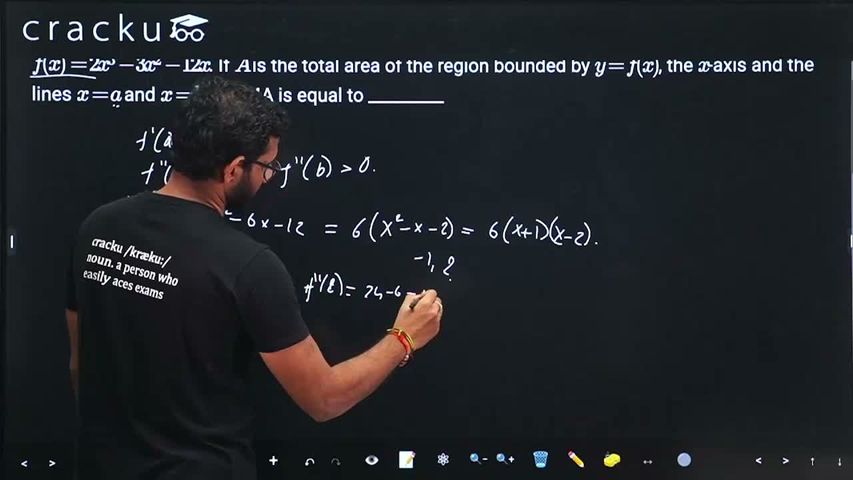
$$f'(x)=\dfrac{d}{dx}(2x^3)-\dfrac{d}{dx}(3x^2)-\dfrac{d}{dx}(12x)$$ $$=2\cdot3x^{\,2}-3\cdot2x^{\,1}-12$$ $$=6x^2-6x-12.$$
We set the derivative equal to zero to find critical points:
$$6x^2-6x-12=0 \Longrightarrow 6\bigl(x^2-x-2\bigr)=0$$ $$x^2-x-2=0.$$
Factoring, $$x^2-x-2=(x-2)(x+1)=0,$$ hence
$$x=-1 \quad\text{or}\quad x=2.$$
Next we apply the second-derivative test. Differentiate once more: $$f''(x)=\dfrac{d}{dx}(6x^2-6x-12)=12x-6.$$
At $$x=-1$$ we get $$f''(-1)=12(-1)-6=-18<0,$$ indicating a local maximum. Thus $$a=-1.$$
At $$x=2$$ we get $$f''(2)=12(2)-6=18>0,$$ indicating a local minimum. Thus $$b=2.$$
The required region is bounded by the curve $$y=f(x),$$ the $$x$$-axis, and the vertical lines $$x=a=-1$$ and $$x=b=2.$$ Because the curve crosses the axis inside this interval, we must separate the area into parts that lie above and below the axis and use absolute values.
First we identify where $$f(x)=0.$$ Factorising, $$f(x)=x\bigl(2x^2-3x-12\bigr).$$ The obvious root is $$x=0.$$ (The other two roots are outside the present calculation, but they confirm that the graph crosses the axis only at $$x=0$$ between $$-1$$ and $$2.$$)
Hence we split the integral at $$x=0$$:
$$A=\int_{-1}^{0}f(x)\,dx-\int_{0}^{2}f(x)\,dx,$$ the minus sign in the second term ensuring positivity of area below the axis.
We now find an antiderivative. Using $$\int x^n\,dx=\dfrac{x^{n+1}}{n+1},$$
$$\int f(x)\,dx=\int(2x^3-3x^2-12x)\,dx$$ $$=2\cdot\dfrac{x^{4}}{4}-3\cdot\dfrac{x^{3}}{3}-12\cdot\dfrac{x^{2}}{2}+C$$ $$=\dfrac{x^{4}}{2}-x^{3}-6x^{2}+C.$$
Denote $$F(x)=\dfrac{x^{4}}{2}-x^{3}-6x^{2}.$$
Area above the axis (from $$-1$$ to $$0$$):
$$\int_{-1}^{0}f(x)\,dx=F(0)-F(-1).$$ Compute $$F(0)=0,$$ and $$F(-1)=\dfrac{(-1)^{4}}{2}-(-1)^{3}-6(-1)^{2}=\dfrac{1}{2}+1-6=-\dfrac{9}{2}.$$ So
$$\int_{-1}^{0}f(x)\,dx=0-\left(-\dfrac{9}{2}\right)=\dfrac{9}{2}=4.5.$$
Area below the axis (from $$0$$ to $$2$$):
$$\int_{0}^{2}f(x)\,dx=F(2)-F(0).$$ Compute $$F(2)=\dfrac{2^{4}}{2}-2^{3}-6\cdot2^{2}=8-8-24=-24.$$ Therefore
$$\int_{0}^{2}f(x)\,dx=-24.$$ Taking its absolute value gives an area of $$24.$$
Adding the two parts,
$$A=4.5+24=28.5=\dfrac{57}{2}.$$
Finally, the question asks for $$4A:$$
$$4A=4\times28.5=114.$$
Hence, the correct answer is Option 114.
Was this solution helpful?
Click on the Email ☝️ to Watch the Video Solution
Create a FREE account and get:
_1.webp)

Educational materials for JEE preparation

Ask our AI anything

AI can make mistakes. Please verify important information.
AI can make mistakes. Please verify important information.
