
Join Our JEE Preparation Group
Prep with like-minded aspirants; Get access to free daily tests and study material.
Sign in
Please select an account to continue using cracku.in
↓ →
Join Our JEE Preparation Group
Prep with like-minded aspirants; Get access to free daily tests and study material.
The number of symmetric relations defined on the set $$\{1, 2, 3, 4\}$$ which are not reflexive is _______.
Correct Answer: 960
A relation $$R$$ on a set $$A$$ is symmetric if whenever $$(a, b)\in R$$ then $$(b, a)\in R$$.
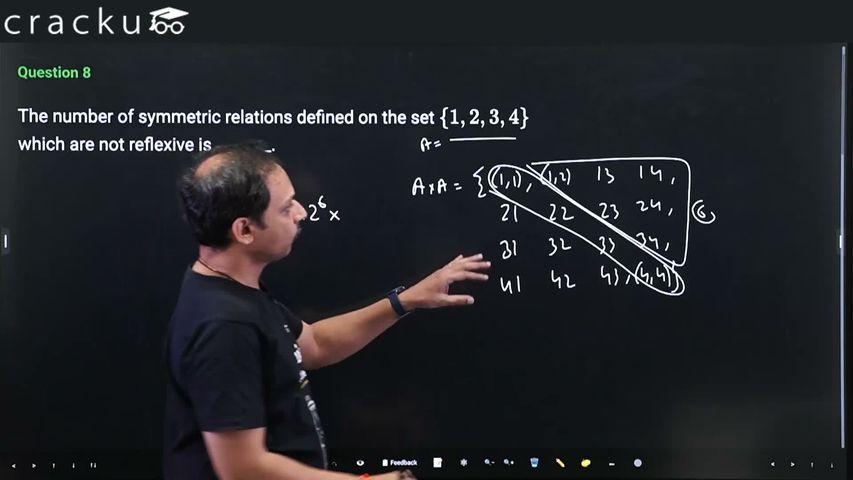
For a set with $$n$$ elements, a relation is a subset of $$A\times A$$, which has $$n^2$$ possible ordered pairs. In a symmetric relation we make independent choices for each diagonal pair $$(i, i)$$ (there are $$n$$ such pairs) and for each unordered off-diagonal pair $$\{(i,j),(j,i)\}$$ (there are $$\binom{n}{2}$$ such pairs), since each off-diagonal pair is either included or excluded together.
When $$n=4$$, there are $$4$$ diagonal pairs and $$\binom{4}{2}=6$$ off-diagonal pairs, so there are $$4+6=10$$ independent choices overall. Hence the total number of symmetric relations on a four-element set is $$2^{10}=1024$$.
A relation is reflexive if $$(i,i)\in R$$ for all $$i\in A$$. To count symmetric relations that are also reflexive, we must include all four diagonal pairs, leaving only the six off-diagonal pairs as free choices. Thus there are $$2^6=64$$ reflexive symmetric relations.
Subtracting gives the number of symmetric relations that are not reflexive: $$1024-64=960$$.
Was this solution helpful?
Click on the Email ☝️ to Watch the Video Solution
Create a FREE account and get:
_1.webp)

Educational materials for JEE preparation

Ask our AI anything

AI can make mistakes. Please verify important information.
AI can make mistakes. Please verify important information.
